Most people first discover 2048 on the classic 4×4 board. It is compact, fast, surprisingly difficult, and perfectly suited to the original goal: combine matching tiles until you create 2048.
But 2048 does not have to stop at 4×4.
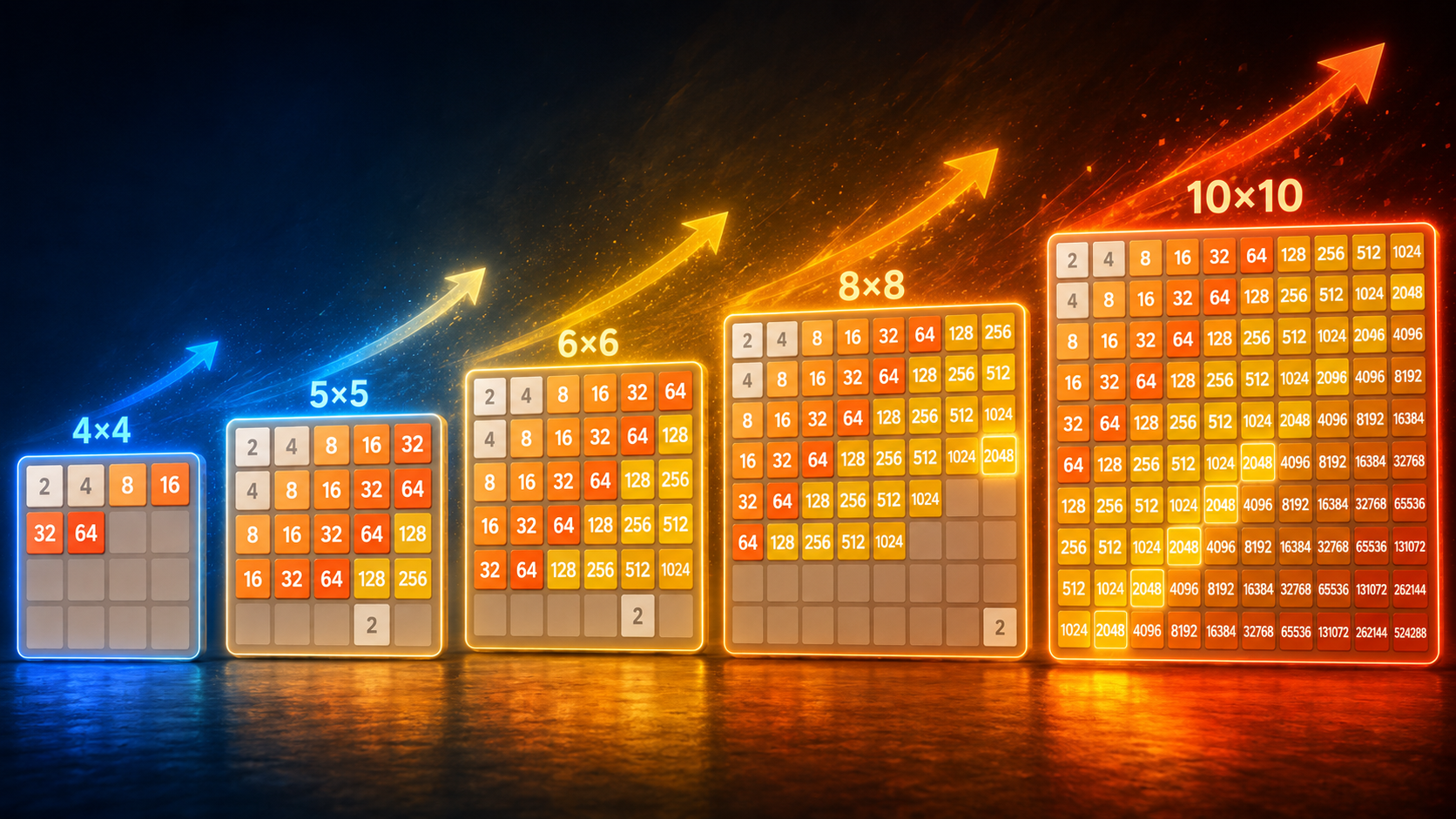
Larger versions such as 5×5, 6×6, 8×8, and 10×10 change the way the game feels. You have more empty cells, more room to organize tiles, longer games, and the opportunity to build numbers far beyond 2048.
That raises an interesting question:
Which 2048 board size should you play?
The answer depends on what you want from the game.
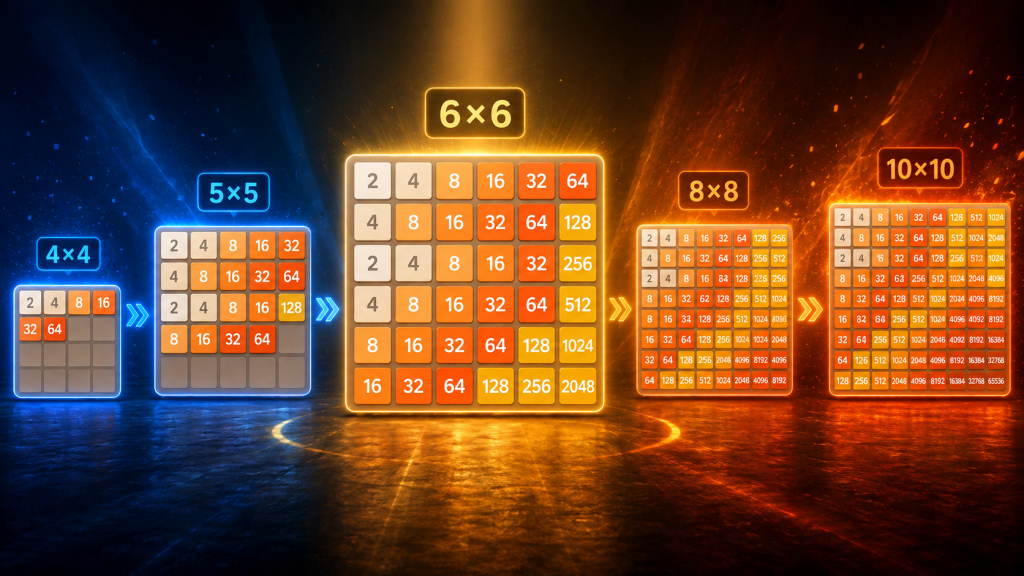
The classic 4×4 board offers the most pressure and the purest version of traditional 2048 strategy. A 5×5 or 6×6 board gives you additional breathing room without making the game feel endless. Meanwhile, 8×8 and 10×10 boards turn 2048 into a much larger long-form number puzzle where reaching 2048 may be only the beginning.
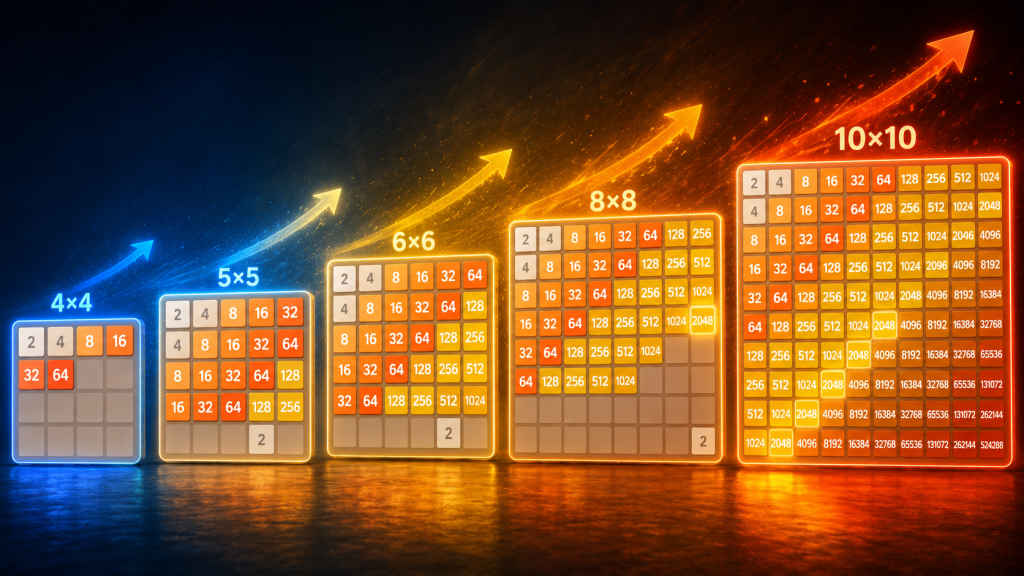
In this guide, we compare 2048 4×4 vs 5×5 vs 6×6 vs 8×8 vs 10×10, including difficulty, game length, strategy, board management, and which size is best for different types of players.
Quick Comparison: 2048 Board Sizes
Here is the simplest way to understand the differences.
| Board Size | Cells | Difficulty | Typical Game Style | Best For |
|---|---|---|---|---|
| 4×4 | 16 | High | Fast and tactical | Classic 2048 players |
| 5×5 | 25 | Medium-High | Balanced | Players wanting more flexibility |
| 6×6 | 36 | Medium | Strategic and longer | High-tile building |
| 8×8 | 64 | Lower early, complex later | Long-form | Relaxed extended games |
| 10×10 | 100 | Low early, very complex late | Marathon | Huge tiles and experimentation |
This does not mean a 10×10 game is automatically “easy.”
A larger board gives you more room to survive, but it also creates a much larger puzzle to manage.
The challenge changes rather than disappearing.
2048 4×4: The Classic Experience
The 4×4 board is the original and most recognizable version of 2048.
It contains just 16 cells.
That limited space is what makes the game so demanding.
Every new tile takes up a meaningful percentage of the available board, and a few poorly positioned numbers can quickly create a game-over situation.
Why 4×4 Is Difficult
On a 4×4 board, there is very little room for mistakes.
If you scatter your larger tiles around the board, recovering can be difficult. If you fill too many cells without creating useful merges, you may run out of legal moves quickly.
The classic corner strategy is therefore especially important.
Players generally try to:
- keep their largest tile in one corner;
- organize other large tiles beside it;
- maintain a descending sequence;
- preserve empty cells;
- avoid unnecessary movement in the opposite direction.
For example, a strong bottom row might look like:
1024 | 512 | 256 | 128
With only four cells per row, however, maintaining this structure takes discipline.
Who Should Play 4×4?
Choose 4×4 if you:
- want the traditional 2048 experience;
- enjoy short, challenging games;
- want to improve classic 2048 strategy;
- are chasing the standard 2048 tile;
- prefer pressure over long-term building.
If you want to compare the classic board with larger modes directly, you can play the different versions on 2048playgame.com without changing the basic swipe-and-merge mechanics.
2048 5×5: More Room Without Losing the Challenge
Moving from 4×4 to 5×5 may sound like a small change.
It is not.
A 4×4 board has 16 spaces.
A 5×5 board has 25.
That gives you nine additional cells, or more than 50% extra board space.
The difference is immediately noticeable.
You can keep more small tiles on the board without becoming trapped, and inconvenient new tile spawns are often easier to repair.
At the same time, 5×5 still feels reasonably compact.
How Strategy Changes on 5×5
The corner strategy remains effective.
However, the extra column and row give you more room to build a longer ordered sequence.
Instead of fitting only four values along an edge, you can potentially maintain something like:
2048 | 1024 | 512 | 256 | 128
This makes high-tile development easier.
The additional space also means that one accidental move away from your preferred edge is less likely to destroy the entire game.
But that extra freedom creates a new problem: careless players may become too relaxed.
Because the board takes longer to fill, poor structure can go unnoticed for many moves.
Eventually, you can end up with many medium-value tiles that cannot easily reach one another.
Who Should Play 5×5?
5×5 is ideal if classic 2048 feels slightly too restrictive but you still want a game that requires careful board management.
It may be the most natural next step after mastering 4×4.
2048 6×6: The Balanced High-Tile Mode
A 6×6 board contains 36 cells, more than twice the space of a classic 4×4 game.
At this point, the experience starts to feel significantly different.
You have enough room to recover from many awkward tile placements, and reaching 2048 becomes less of an end goal and more of a milestone.
The game increasingly becomes about seeing how far beyond 2048 you can go.
Why 6×6 Feels Different
On 4×4, survival is often the immediate concern.
On 6×6, you can spend more time thinking about structure.
You have enough space to develop several groups of tiles before combining them into your main sequence.
This makes 6×6 particularly satisfying for players who enjoy building large numbers.
You may find yourself working toward:
2048 → 4096 → 8192 → 16384
rather than treating 2048 itself as the finish line.
Is 6×6 Easier Than 4×4?
Early in the game, definitely.
There is much more free space, so it takes considerably longer to become trapped.
But a large board can become complicated later.
With 36 cells, you may have many separate tile chains developing simultaneously.
The challenge becomes organization.
You have to decide:
- which area of the board should hold the largest tiles;
- where smaller tiles should be developed;
- when to consolidate rows;
- how to prevent high-value tiles from becoming separated.
So while the immediate risk of losing is lower, long-term planning becomes more important.
Who Should Play 6×6?
6×6 is a strong choice if you:
- already understand classic 2048;
- want longer games;
- enjoy building beyond 2048;
- want more freedom without an enormous board;
- prefer strategy over constant survival pressure.
For many players, 6×6 is the sweet spot between classic difficulty and large-board freedom.
2048 8×8: A Long-Form Strategy Game
An 8×8 board has 64 cells.
That is four times as many cells as 4×4.
At this size, the game changes dramatically.
You are unlikely to feel immediate pressure during the opening stage because the board has so much space.
Instead, your main challenge is maintaining order across a large number of tiles.
2048 Is No Longer the Main Goal
On an 8×8 board, reaching 2048 can happen much earlier relative to the total potential length of the game.
The interesting question becomes:
How large can you make your biggest tile?
Depending on how long you continue and how well you organize the board, much higher tiles become practical targets.
The experience is therefore less about “Can I reach 2048?” and more about long-term optimization.
Why 8×8 Can Still Be Difficult
Extra space makes early survival easier, but it can encourage bad habits.
You might think you can swipe freely because there are many empty cells.
That works for a while.
Eventually, however, the board may contain dozens of tiles spread across different values.
If your large numbers are scattered throughout the grid, combining them can require substantial restructuring.
On a big board, disorder grows slowly—but when it becomes serious, fixing it can take many moves.
A Better Strategy for 8×8
Do not treat the entire board as one giant open area.
Instead, think of it as several connected zones.
For example:
- reserve one edge for your largest tiles;
- use nearby rows to develop medium-value tiles;
- use the remaining space for small-tile processing;
- gradually feed completed combinations toward your main edge.
This creates a more controlled flow.
Who Should Play 8×8?
Choose 8×8 if you enjoy:
- long sessions;
- huge-number goals;
- less early-game pressure;
- experimenting with board patterns;
- building complex tile structures.
It is particularly good for players who find classic 4×4 too unforgiving.
2048 10×10: The Marathon Board
The 10×10 version contains 100 cells.
Compared with the classic board’s 16 cells, that is enormous.
A 10×10 game is less like a quick puzzle and more like a marathon.
There is so much room early in the game that losing quickly is unlikely if you make even reasonably sensible moves.
But that does not mean strategy becomes irrelevant.
It becomes different.
Managing 100 Cells Is Its Own Challenge
On 4×4, you can understand the entire board almost instantly.
On 10×10, there may be dozens of active tile combinations at once.
You need to think about larger patterns.
Instead of focusing only on whether two 32 tiles can merge, you may be managing several areas containing:
- small development tiles;
- medium-value chains;
- completed high-value rows;
- temporary storage spaces.
A poorly organized 10×10 board can contain enormous total value while still being inefficient.
Why Play 10×10?
The biggest attraction is progression.
You have the opportunity to keep merging far beyond the numbers normally seen in classic 2048.
The board gives you room to experiment with unusual strategies without being punished immediately for every small mistake.
It can also be relaxing.
Classic 4×4 requires frequent attention because a few bad moves can end a game.
10×10 gives you more time to develop your structure.
Who Should Play 10×10?
Choose 10×10 if you:
- want extremely long 2048 games;
- enjoy chasing very large tiles;
- prefer a lower-pressure opening;
- like experimenting with different strategies;
- want a completely different experience from classic 2048.
If you only want a quick five-minute game, 10×10 probably is not the best choice.
Which 2048 Board Size Is the Hardest?
The answer depends on what you mean by “hard.”
Hardest to Survive: 4×4
The classic board gives you the least space and punishes mistakes quickly.
For basic survival and reaching the standard 2048 tile, 4×4 is generally the most demanding.
Hardest to Organize: 8×8 and 10×10
Large boards are much more forgiving early in the game.
But if your goal is to build extremely high-value tiles efficiently, managing dozens of cells becomes a complex organizational problem.
So difficulty changes with board size:
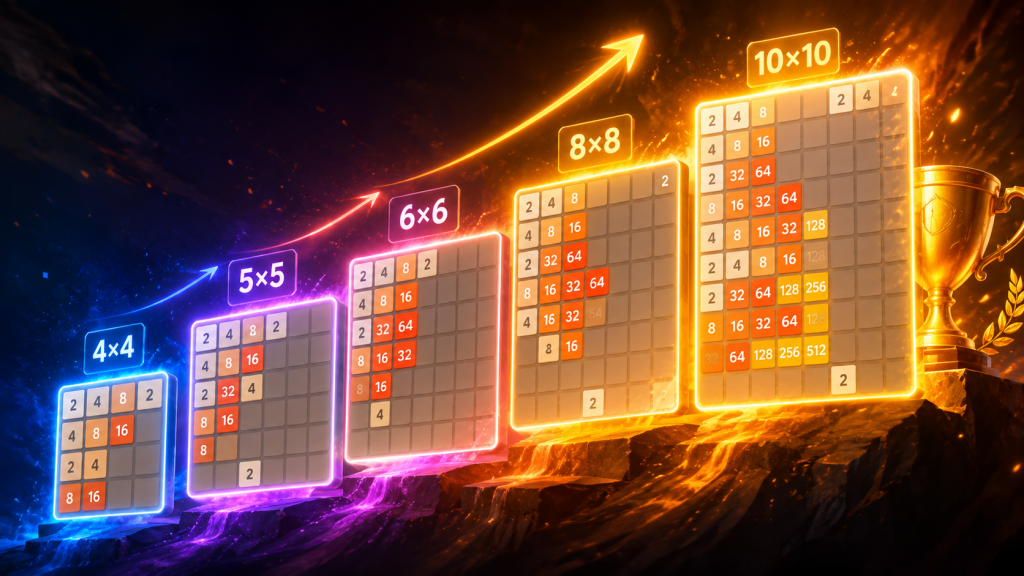
Small boards test precision. Large boards test organization and endurance.
Which Board Size Is Best for Beginners?
A beginner might assume that starting with 10×10 is best because it is harder to lose.
But that is not necessarily the best way to learn 2048.
A 5×5 or 6×6 board may be better.
These sizes offer enough extra space to recover from mistakes while still making board structure important.
You can learn:
- corner control;
- ordered tile placement;
- space management;
- merge planning;
without getting punished as quickly as on 4×4.
Once you understand those ideas, moving back to classic 4×4 becomes easier.
Which Board Size Is Best Overall?
There is no single winner.
The best board depends on how you enjoy playing.
Choose 4×4 for the original, competitive experience.
Choose 5×5 if you want classic gameplay with a little more freedom.
Choose 6×6 if you want the best balance between strategy, space, and high-value tiles.
Choose 8×8 for long sessions and ambitious tile-building.
Choose 10×10 if you want a marathon version of 2048 with maximum space.
If you are unsure, try several modes on 2048playgame.com. Playing the same basic strategy across different board sizes makes the differences immediately noticeable.
You may discover that the board you enjoy most is not the one you expected.
Does the Same 2048 Strategy Work on Every Board Size?
The basic principles remain useful everywhere:
- Keep your largest tiles organized.
- Preserve empty cells.
- Avoid unnecessary movement.
- Build values in a predictable sequence.
- Think about the board after the next move, not just the current merge.
But the importance of each principle changes.
On 4×4, protecting empty cells is critical because space disappears quickly.
On 10×10, you may have plenty of space but need much stronger organization.
The larger the board becomes, the more useful it is to think in regions rather than individual tiles.
Final Verdict: 4×4 vs 5×5 vs 6×6 vs 8×8 vs 10×10
Changing the size of the 2048 board does much more than add extra squares.
It changes the rhythm of the entire game.
The 4×4 board is fast, tight, and unforgiving. Every move matters.
The 5×5 board keeps much of that classic feeling while providing enough extra space to recover from mistakes.
The 6×6 board offers an excellent balance and is especially enjoyable for building tiles beyond 2048.
The 8×8 board turns the game into a longer strategic challenge where organization matters more than immediate survival.
And the 10×10 board transforms 2048 into a marathon puzzle with 100 cells and enormous potential for high-value tiles.
If your goal is mastering traditional 2048, stick with 4×4.
If you want a balanced alternative, try 5×5 or 6×6.
If you want to see just how far the merging system can go, 8×8 and 10×10 open up an entirely different style of play.
There is no wrong board size.
The best one is the board that makes you want to start another game.
Frequently Asked Questions
What is the standard 2048 board size?
The standard version of 2048 uses a 4×4 grid containing 16 cells.
Is 5×5 2048 easier than 4×4?
Generally, yes. A 5×5 board provides nine additional cells, giving you more space to recover from awkward tile placements. However, good organization is still important.
Is 6×6 a good 2048 board size?
Yes. 6×6 is one of the most balanced alternatives to classic 2048. It offers significantly more space while remaining manageable and strategic.
Can you play 2048 on an 8×8 board?
Yes. An 8×8 version gives you 64 cells and creates much longer games where building tiles far beyond 2048 becomes more practical.
What is the biggest 2048 board?
There is no universal maximum board size across every implementation of 2048. On 2048playgame.com, players can choose modes including 4×4, 5×5, 6×6, 8×8, and 10×10.
Which 2048 board is best for high scores?
Larger boards such as 8×8 and 10×10 generally provide more room to continue merging and therefore allow much longer games and larger tiles.
Which 2048 board should a beginner play?
5×5 or 6×6 can be excellent for beginners because they provide more room for mistakes while still teaching important concepts such as corner strategy and tile organization.
Is 10×10 2048 too easy?
It is easier to survive the early game because you have 100 cells, but efficiently organizing a large number of tiles creates a different type of challenge.
Does 2048 strategy change with board size?
The core principles stay similar, but larger boards place more emphasis on long-term organization while smaller boards require tighter space management and more precise moves.