Few puzzle games offer such a clear mix of simplicity, tension, and long-term challenge as 2048. The rules can be explained in seconds: slide numbered tiles across a grid, combine equal values, and create a tile marked 2048. Yet reaching that goal requires much more than matching numbers. Every move changes the shape of the board, closes some options, and may create problems several turns later.
That contrast is the foundation of the game’s appeal. 2048 is easy to start, quick to play, and available on almost any modern device. At the same time, it rewards planning, patience, pattern recognition, and careful risk management. A short session can become an extended attempt to beat a personal best because the next move always feels close to solving the current problem.
The simple rules hide a demanding puzzle

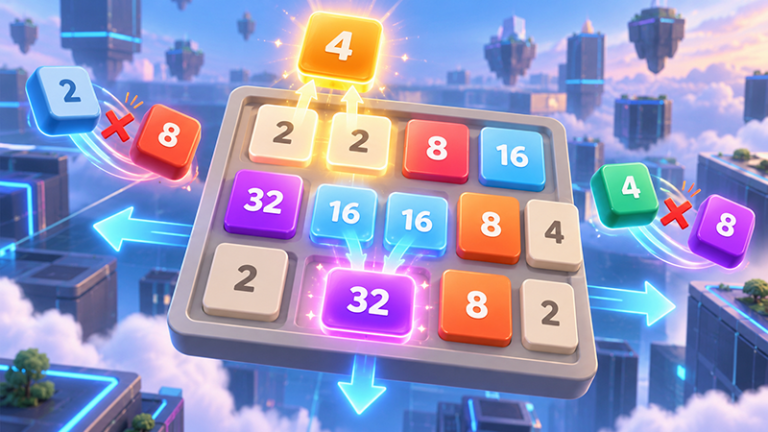
A standard 2048 board has four rows and four columns. Tiles appear with small numerical values, usually 2 or 4. When a player swipes in one of the four directions, every tile moves as far as possible in that direction. If two tiles with the same value meet during the movement, they merge into one tile with double the value.
For example, a row containing 2, 2, 4, 8 can become 4, 4, 8 after a move, depending on the direction and the complete board arrangement. The newly created 4 may then combine with another 4 only when the movement rules allow it. A tile cannot normally merge twice during a single swipe, which prevents unlimited combinations from happening at once.
After each valid move, a new tile appears in an empty space. This means every action has two effects: it improves the board in one direction and introduces another variable. As empty spaces disappear, the player has fewer ways to respond. The game ends when the board is full and no neighboring tiles can be merged.
Why 2048 feels so addictive
Instant understanding, gradual mastery
Many puzzle games require a tutorial before their systems become clear. 2048 does not. Players can understand the basic interaction immediately, but mastering it takes repeated practice. The gap between knowing the rules and playing well creates a strong reason to return.
A beginner may focus only on making the largest possible merge. An experienced player thinks about where that merge will leave the next several tiles. This change in perspective makes progress feel measurable. A player may first struggle to reach 128, then learn to reach 512, and later begin working toward 1024 or beyond.
Small rewards arrive constantly
Each merge produces a visible improvement. A 2 becomes a 4, a 4 becomes an 8, and a group of modest tiles slowly develops into a more valuable structure. These frequent rewards keep the game engaging even when the final objective is still far away.
The scoring system strengthens that effect. A merge that creates a tile worth V adds V points to the score. Creating a 16 adds 16 points, while creating a 256 adds 256 points. Because larger merges contribute more, careful board development becomes more valuable than making random combinations as quickly as possible.
Failure feels understandable
When a game ends, the result usually appears connected to earlier decisions. Perhaps the largest tile was placed in the center, a corner became blocked, or too many low tiles were left scattered across the board. This sense of responsibility makes losing less frustrating than failure in a game based mainly on chance.
Random tile spawns still matter, but a disciplined player can often manage uncertainty. A poor outcome suggests something to adjust, which turns each failed run into a source of information rather than a complete dead end.
The core strategy: build a stable board

The most reliable general strategy is to choose one corner for the largest tile and keep that tile there. The corner acts as an anchor. Smaller tiles can be organized around it, while the player avoids moves that pull the anchor into the middle of the board.
Many players begin by using three directions and treating the fourth direction as dangerous. For example, if the highest tile is kept in the lower-left corner, left, down, and sometimes right may be useful, while upward movement should be used only when the board requires it. This is not an absolute rule, but limiting movement reduces accidental disruption.
A stable arrangement often has a descending sequence near the anchor. A simplified row might look like this:
128 64 32 16
The exact pattern does not need to be perfect. The important idea is that large tiles should support one another instead of being separated by unrelated values. If the 128 is trapped in one corner while the 64 is placed on the opposite side, future merges become harder and more moves are required to connect them.
How to make better decisions during a game
Count empty spaces
Empty cells are the board’s safety margin. When several spaces are open, the player can usually recover from an imperfect move. When only one or two spaces remain, every swipe becomes more important.
A practical habit is to check the board before creating a large merge. Ask whether the move will leave at least one useful empty cell and whether the new tile could appear in a harmful position. A visually impressive combination is not automatically a good move if it fills the last flexible area.
Look for future merges, not only current merges
Suppose a board contains 8, 8, and 16. Combining the two 8 tiles is attractive because it creates another 16. However, the better move may be to reposition one 8 first if the immediate merge would place the new 16 where it cannot later connect with the existing 16.
Before swiping, scan for pairs that are one move away from merging. Then consider whether the move also improves the next layer of the board. A useful question is: What will this tile need in order to merge later, and will I still be able to reach it?
Protect the largest tile
The largest tile often determines the structure of the entire board. Moving it away from the chosen corner can break an otherwise organized sequence. This usually happens when a player uses a direction simply because it creates an immediate merge.
Before using a risky swipe, check whether it moves the anchor, separates a useful chain, or leaves a high-value tile behind smaller pieces. If the move is necessary, plan how the board will be rebuilt afterward rather than treating the disruption as harmless.
Do not chase every possible merge
Not all available combinations should be made immediately. A merge may remove a useful buffer, create an awkward gap, or force the next new tile into a crowded section. Sometimes leaving two equal tiles apart for a few turns gives the rest of the board time to improve.
This is one of the main differences between beginner and advanced play. Beginners often ask, “Can I merge these tiles?” Stronger players ask, “Should I merge them now?”
Common mistakes that cause early losses
- Moving without checking all four directions: The first attractive move may not be the safest option. Compare how each swipe affects empty spaces and the position of the largest tile.
- Using the forbidden direction too often: If a corner-based strategy is in use, repeated movement away from that corner can destroy the tile order.
- Building high tiles in the center: A central high tile may have more immediate movement options, but it can become difficult to organize as the board fills.
- Ignoring small tiles: A 2 or 4 in an inconvenient location can block a valuable lane. Small tiles are not harmless simply because they have low scores.
- Waiting until the board is nearly full: Planning should happen before space becomes scarce. Late corrections are often impossible.
- Repeating a familiar pattern mechanically: A fixed sequence of swipes cannot handle every random tile placement. Strategy should guide decisions, not replace observation.
A practical approach for beginners
- Choose a corner. Decide where the largest tile should remain and avoid moving it without a clear reason.
- Use a primary direction. Frequent movement toward the chosen corner helps keep the board compact.
- Keep the largest values ordered. Try to place the next-largest tile beside the anchor or in a position that can feed into it.
- Preserve an empty lane. Do not fill every space merely to create a quick merge. Flexibility is more valuable than a small short-term score.
- Pause before each swipe. Identify the best available merge, the likely location of the new tile, and the effect on your anchor.
- Review the ending. When the board locks, notice which tile or decision caused the structure to fail. Use that observation in the next attempt.
Players can practice these steps on Game 2048 through 2048playgame.com, where the classic format and other board or mode variations provide different levels of challenge. The key is to use each run as a focused exercise: one session might emphasize protecting the corner, while another might focus on keeping more empty spaces available.
Why different board sizes change the experience
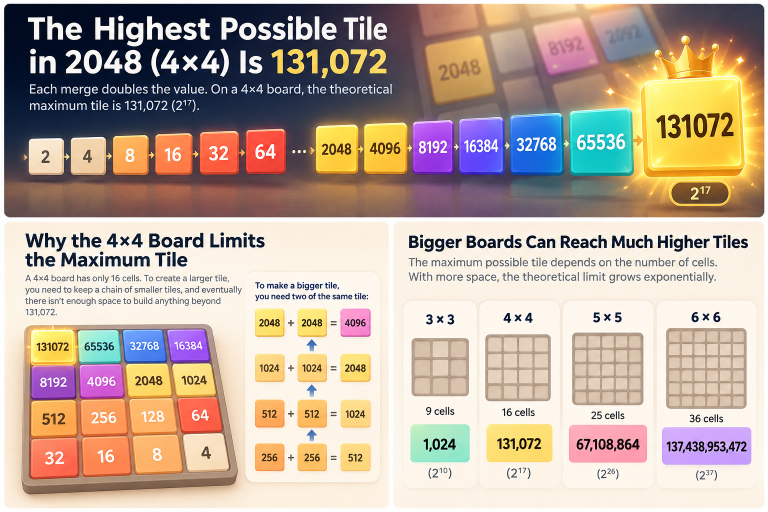
The familiar 4×4 board creates a strong balance between planning and pressure. There is enough room to build combinations, but not enough space to recover from every mistake. That limited capacity is a major reason the standard version feels tense.
Larger boards generally provide more room for experimentation. Players may have additional time to organize tiles and recover from poor placements, but they also need to manage a wider structure. A larger board can therefore feel less immediately restrictive while still demanding more attention over a longer session.
Smaller boards create the opposite effect. With fewer cells, every new tile has a greater impact and mistakes become difficult to repair. Different board sizes are valuable because they change the balance between speed, planning, and available recovery space rather than merely changing the visual layout.
The role of psychology and design
2048 is visually quiet compared with many modern games. Its numbered tiles, simple colors, and short animations make the important information easy to read. The player’s attention stays on position, value, and movement instead of on complicated controls.
The game also creates a repeating cycle:
- Find a promising move.
- Make a merge and receive a small reward.
- Deal with the newly spawned tile.
- Protect the developing structure.
- Recover from a mistake or continue toward a larger tile.
This cycle is short enough to repeat constantly. Because a new decision arrives after almost every swipe, the player remains mentally involved. Even a failed run often ends with the feeling that one better choice might have changed the result.
Why 2048 remains relevant as a browser puzzle
The game works well in short sessions, but it also supports deep improvement. It does not require a large download, complex controls, or a long explanation. A player can start on a desktop, continue on a mobile device, and return later without losing the basic understanding of the puzzle.
Its rules also make the game suitable for many types of players. Casual users can enjoy making a few merges during a break. Competitive players can track high scores and refine their board management. Students and puzzle enthusiasts can examine probability, spatial organization, and decision-making under limited resources.
Ultimately, 2048 became so compelling because it turns a handful of rules into an unusually rich decision system. The numbers are simple, but the consequences are not. Success depends on preserving space, arranging values, anticipating future merges, and accepting that the safest move is not always the most immediately rewarding one. That combination gives every board a clear goal, a steady stream of small victories, and enough strategic depth to make another attempt feel worthwhile.