Reaching the 2048 tile is usually a milestone, not the end of the session. In the classic version of the game, creating 2048 means you have completed the main objective, but the board normally remains active. You can keep sliding, combining tiles, and trying to build 4096 or an even larger number until no legal moves remain. On some versions, a win message appears and pauses the board; selecting the option to continue lets you play beyond 2048.
This distinction matters because 2048 has two separate conditions: a win condition and a game-over condition. The win condition is reaching the target tile. Game over happens only when the board is full and no adjacent tiles can merge. Reaching 2048 does not automatically mean that every square is occupied or that no moves are available.
What Happens When You Create the 2048 Tile?
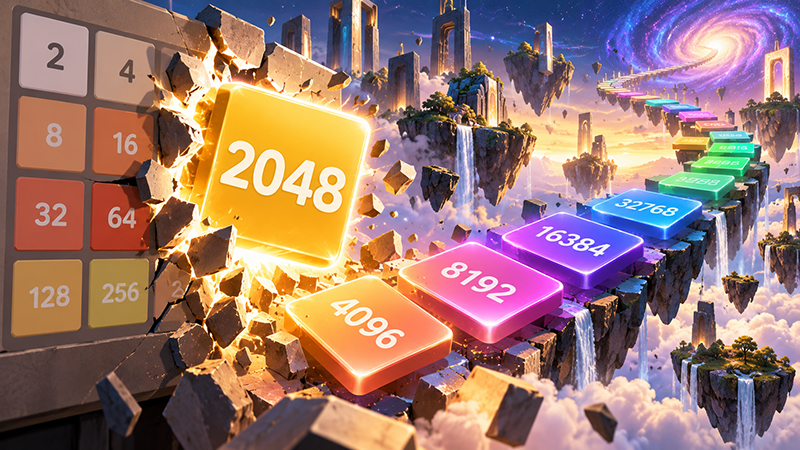
The game detects the moment two 1024 tiles merge into one 2048 tile. Depending on the version you are playing, one of several things may happen:
- A congratulations or victory message appears.
- The board pauses and offers a choice to continue.
- The game marks the puzzle as won but allows the next move immediately.
- The game ends at 2048 if it has been designed as a single-target version.
In the familiar classic format, the usual choice is to continue. Your score remains intact, the existing tiles stay on the board, and you can make another move. The 2048 tile does not disappear, reset, or become unusable. It acts like any other tile, except that it is much more valuable and difficult to protect.
When playing through 2048playgame.com, check the message shown after the tile appears. Different board sizes and game modes can handle the milestone in slightly different ways, so the on-screen controls are the final guide for that particular game.
Can You Keep Playing After 2048?
Yes, in most classic 2048 games you can keep playing after reaching 2048. The board continues to accept moves until the game-over condition is reached. The next natural target is 4096, which requires merging two 2048 tiles.
That sounds simple, but producing a second 2048 tile is significantly harder than producing the first one. The first 2048 tile usually occupies your best corner and depends on a carefully organized chain of smaller tiles. To make another one, you must preserve enough open space and maintain the structure that supports your largest tile while also building a second large chain.
After 2048, the challenge changes from reaching a single target to managing long-term stability. A move that was acceptable earlier may now be dangerous because it can separate large tiles, fill the last empty spaces, or force your corner tile away from its position.
How the Win and Game-Over Rules Differ
| Situation | What it means | Can play continue? |
|---|---|---|
| You create 2048 | The main target has been reached | Usually yes |
| You create 4096 | You have passed the standard target | Usually yes |
| The board is full | There may be no empty cells | Only if a merge is available |
| No empty cells and no matching neighbors | There are no legal moves | No; the game is over |
A full board is not always the end. For example, if two neighboring 8 tiles can merge, a legal move still exists even when every cell is occupied. The game ends only after checking both possibilities: empty spaces and possible adjacent matches.
What Is the Next Target After 2048?
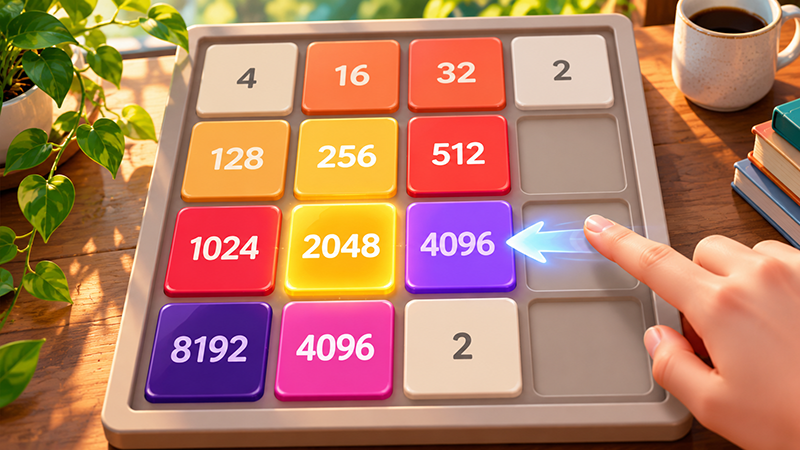
The most common next target is 4096. To create it, you need two 2048 tiles in a position where they can eventually be brought together. The same pattern continues:
- Two 2048 tiles merge into 4096.
- Two 4096 tiles merge into 8192.
- Two 8192 tiles merge into 16,384.
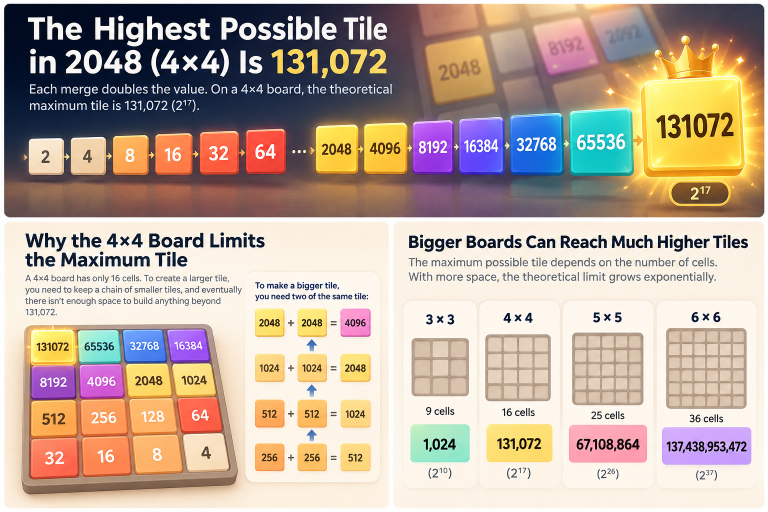
Each step requires twice the value of the previous tile. The number of required combinations grows quickly, and every merge also consumes space that must be replaced with new tiles. That is why scores and tile values become increasingly difficult to extend after the original milestone.
There is no universal practical endpoint in the normal rules. The theoretical limit depends on the board, the spawning rules, available space, and whether the player can keep making legal moves. In real play, most sessions end because the board becomes too crowded or the tile arrangement becomes impossible to repair.
Why Playing Beyond 2048 Is So Difficult
Early in a game, the board often has several empty cells. You can make temporary moves, correct a poor arrangement, and search for a convenient merge. After reaching 2048, the margin for error is much smaller.
Large tiles need protection
A common strategy is to keep the largest tile in one corner, such as the bottom-left corner. The surrounding tiles should follow a descending order so that smaller values support larger ones. If a move pulls the largest tile away from the corner, the whole structure may begin to unravel.
Empty spaces become more valuable
An empty cell is not merely unused space. It is a temporary resource that lets tiles move and gives you somewhere to place the newly spawned tile. After 2048, spending the last empty cell on a low-value move can be as dangerous as breaking a large tile chain.
Bad moves have longer consequences
A move may not cause immediate damage, but it can create a blocked row or column that becomes impossible to reorganize later. This is especially common when players chase a quick merge without considering where the next several tiles will go.
How to Continue Safely After Reaching 2048
- Pause before making the next move. Do not treat the victory message as a signal to play faster. Examine your largest tile, empty spaces, and available merges.
- Keep your main corner whenever possible. If your 2048 tile is in the bottom-left corner, avoid moves that pull it upward or into the center unless there is no safer option.
- Protect the preferred direction. Many successful players use three directions regularly and reserve the fourth direction for emergencies. For a bottom-left strategy, left and down are usually important, while upward movement may be limited.
- Build the second chain away from the largest tile. The route to a second 2048 must not interfere with the structure supporting the first one.
- Preserve at least one useful empty cell. More open cells are better, but even one well-positioned space can provide a crucial escape move.
- Check the next spawn locations. New tiles appear in empty cells, so consider how a 2 or 4 in each open position would affect your plan.
The goal is not to merge on every turn. Sometimes the strongest move is one that creates no large combination but improves the board’s shape. Good post-2048 play is often about refusing an attractive merge when it damages the long-term layout.
What Should You Do If the Game Pauses at 2048?

If a win screen appears, look for a button such as Continue, Keep Playing, or a similar option. Choosing it normally closes the message without restarting the board. Avoid selecting a new game unless you are ready to lose the current position.
Some versions may offer a separate choice to finish the game and display your result. That option is useful if your goal is simply to complete the puzzle. If you want to test your maximum score or pursue 4096, choose the continuation option instead.
If there is no visible continuation control, the version may be configured to stop at 2048. This is a design choice rather than a rule shared by every version of the game. A classic endless-style implementation generally allows further play, while simplified versions may treat the first 2048 tile as the final result.
Does the Score Continue Increasing?
Yes. In the standard scoring system, every merge adds the value of the newly created tile to your score. For example, merging two 1024 tiles creates a 2048 tile and adds 2048 points. If you continue and later merge two 2048 tiles, the game adds 4096 points.
Your score can also increase through smaller merges while you prepare the next large tile. This means a player may achieve a higher score without immediately creating 4096. Score is therefore a useful measure of progress, but it does not always show how close the board is to collapse.
Two boards can have the same score and very different prospects. One may have a stable corner arrangement and several open cells. The other may contain a high tile in the center, broken ordering, and almost no room to move. Board quality matters more than the score alone when deciding whether to continue.
Common Mistakes After Reaching 2048
- Assuming the board is safe: Reaching the target does not remove the normal game-over rules.
- Moving randomly: Random swipes can break the corner strategy and waste empty cells.
- Chasing every immediate merge: A quick combination may create an awkward high tile or block a key lane.
- Using the forbidden direction too often: Repeated movement in the wrong direction can pull the largest tile out of position.
- Ignoring small tiles: A 2 or 4 in a bad location can obstruct an entire row or column.
- Restarting too quickly: A difficult board may still be recoverable if at least one legal move and one useful empty space remain.
Can You Reach 4096 on Any Board Size?
Board size has a major effect on how far you can progress. The familiar 4-by-4 board offers limited space and requires disciplined management. Larger boards provide more cells, making it easier to combine tiles and recover from mistakes, although they may also use different target rules or spawn patterns.
A larger board does not automatically make high tiles easy. The player still needs a reliable layout, a protected largest tile, and enough planning to prevent scattered values from becoming isolated. Some alternative modes may also introduce different goals, starting tiles, or movement behavior, so results from one board size should not be compared directly with another.
Should You Stop at 2048?
That depends on your objective. If you are learning the game, reaching 2048 is a meaningful stopping point because it confirms that your basic board-management method worked. Saving the result can be more satisfying than risking a strong board for a much higher target.
If you enjoy long sessions or want to improve your score, continuing is worthwhile. Treat 2048 as the beginning of a more demanding phase rather than as permission to abandon your strategy. Before each move, ask three questions:
- Will my largest tile remain in a safe position?
- Where will a new tile appear if the move creates space?
- How many useful moves will remain if the board does not produce the merge I want?
Reaching 2048 usually means the main objective is complete, but the puzzle itself is not necessarily over. You can often continue toward 4096 and beyond, provided the board still has legal moves and your version supports endless play. The safest approach is to preserve your corner, protect empty space, and plan for the next few moves instead of focusing only on the next merge.