When two tiles that appear to have the same value do not merge in 2048, the problem is usually not a bug. In most cases, the tiles are either not actually adjacent, they are blocked by another tile, or they have already merged during that move and cannot merge a second time. Understanding the movement and merge sequence makes the board much easier to read and helps prevent wasted moves.
On 2048playgame.com, the same basic rules apply whether you are playing the classic version or exploring another board format: every move slides the tiles as far as possible in one direction, equal neighboring tiles combine once, and a new tile appears after a successful move.
The basic rule: equal tiles must become neighbors
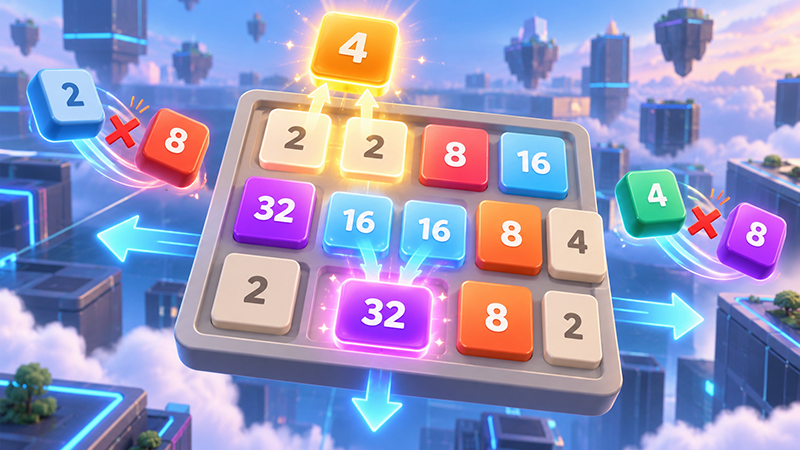
A merge can happen only when two tiles with the same number end up directly next to each other along the direction of movement. The tiles do not merge merely because they are in the same row or column. There cannot be a different tile, an empty space that prevents contact, or a board edge separating the matching values after movement.
For example, suppose a row contains:
2 | 2 | 4 | 8
If you move left, the first two tiles are already adjacent, so they combine into:
4 | 4 | 8
The new 4 can then be considered in the movement sequence, but it does not automatically combine with the existing 4 in the same move if doing so would require an additional merge after the first combination. This one-merge-per-tile rule is central to 2048.
What happens during a move?
Every move follows a logical sequence rather than simply moving all tiles at once. Although the exact internal implementation can vary between versions, the visible result follows these stages:
- Tiles slide toward the selected edge. Empty spaces between tiles disappear as far as possible.
- Matching tiles that become adjacent are merged. Two equal values become one tile worth twice as much.
- The board is compacted again. The remaining tiles continue to sit against the chosen edge.
- A new tile appears. This normally happens only if the move changed the board.
Consider this row:
2 | empty | 2 | 4
Moving left first compresses it to:
2 | 2 | 4 | empty
The two 2 tiles are now adjacent and merge, producing:
4 | 4 | empty | empty
The two 4s do not merge again in that same move. They came from different positions, and the newly created 4 has already participated in a merge. On the next appropriate move, they may be combined if they become eligible.
Why a matching tile may not merge

Another tile is between them
Two equal tiles cannot jump over a tile of another value. In this row, the matching 2s are separated:
2 | 4 | 2 | empty
Moving left produces:
2 | 4 | 2 | empty
No merge occurs because the 4 remains between the two 2s. Moving right also does not make the 2s adjacent; the order becomes 2, 4, 2 from the opposite side. The 2s can merge only after a later sequence of moves removes or relocates the blocking 4.
The tiles are not aligned with the movement
2048 merges tiles along rows or columns, not diagonally. Two 8 tiles positioned diagonally from one another are not eligible to merge, even if they are close together. A horizontal move affects horizontal relationships, while a vertical move affects vertical relationships.
For instance, these two 16 tiles do not merge during any single move simply because they are diagonal:
16 | empty
empty | 16
You must first move one tile so that both values occupy the same row or column, and then arrange for them to become adjacent.
The values are not exactly equal
Only identical values merge. A 2 cannot combine with a 4, and a 128 cannot combine with a 256. The number displayed on the tile matters; visual similarity, color, or nearby position does not.
The tile has already merged during the move
This is the most common source of confusion in a chain such as:
2 | 2 | 2 | 2
If you move left, the result is:
4 | 4 | empty | empty
The result is not a single 8. The first pair becomes 4, and the second pair becomes another 4. Each original tile can participate in only one merge during a move.
The same principle applies to longer rows:
4 | 4 | 8 | 8
A suitable move creates:
8 | 16 | empty | empty
The newly created 8 does not merge again with the original 8 in the same move.
Merge order matters
When several equal tiles are arranged in a line, 2048 resolves them from the side toward which the tiles are moving. This determines which pairs combine first.
Compare these examples:
| Starting row | Move direction | Result |
|---|---|---|
| 2 | 2 | 4 | empty | Left | 4 | 4 | empty | empty |
| 2 | 2 | 4 | empty | Right | empty | empty | 4 | 4 |
| 2 | 2 | 2 | empty | Left | 4 | 2 | empty | empty |
| 2 | 2 | 2 | empty | Right | empty | empty | 2 | 4 |
In the three-2 example, only two tiles can merge. The remaining 2 stays separate because the resulting 4 is not allowed to merge again during the same move. Choosing a direction can therefore change both the immediate result and the future shape of the board.
Why tiles sometimes seem to stop before reaching the edge

A tile slides until it reaches the board edge or encounters another tile that cannot merge with it. For example:
2 | empty | 4 | empty
Moving left gives:
2 | 4 | empty | empty
The 2 stops next to the 4 because different values cannot combine. It cannot continue through the 4 or move beyond it. If the row were:
2 | empty | 2 | empty
moving left would allow the tiles to meet and create a 4.
This is why an empty square between matching tiles is not a permanent barrier. Empty spaces disappear during the slide. A nonmatching tile, however, remains a barrier.
What counts as a legal move?
A move is legal when at least one tile changes position or at least one merge occurs. Pressing a direction that leaves every tile exactly where it was does not create a new tile.
This distinction is useful when the board is crowded. Players sometimes press a direction repeatedly, expecting a new tile to appear after every key press. If the board cannot shift in that direction, the move has no effect. The game should not treat it as a meaningful turn.
A direction can also be legal without producing a merge. For example, moving a lone 8 across several empty spaces changes its position but does not combine it with anything. A new tile may still appear because the board changed.
Common situations that look like broken merging
Matching tiles are separated by empty squares
This situation usually does allow a merge, but only if you move toward the side that brings the tiles together. If the matching values are in a row, use a horizontal move. If they are in a column, use a vertical move.
A new tile appears to block the merge
A new tile is added after the movement and merge resolution, not before it. If a merge does not occur, the reason was already present in the board arrangement before the new tile appeared. Once the new tile arrives, it may make the next move more difficult, but it did not cancel the previous merge.
Two large tiles are close but cannot combine
Large tiles often seem more important because there are fewer of them on the board. However, they follow exactly the same rules as 2 tiles. They must be equal, aligned, and adjacent after sliding. A 512 beside a 256 remains separate until another 512 is brought into position.
A move creates a pair but the pair does not combine immediately
Sometimes a move places equal tiles next to one another without moving them into the direction of the slide in a way that permits the expected combination. Examine the final row or column after compression. The pair must be part of the movement path toward the selected edge, and each tile may merge only once in that move.
How to set up reliable merges
Good 2048 play is less about chasing every visible pair and more about creating controlled positions. Use these habits:
- Choose a preferred corner. Keeping your highest tile in one corner reduces unnecessary movement and makes the board easier to organize.
- Protect the main row or column. A stable line gives you space to build smaller tiles without constantly disturbing your largest values.
- Look beyond the next merge. Before moving two 8s together, check whether the resulting 16 will block your corner or leave no useful follow-up.
- Preserve empty spaces. Open squares give you room to slide tiles and create new matches.
- Avoid random direction changes. Alternating moves without a plan can pull valuable tiles away from your chosen structure.
Before making a move, ask three questions: Which tiles will touch? Which merges will happen first? Where will the new tile and resulting values leave the board? This quick check prevents many accidental dead ends.
A practical example of planning a merge
Imagine a row containing:
8 | empty | 8 | 16
Moving left produces:
16 | 16 | empty | empty
The two 8s combine, but the new 16 does not combine with the existing 16 in the same move. If the board position is already crowded, this result may be less useful than it first appears. You now have two adjacent 16 tiles, but a newly spawned tile may occupy a location that prevents the next merge.
A careful player therefore considers not only whether the current merge is possible, but also whether the resulting pair can be merged safely on a later turn. Sometimes delaying a merge is better than forcing it immediately, especially when the move would damage the board’s structure.
Fast checklist when a merge fails
- Are the two tiles exactly equal?
- Will they occupy the same row or column after the move?
- Is a different-value tile blocking them?
- Are they actually adjacent after empty spaces are removed?
- Has one of the tiles already merged during this move?
- Did the chosen direction move the tiles toward one another?
- Did the board change at all, or was the move ineffective?
Most failed merges can be explained by one of these seven checks. Once you start viewing each move as a sequence of sliding, pairing, and one-time merging, the board becomes predictable rather than mysterious.
The key rule is simple: equal tiles merge only when they become adjacent along the direction of movement, and a tile cannot merge twice in one turn. Use that rule to read the next board position before you swipe. With practice, you will stop reacting to isolated pairs and start building moves that create several useful options at once.