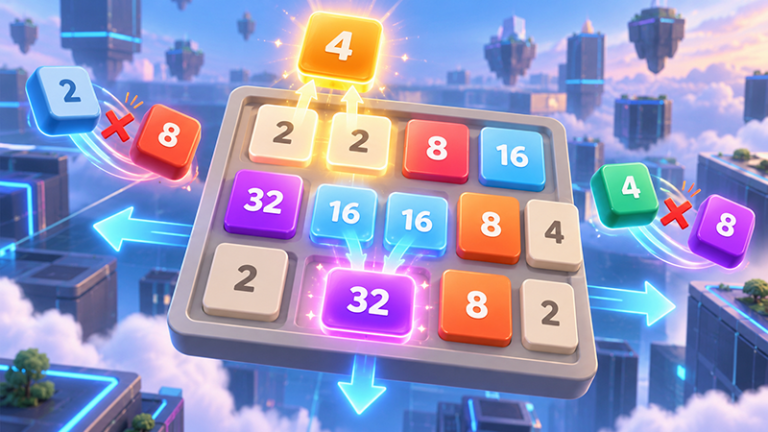
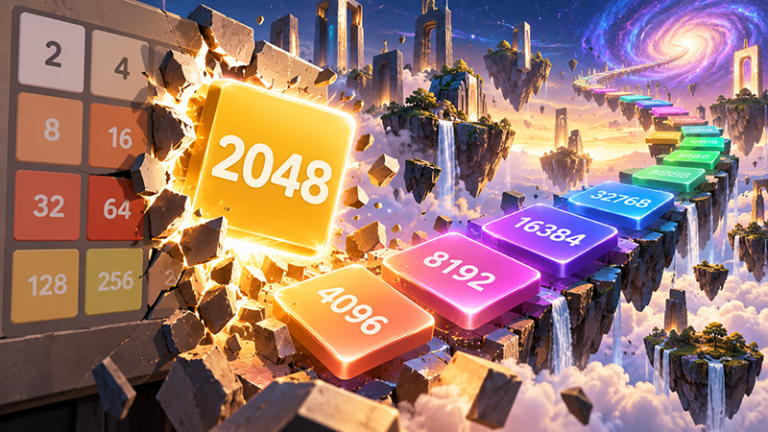
Most people assume the biggest tile in 2048 is, naturally, 2048.
It is the name of the game, after all.
But 2048 is only the first major goal. Once you create it, the game can continue, allowing you to build 4096, 8192, 16384 and even larger tiles.
So how far can 2048 actually go?
On a standard 4×4 board, the commonly accepted theoretical maximum tile is 131,072 — or 2¹⁷. The limit does not come from the game stopping at a certain number. It comes from something much simpler: a classic 2048 board has only 16 cells, and eventually there is not enough room to maintain the chain of smaller tiles needed to build anything larger.
That number is a mathematical ceiling, not a realistic target for an ordinary game.
Here is why.
Quick Answer: What Is the Highest Possible Tile in 2048?

For the standard 4×4 version of 2048, the theoretical maximum tile is:
131,072
In powers of two:
131,072 = 2¹⁷
The familiar sequence is:
2 → 4 → 8 → 16 → 32 → 64 → 128 → 256 → 512 → 1024 → 2048 → 4096 → 8192 → 16384 → 32768 → 65536 → 131072
The game does not normally stop when you reach 2048. On 2048PlayGame.com, for example, you can continue after creating the 2048 tile and keep playing toward 4096, 8192 and beyond.
However, a classic 4×4 board eventually runs into a hard space constraint.
That is where the 131,072 limit comes from.
Why Isn’t 2048 the Maximum Tile?
2048 is the game’s named objective, not its numerical ceiling.
The basic rule is simple:
- 2 + 2 = 4
- 4 + 4 = 8
- 8 + 8 = 16
- 16 + 16 = 32
and so on.
Every time two equal tiles merge, they create a tile twice as large.
So after 2048:
2048 + 2048 = 4096
Then:
4096 + 4096 = 8192
And the process continues.
The original mechanics also allow new tiles to appear after valid moves, typically as a 2 with 90% probability or a 4 with 10% probability. 2048PlayGame.com follows those same spawn probabilities.
There is therefore no special rule that says:
Stop because you reached 2048.
The real limit comes from the board.
The 4×4 Board Has Only 16 Cells
A classic game of 2048 uses a:
4 × 4 = 16-cell board
That fact is more important than it first appears.
To create a large tile, you need another tile of the same size.
For example:
To make 4096, you need:
2048 + 2048
But while you preserve one 2048 tile, you must construct another.
To make that second 2048, you need smaller tiles:
1024 + 1024
Those 1024s themselves come from:
512 + 512
and the process continues downward.
As the target tile becomes larger, more of the board must effectively be devoted to maintaining this hierarchy of powers of two.
Eventually all 16 cells matter.
The Mathematical Idea Behind 131,072
Consider an ideal late-game board.
To continue increasing the largest tile efficiently, you want a descending sequence approximately like:
65536 → 32768 → 16384 → 8192 → 4096 → 2048 → 1024 → 512 → 256 → 128 → 64 → 32 → 16 → 8 → 4
That is already 15 different tiles.
There is only one cell left.
If a new 4 appears in that final usable position, there is theoretically enough total structure to begin merging upward through the chain until the board’s value can eventually be consolidated into:
131,072
This is why the possibility of new 4 tiles matters.
If every new tile were always a 2, the space calculation would be different. Early analyses of 2048 often produced a maximum of 65,536 when ignoring 4-tile spawns. Once standard 4 spawns are included, the commonly cited upper bound becomes 131,072.
Why 262,144 Is Beyond the Classic 4×4 Limit

The next tile after 131,072 would be:
262,144
To create it normally, you would need:
131,072 + 131,072
That means building one enormous tile while somehow preserving enough board structure to build another tile of exactly the same value.
A 16-cell grid does not provide enough room for the required hierarchy under standard 2048 spawning rules.
That is why the standard 4×4 ceiling is generally given as:
2¹⁷ = 131,072
rather than:
2¹⁸ = 262,144
The limiting factor is therefore not the size of an integer in the game code.
It is board capacity.
The General Rule: Board Size Determines the Ceiling
A useful mathematical shortcut is that, under standard rules that allow new 4 tiles, a board with C cells has a theoretical ceiling often expressed as:
2^(C + 1)
For a 4×4 board:
C = 16
Therefore:
2^(16 + 1) = 2¹⁷ = 131,072
This immediately explains why larger boards can support vastly larger theoretical tiles.
For example:
| Board | Cells | Theoretical tile ceiling |
|---|---|---|
| 3×3 | 9 | 1,024 |
| 4×4 | 16 | 131,072 |
| 5×5 | 25 | 67,108,864 |
| 6×6 | 36 | 137,438,953,472 |
These are mathematical limits, not realistic expectations for an ordinary human game.
The numbers grow incredibly quickly because adding even one additional cell increases the exponent.
Why a 3×3 Board Cannot Reach 2048
This produces an interesting result.
A 3×3 board contains only:
9 cells
Using the same theoretical bound:
2^(9 + 1) = 2¹⁰ = 1024
So under standard assumptions, the maximum theoretical tile on a 3×3 board is only:
1024
That means a standard 3×3 board does not have enough capacity to build a 2048 tile.
This is one reason tiny-board 2048 is so different from the original game. You have dramatically less room to maintain the ordered hierarchy of tiles necessary for late-game progression.
2048PlayGame.com includes a 3×3 mode alongside larger variants, making it possible to experience that difference directly.
How Many 2 Tiles Are Needed to Make 131,072?
Another way to understand the scale is to imagine building the target entirely from 2 tiles.
Because:
131,072 ÷ 2 = 65,536
you would need the equivalent value of:
65,536 tiles worth of 2
to create one 131,072 tile if everything ultimately originated from 2s.
The merge tree looks like this:
- 2 twos → 4
- 4 twos → 8
- 8 twos → 16
- 16 twos → 32
- 32 twos → 64
- 64 twos → 128
- 128 twos → 256
- 256 twos → 512
- 512 twos → 1024
- 1,024 twos → 2048
- 2,048 twos → 4096
- 4,096 twos → 8192
- 8,192 twos → 16384
- 16,384 twos → 32768
- 32,768 twos → 65536
- 65,536 twos → 131072
Of course, real games also spawn 4s, so an actual run would not literally require 65,536 separate 2-tile spawns.
But the calculation demonstrates just how enormous the target is.
You can experiment with this relationship using the 2048 Tile Calculator on 2048PlayGame.com, which works backward from target tiles such as 2048, 4096 and higher values.
How Many Merges Does 131,072 Require?
If a tile is constructed entirely from 2s, every pair must ultimately be combined.
Starting with the equivalent of 65,536 twos, the merge process would contain:
32,768 first-level merges
then:
16,384
then:
8,192
and so on.
The total number of merges in a perfect binary merge tree is:
65,536 − 1 = 65,535 merges
Again, standard gameplay includes 4-tile spawns, which reduce the number of required low-level merges.
But this number gives useful intuition about the sheer amount of tile value represented by 131,072.
2048 Tiles Are Powers of Two
There is another elegant mathematical property behind the game.
Every normal tile is a power of 2.
For example:
| Tile | Power of 2 |
|---|---|
| 2 | 2¹ |
| 4 | 2² |
| 8 | 2³ |
| 16 | 2⁴ |
| 32 | 2⁵ |
| 64 | 2⁶ |
| 128 | 2⁷ |
| 256 | 2⁸ |
| 512 | 2⁹ |
| 1024 | 2¹⁰ |
| 2048 | 2¹¹ |
| 4096 | 2¹² |
| 8192 | 2¹³ |
| 16384 | 2¹⁴ |
| 32768 | 2¹⁵ |
| 65536 | 2¹⁶ |
| 131072 | 2¹⁷ |
This happens because the game always merges two equal values.
If a tile has value:
2ⁿ
then merging two of them gives:
2ⁿ + 2ⁿ = 2 × 2ⁿ = 2ⁿ⁺¹
That is why the sequence never produces values such as 3000, 5000 or 10000.
Every merge simply moves one step higher through the powers of two.
Is 131,072 Actually Reachable in a Real Game?

This is where theory and practical gameplay separate.
Mathematically, 131,072 is generally treated as the theoretical maximum tile on a standard 4×4 board with normal 2/4 spawning.
Practically, reaching it is extraordinarily difficult.
Several things must go right for an extremely long time:
- your largest tile must stay organized;
- smaller tiles must remain in a useful order;
- you need enough empty cells for future spawns;
- random 2 and 4 placements must remain manageable;
- accidental disruption of the tile chain must be avoided;
- and the run must survive through an enormous number of merges.
By the time the board contains tiles such as 16384, 32768 and 65536, a single bad move can destroy hours of progress.
That is why 131,072 is better understood as a mathematical boundary than an ordinary gameplay objective. Current 2048 guides similarly distinguish between the theoretical ceiling and realistic player targets.
What Is a Realistic High Tile in 2048?
For most players, much smaller milestones are more meaningful.
2048
This is the game’s original goal.
Reaching it shows that you can keep a board organized long enough to build a substantial tile hierarchy.
4096
To reach 4096, you effectively need to create another 2048 while preserving your first one.
This demands much better space management.
8192
An 8192 tile requires much longer-term control.
Mistakes that were recoverable earlier become much more expensive.
16384
At this level, maintaining the order of your largest tiles becomes increasingly important.
32768 and above
These runs are already dramatically removed from casual play.
The difference between reaching 2048 and reaching 32768 is not simply five more merges.
Each doubling requires rebuilding an enormous amount of value while your existing large tile continues consuming board space.
Why Each New Tile Is Much Harder Than the Last
At first glance, progressing from:
2048 → 4096 → 8192
may look like a linear increase.
It is not.
To create 4096, you need two 2048 tiles.
To create 8192, you need two 4096 tiles — which means effectively building four 2048 tiles worth of value.
For 16384:
8 × 2048
For 32768:
16 × 2048
For 65536:
32 × 2048
For 131072:
64 × 2048
The amount of required tile value doubles at every level.
That exponential growth is why progress slows dramatically in the late game.
How Much Bigger Is 131,072 Than 2048?
Divide:
131,072 ÷ 2,048 = 64
So a single 131,072 tile contains the same total value as:
64 tiles of 2048
That gives a much clearer sense of the scale.
Creating your first 2048 can already take a substantial number of moves.
A theoretical 131,072 run represents vastly more successful tile generation, merging and survival.
Does the Game End at 2048?
No.
Creating the 2048 tile fulfills the original goal, but the game can continue.
Players can pursue:
4096 → 8192 → 16384 → 32768 → 65536 → 131072
On 2048PlayGame.com, the standard mode explicitly allows continued play after 2048, and separate target modes are also available for goals such as 4096 and 8192.
So if you have reached 2048, you have won the named challenge.
But mathematically, you are nowhere near the board’s theoretical limit.
Highest Tile and Highest Score Are Different
This distinction is important.
The highest tile asks:
What is the largest numbered tile that can exist?
The score asks:
How many points have been earned from all merges during the run?
In standard 2048 scoring, when two tiles merge, you earn points equal to the value of the newly created tile.
For example:
2 + 2 → 4
earns:
4 points
And:
1024 + 1024 → 2048
earns:
2048 points
Therefore, reaching a certain tile does not mean your score is equal to that tile’s number.
Your total score includes every previous merge used during the run. 2048PlayGame.com mechanics page follows this standard rule, and its Score Calculator can total the points generated by a sequence of merges.
Why Empty Cells Matter More at High Tiles
When beginners first play 2048, merges are usually the most exciting thing on the board.
In the late game, space becomes more valuable than immediate points.
Every empty cell provides:
- room for a new 2 or 4;
- room to reposition smaller tiles;
- room to maintain the descending chain;
- and a buffer against bad random spawns.
A board with several exciting merge opportunities but no empty space can be much more dangerous than a board with fewer immediate merges and plenty of flexibility.
This is also why the theoretical maximum is fundamentally a space problem.
Why the Corner Strategy Helps
A common 2048 strategy is to keep the largest tile in one corner.
The idea is to create an ordered sequence along an edge, such as:
8192 → 4096 → 2048 → 1024
Keeping large values ordered reduces the need to move them around and preserves more of the board for building smaller tiles.
2048PlayGame.com’s own strategy benchmark compared several simple policies across 2,000 fixed-seed games and found that structured corner-based play with lookahead performed much better than random or purely greedy merging.
That does not make corner play mathematically perfect.
But it reflects the same principle responsible for the 131,072 ceiling:
large tiles consume structure as well as value.
Could a Bigger Board Go Beyond 131,072?
Absolutely.
131,072 is specifically associated with the standard 4×4 board.
A larger board has more cells available for:
- supporting intermediate tiles;
- keeping multiple large chains;
- absorbing random spawns;
- and building much higher values.
This is why comparing the highest tile on a 4×4 board with one from a 5×5 or 8×8 game is not really fair.
They are different mathematical environments.
2048PlayGame.com currently includes 4×4, 5×5, 6×6, 8×8 and 10×10 boards, along with additional experimental sizes.
What Is the Highest Tile on a 5×5 Board?
A 5×5 board contains:
25 cells
Applying the same theoretical cell-count model:
2^(25 + 1)
gives:
2²⁶ = 67,108,864
That is already more than 67 million.
Again, this is a theoretical ceiling.
It should not be confused with a realistically achievable player target.
What Is the Highest Tile on a 6×6 Board?
A 6×6 board has:
36 cells
Using the same model:
2^(36 + 1)
=
2³⁷
=
137,438,953,472
That is more than 137 billion.
The numbers become enormous very quickly because the exponent grows with the number of cells.
Why Bigger Boards Change the Game So Much
Compare:
4×4 = 16 cells
with:
5×5 = 25 cells
That is only nine extra cells.
Yet the theoretical maximum jumps from:
131,072
to:
67,108,864
The reason is exponential growth.
Every extra position potentially supports another level in the hierarchy of powers of two.
That makes larger 2048 boards feel more forgiving and allows games to continue far longer.
The strategy also changes because you have more freedom to maintain several regions of the board instead of relying so heavily on one compact chain.
Can You Calculate Any Target Tile Yourself?
Yes.
Every normal 2048 tile follows:
Target tile = 2ⁿ
To find how many starting 2s would represent the same total value:
Target ÷ 2
For example:
2048
2048 ÷ 2 = 1024
Equivalent to 1,024 twos.
4096
4096 ÷ 2 = 2048
Equivalent to 2,048 twos.
8192
8192 ÷ 2 = 4096
Equivalent to 4,096 twos.
131072
131072 ÷ 2 = 65536
Equivalent to 65,536 twos.
The 2048 Tile Calculator on 2048PlayGame.com can do this calculation automatically for larger targets.
Frequently Asked Questions
What is the highest possible tile in 2048?
On the standard 4×4 board, the commonly accepted theoretical maximum is 131,072, or 2¹⁷. The limit comes from the board having only 16 cells and standard new tiles being 2 or 4.
Can you get higher than 2048 in 2048?
Yes.
You can continue to:
4096, 8192, 16384, 32768, 65536 and theoretically 131072 on a standard 4×4 board.
Does 2048 stop when you reach the 2048 tile?
No.
Reaching 2048 achieves the original objective, but play can continue for a higher score and larger tiles.
Can you get 4096 in 2048?
Yes.
4096 is created by merging two 2048 tiles.
Can you get 8192 in 2048?
Yes.
An 8192 tile is mathematically possible on a normal 4×4 board and is created from two 4096 tiles.
Can you get 65536 in 2048?
Yes, theoretically.
It is below the 131072 ceiling, although reaching it in real play requires an exceptionally long and well-managed game.
Can you get 131072 in 2048?
Under standard assumptions that include the possibility of new 4 tiles, 131072 is treated as the theoretical 4×4 maximum. Achieving such a position in ordinary human play would be extraordinarily difficult.
Can you get 262144 in standard 2048?
Not on the normal 4×4 board under the standard theoretical model.
Creating a tile that large would require more supporting space than the 16-cell board provides.
What is the highest possible tile on a 3×3 board?
The same cell-count model gives:
2¹⁰ = 1024
for a nine-cell 3×3 grid.
What is the highest possible tile on a 5×5 board?
Using the same theoretical model:
2²⁶ = 67,108,864
Is the highest tile the same as the highest score?
No.
Tile value and score are different.
Your score accumulates points from every successful merge, while the highest tile records only the largest individual tile you have created.
The Bottom Line
The number 2048 is not the true mathematical end of 2048.
On a standard 4×4 board, the commonly accepted theoretical maximum tile is:
131,072
or:
2¹⁷
The reason is not an arbitrary software restriction.
It is the geometry of the board.
A classic game has only 16 cells, and building larger tiles requires preserving an increasingly demanding hierarchy of smaller powers of two. Eventually there is simply not enough space to support the next doubling.
That is also why late-game 2048 becomes dramatically harder even though the rules never change.
Your practical milestones are much more approachable:
2048 → 4096 → 8192 → 16384 → 32768 → 65536
with 131072 sitting at the far edge of what the mathematics of the classic board allows.
If you want to see how much work goes into building each tile, use the Tile Calculator on 2048PlayGame.com — or start a 4×4 game and see how far beyond 2048 you can actually go.