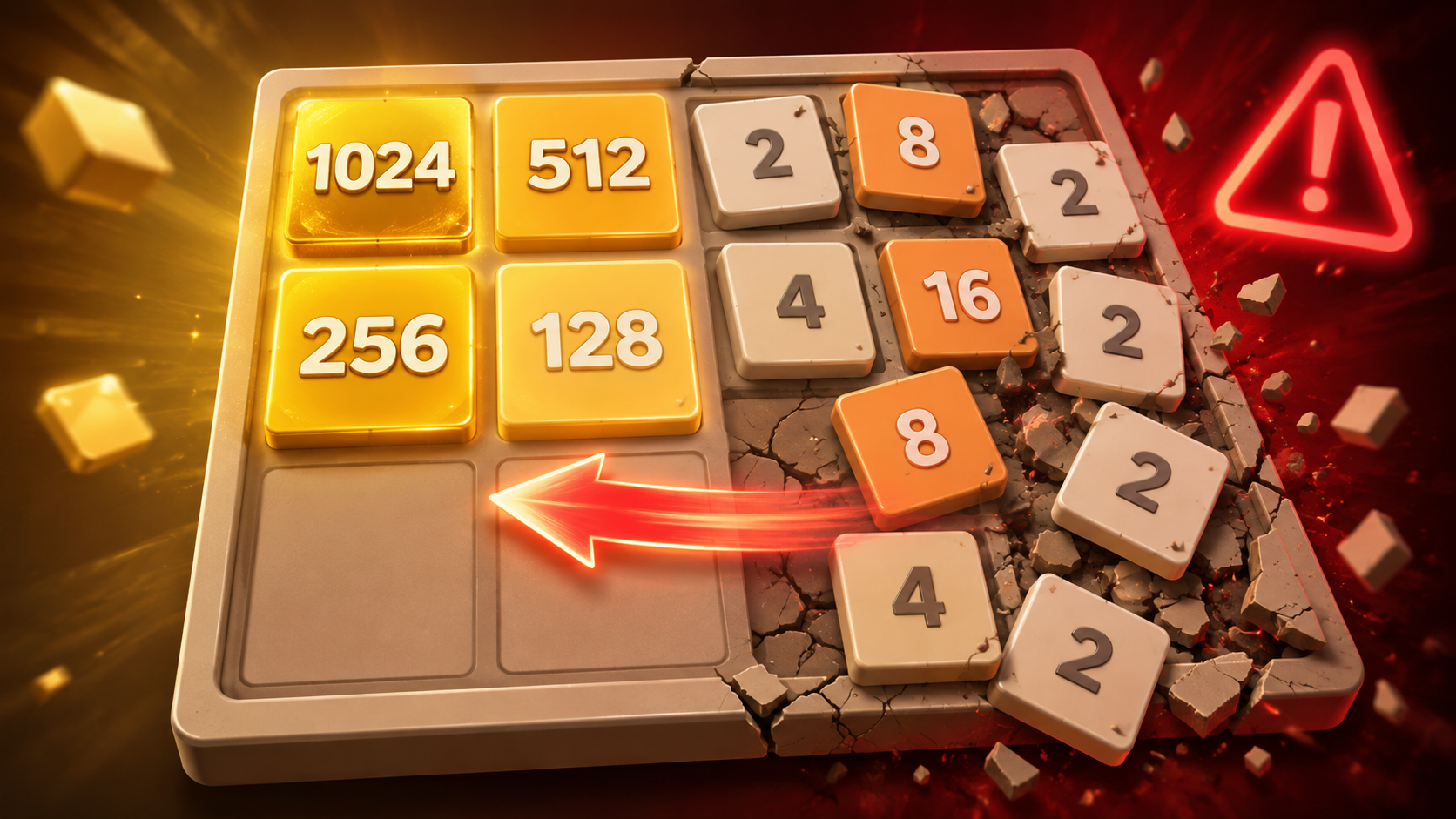
Most 2048 losses are not caused by one unlucky tile. They are caused by several small structural mistakes that leave the board with no safe answer when the unlucky tile finally appears.
1. Swiping in all four directions without a plan
Random movement feels productive early because almost every swipe creates a merge. Later, the same habit scatters medium and large tiles across the grid. Choose an anchor corner and give each move a purpose.
2. Moving the largest tile out of its corner
A high tile in the middle blocks traffic and needs an equal partner before it becomes useful again. Protect the anchor unless breaking it is necessary to keep the game alive.
3. Chasing the nearest merge
A 32+32 merge is not automatically good if the new 64 lands on the wrong side of a 256. Evaluate where the result belongs in your chain.
4. Ignoring empty cells
Empty space is a resource. If a move earns points but reduces the board to one open cell, the next random spawn may remove your only escape route.
5. Building two competing high-value corners
Two separate 512 tiles on opposite sides sound promising, but connecting them later is difficult. Concentrate high values so future partners have a clear merge path.
6. Leaving gaps in the anchor row
A gap can allow the whole row to shift during a corrective swipe. Consolidate the anchor edge before making a move that pulls away from it.
7. Letting a medium tile become isolated
A misplaced 128 or 256 takes a long time to match. Move medium values toward the main structure while the board still has space.
8. Trying to repair every imperfect tile immediately
One small tile out of order is often harmless. Forcing a repair can move your anchor or consume empty space. Protect the important structure first.
9. Playing too fast near the endgame
Speed is not rewarded. When the board is crowded, pause long enough to visualize the entire row and column shift. One accidental swipe can undo dozens of careful moves.
10. Comparing unlike scores
A 10×10 run, an undo-enabled 4×4 run, and a strict Classic run are different challenges. Track personal bests within the same mode instead of treating every number as directly comparable.
A simple recovery routine
- Stop making automatic swipes.
- Find the largest tile and choose the corner you want to restore.
- Count empty cells.
- Identify one small merge that creates space without moving the anchor farther away.
- Rebuild the edge before pursuing a large merge.
If you repeatedly lose around the same milestone, use the strategy guide and practice on the standard 4×4 board. A larger 5×5 board can also help you rehearse ordering with more room.