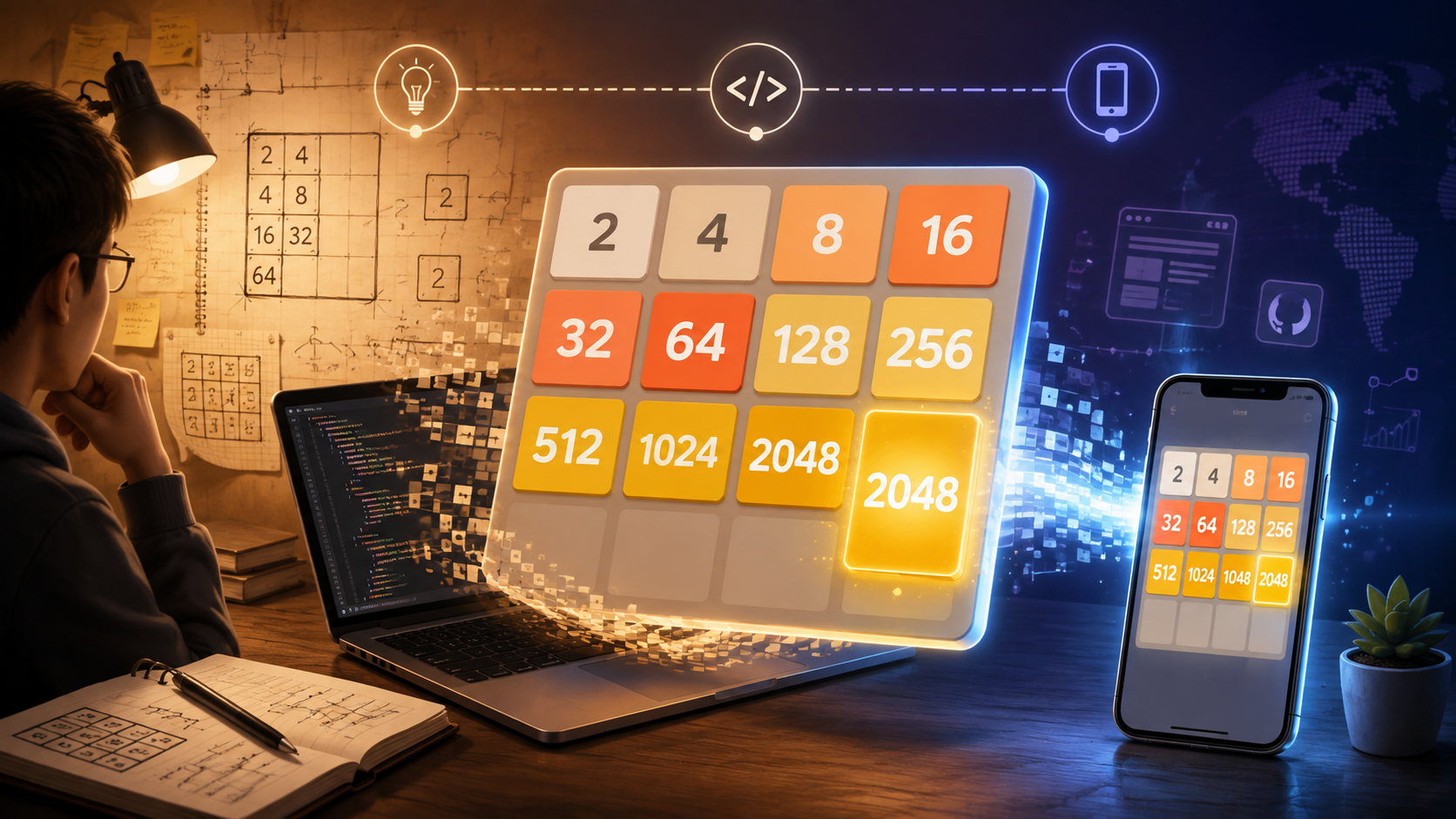
2048 became one of the best-known browser puzzle games of the 2010s because its rules were instantly understandable and the game was easy to share. The original project was created by Italian web developer Gabriele Cirulli and released in 2014.
Who created 2048?
Gabriele Cirulli created the version that became widely known as 2048. In the original project README, Cirulli described it as a small clone of 1024, based on Saming’s 2048, and said it was indirectly inspired by Threes.
The original source code remains publicly available under the MIT license. That openness helped developers study, adapt, translate, and remix the game across many platforms.
Why did 2048 spread so fast?
The game had several properties that made sharing unusually easy:
- The objective fits in one sentence: combine equal numbers until you reach 2048.
- A complete game can run in a web browser.
- The board is readable at a glance.
- Scores and large tiles give players a simple achievement to compare.
- The code could be forked and modified under an open-source license.
Was 2048 the first game with this idea?
No. Cirulli’s own documentation credits earlier influences rather than presenting 2048 as an isolated invention. That attribution is important when discussing the game’s history.
2048 Online on this website is an independent implementation and does not claim to be the original official site. We preserve attribution to the original creator and explain our own mechanics separately.
Why is the 4×4 board so memorable?
Sixteen cells create a balance between simplicity and pressure. The early game feels open, but the grid becomes crowded fast enough that one poor sequence can matter. The powers-of-two progression also makes every large tile feel like a visible milestone.
How modern 2048 sites differ
The core merging rule has stayed recognizable, but modern versions often add features such as touch controls, undo, saved best scores, accessibility improvements, alternative grid sizes, challenges, and strategy tools.
On this site, you can play the standard 4×4 game, a stripped-back Classic mode, or larger boards from 5×5 through 10×10.
What has not changed?
The satisfying part of 2048 is still the same: one swipe changes the whole board, equal tiles double, and every new tile forces you to decide whether your structure can survive another move.
Our attribution and project information
For details about this independent website, see About 2048 Online, the founder profile, and our game mechanics and methodology.
For the historical source, readers should also consult Gabriele Cirulli’s original 2048 repository and project documentation.