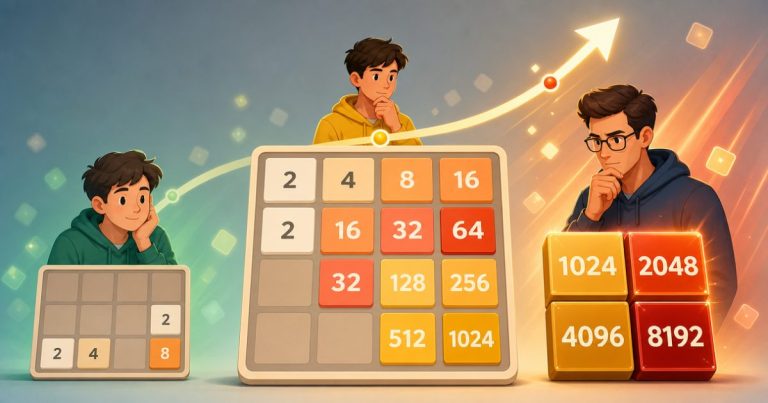
If you have ever finished a game of 2048, stared at the number at the top of the screen and wondered where it came from, you are not alone. Here is the answer in one sentence: your score is the running total of the value of every tile created by a merge. It is not the value of your biggest tile, and it is not a bonus for reaching 2048.
That single idea explains almost everything else about scoring: why a friend can reach the same 2048 tile with a very different score, why the last few merges are worth so much more than the first ones, and why some moves that feel productive add nothing at all. The best way to see it is to Play 2048 and watch the score change only when tiles actually merge.
The one rule of 2048 scoring
Every merge pays you the value of the tile it creates. Merge two 2s and you make a 4, so you earn 4 points. Merge two 4s and you make an 8, so you earn 8 points. The pattern continues all the way up the ladder:
- 2 + 2 = 4: +4 points
- 4 + 4 = 8: +8 points
- 64 + 64 = 128: +128 points
- 1,024 + 1,024 = 2,048: +2,048 points
Your score is cumulative. It never resets when you make a larger tile, and earlier points are never taken away. If you make a 4, then later an 8, then later a 16, your score from those three merges is 4 + 8 + 16 = 28 points. That is all there is to it — no hidden multiplier, no combo bonus and no points for style.
Sliding without merging earns 0 points. You can slide tiles back and forth for a dozen moves, tidy the board and set up a good position, and your score will not move. That does not mean those moves were wasted. In 2048, a quiet move that lines up the next big merge is often worth far more than a noisy move that grabs a few points now and ruins the board.
One merge per tile per move
There is one important limit on the rule above: a tile created by a merge cannot merge again in the same move. This stops a whole row from collapsing into one giant tile in a single swipe.
Take a row of four 2s and slide it left. The first pair merges into a 4, and the second pair merges into a separate 4. The row becomes 4, 4, and you earn 4 + 4 = 8 points. It does not become a single 8, and you do not earn 8 points for a merge that never happened.
With three equal tiles, the pair nearest the wall merges first. Slide 2, 2, 2 to the left and the two tiles closest to the left edge combine into a 4, leaving 4, 2 and 4 points. Slide the same row to the right and the pair on the right merges instead, leaving 2, 4. The direction matters, so think about which tile you want to keep free before you swipe.
The maths: what is a 2048 tile really worth?
Building a big tile is not one merge; it is a long chain of smaller merges, and every step in that chain paid you points along the way.
There is a neat way to check this. Suppose you build one tile of value 2k purely from 2-tiles, with no spawned 4s helping you. The total points earned in building it is (k − 1) × 2k. You can verify it with small tiles first:
- A 4 (22) earns 4 points: 1 × 4.
- An 8 (23) earns 16 points: 2 × 8. You make two 4s (4 + 4), then merge them (8).
- A 16 (24) earns 48 points: 3 × 16. You make two 8s (16 + 16), then merge them (16).
Follow the same ladder up to 2,048, which is 211. Building a 2048 tile only from 2s is worth 10 × 2,048 = 20,480 points. That is the score locked inside the tile itself, before counting any other merges you made along the way — the spare 16s, 32s and 64s built while reorganising the board, or tiles consumed in chains that did not lead directly to the 2048.
In a real game, the first 2048 usually lands at around 20,000 to 25,000 points. Spawned 4s skip one merge layer, which slightly lowers the total, because a 4 that appears for free never paid for the 2 + 2 merge that would otherwise have created it. Extra merges elsewhere add points back. If you want to see how the values climb, our guide to tile values from 2 to 2048, 4096, 8192 and beyond walks through the full ladder.
Why late merges matter so much
Because every merge pays the value of the tile it creates, points grow fast at the top of the ladder. One 1,024 + 1,024 merge pays 2,048 points. To earn the same amount from the smallest merges, you would need 512 merges of 2 + 2, at 4 points each. That is why the end of a game can transform a score that looked ordinary for most of the run.
Picture a corner row reading 1,024, 512, 256, 128, with a second 128 sliding into place at the end. The new 128 merges with the old one and makes a 256: +256 points. That 256 merges with the next 256 and makes a 512: +512 points. That 512 merges with the next 512 and makes a 1,024: +1,024 points. Finally, that 1,024 merges with the first tile and makes a 2,048: +2,048 points. One well-set-up move has earned 256 + 512 + 1,024 + 2,048 = 3,840 points.
That is the real prize in 2048: not the single 2,048-point merge, but the chain — a row of descending tiles, each one ready to fall into the next. Games are often won or lost on whether that chain is in place before the board fills up. For a practical way to build it, read our corner strategy guide, which explains how to keep your biggest tile in one corner and arrange the rest in a descending line beside it.
What does not score
Just as useful as knowing what earns points is knowing what does not:
- Moving tiles. Sliding tiles without a merge earns 0 points, however far they travel.
- Spawning tiles. A new tile appearing on the board adds nothing. New tiles are a 2 with a 90% chance and a 4 with a 10% chance, and neither one scores until it merges. You can read more about those odds in our guide to why new tiles are usually 2 instead of 4.
- Reaching 2048 itself. There is no bonus for making the 2048 tile, and no bonus for winning. The 2,048 points you earn are simply the points for that one merge.
- Surviving a long time. A game that lasts 500 moves with mostly small merges can easily score less than a shorter, better-organised game that reaches the big tiles.
How to use scoring to raise your score
Knowing the rule is one thing; using it is another. The scoring system rewards patience and structure, not grabbing every merge in sight.
Build big tiles, not just more merges. A single 512 + 512 merge is worth 1,024 points — the same as 256 merges of 2 + 2. Everything you do should be aimed at keeping the ladder climbing: one corner for your biggest tile, and a snake of descending tiles leading away from it.
Set up chain merges. Before you make the obvious merge, look one step ahead. Can you arrange the row so that the new tile immediately merges again? A prepared chain, like the 1,024-512-256-128 example above, can be worth thousands of points in a single move.
Do not chase small merges that break board order. A 4-point merge is tempting, but not if it pulls a large tile out of its corner or scatters your snake. The points you gain now are often far less than the points you lose when the big chain can no longer form. If you want a fuller plan, see how to get a higher score in 2048 without ruining your board.
Finally, keep your expectations realistic. If you are wondering whether your total is good for your level, compare it with the benchmarks in What Is a Good Score in 2048. A score that looks modest next to an expert total may still be a strong result for a player who has only just learned the corner strategy.
Frequently asked questions
Is my score the same as my biggest tile?
No. Your biggest tile is one number; your score is the sum of every merge you made during the whole game. A player with a 1,024 tile can easily have a higher score than a player with a 2,048 tile if the first player made many more merges along the way.
Why did my friend reach 2048 with a lower score than me?
Because the score counts the journey, not just the destination. Spawned 4s skip merge layers, extra merges add points, and a clean late-game chain can add thousands in a few moves.
Does the best score sync across devices?
No. Your best score is stored locally on the device and browser where you played, so a score set on your phone will not appear on your laptop. If you clear your browser data or switch devices, you start again from zero on that device.
Scoring in 2048 rewards the same habit that wins games: build steadily, keep your big tiles in order, and let the points follow the merges.