In 2048, the next tile appears in a random empty space after every valid move. In the classic version, the game usually spawns a 2 90% of the time and a 4 10% of the time. You cannot choose the location or know the exact value in advance, but the randomness follows rules rather than behaving completely unpredictably. Understanding those rules helps you plan moves, protect your largest tile, and avoid blaming bad luck for mistakes that came from poor board management.
Players using 2048playgame.com can apply the same principles whether they are practicing on a desktop or making quick moves on a mobile device. The most important idea is simple: you cannot control the next tile directly, but you can control how many useful empty spaces remain and where those spaces are located.

How the next tile is generated
A standard 2048 turn follows a predictable sequence. First, you swipe in one of the four directions. The board moves and combines tiles according to the rules of the game. If the swipe changes the board, the game creates one new tile in an empty square. That new tile is normally either a 2 or a 4.
- You choose a direction.
- All tiles slide as far as possible in that direction.
- Matching neighboring tiles merge once according to the move rules.
- The game identifies the empty cells left on the board.
- One empty cell is selected at random.
- A 2 or 4 is placed in that cell according to the tile probability.
This means the new tile does not appear before your move, and it does not appear in a fixed pattern. The game waits until the move has been processed, then adds the tile to one of the spaces that are still empty.
Is the location completely random?
The location is random only among the currently available empty cells. A new tile cannot appear on top of an occupied tile, inside a tile that just merged, or in a square that is not empty after the board has finished moving.
Suppose a board has eight empty cells after a valid swipe. If the game treats each empty cell equally, each one has a one-in-eight chance of receiving the new tile. If only two empty cells remain, each has a one-in-two chance. The odds change because the list of possible locations changes after every move.
| Empty cells after a move | Approximate chance for any one empty cell |
|---|---|
| 16 | 1 in 16, or 6.25% |
| 8 | 1 in 8, or 12.5% |
| 4 | 1 in 4, or 25% |
| 2 | 1 in 2, or 50% |
These are location probabilities, not guarantees. If four empty spaces are available, the game does not promise that each space will be used once. It may select the same general area repeatedly, or it may place several tiles along one edge. Random selection can produce short-term patterns that look deliberate, even when no pattern is built into the game.
What is the probability of getting a 2 or a 4?
In the original style of 2048, the usual tile distribution is:
- 2: approximately 90% of new tiles
- 4: approximately 10% of new tiles
These probabilities apply to the value of the tile, not its position. The location and value are separate parts of the spawning process. For example, if there are five empty cells, the chance of a particular cell receiving a 2 is about 18%: one-fifth for the location multiplied by 90% for the value. The chance of that same cell receiving a 4 is about 2%.
The word “approximately” matters because not every online version uses exactly the same settings. Some game modes, custom board sizes, or redesigned versions may adjust the probabilities or introduce different starting conditions. The classic rules, however, generally use the 90/10 split.
Does the previous tile affect the next tile?
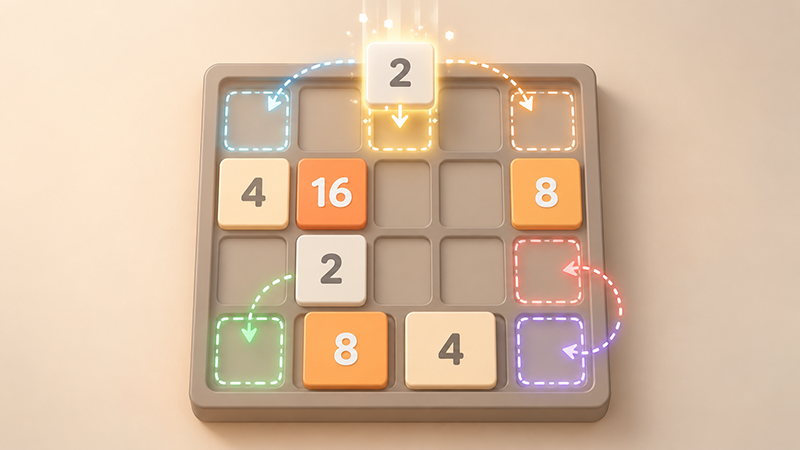
Usually, no. The game does not normally use a sequence such as “after a 4, a 2 must appear” or “after three 2s, a 4 is due.” Each new tile is selected through the game’s random process. A run of several 2s does not make a 4 more likely on the next turn, and receiving several 4s in a short period does not mean a long drought must follow.
This is a common misunderstanding called the gambler’s fallacy. Random events do not compensate for earlier results. If the next tile is normally a 4 with a 10% probability, that probability does not automatically rise just because the last ten tiles were 2s.
Likewise, a lucky sequence does not prove that the game is helping you. You may receive a 4 in a useful corner several times in a row, but that does not create a permanent advantage. Strong play comes from making the board resilient enough to handle ordinary results, not from expecting lucky results to continue.
Why does the game sometimes feel unfair?
Random tiles can create difficult positions, especially when the board is nearly full. A new tile in an awkward space may block a planned merge, split two useful groups, or force you to move a high-value tile away from its intended corner. These events are frustrating, but they are part of the challenge.
The important distinction is between bad luck and avoidable risk. A tile can appear in the worst available square even when you played correctly. However, a crowded board often gives randomness far more power. If only one empty cell remains, the next tile is forced into it. If six safe spaces are available, the same random event is much easier to absorb.
Good players therefore do not try to predict the exact next spawn. They improve the board before the spawn happens. Their aim is to preserve flexibility, maintain several empty cells, and ensure that a 2 or 4 in an unexpected location will not immediately end the game.
How to prepare for an unpredictable spawn
Keep empty spaces available
Empty cells are not wasted space in 2048. They are your room for error. Every valid move adds a new tile, so the board gradually becomes more crowded. Merges create space, while new tiles consume it. If you make moves that do not produce merges for too long, the number of possible spawn locations shrinks quickly.
Before swiping, ask whether the move will create at least one merge or open a useful area. A move that slides tiles without combining them may still be necessary, but it should not become your default habit.
Build around a protected corner
A common strategy is to keep the largest tile in one corner, often the bottom-left or bottom-right corner. The exact corner is less important than consistency. If the highest tile stays anchored, smaller tiles can be arranged in a sequence leading toward it.
For example, a player might keep the largest tile in the bottom-right corner and prefer moves that preserve the bottom row. A random 2 appearing near the top is usually manageable because it can be developed later. A random tile appearing beside the largest tile is more dangerous if it forces an unwanted movement.
Do not treat the corner as an absolute rule, though. If preserving it requires filling the board or making no useful merge, a controlled temporary change may be safer than stubbornly protecting the corner.
Maintain a descending tile order
Many successful boards use a snake-like arrangement in which values decrease as they move away from the largest corner. A simplified bottom row might look like:
128 64 32 16
with the largest value kept at one end. This arrangement makes it easier to combine similar values without scattering your key tiles. Random spawns will not respect the order, but a flexible board lets you repair small disruptions before they become serious.
Use multiple empty areas
A single empty cell is often less useful than several smaller pockets of space. Try to avoid creating a board where all open cells are trapped behind a wall of high-value tiles. Open areas on different sides of the board give you more ways to respond when the next tile lands in an inconvenient position.
Can you predict where the next tile will appear?
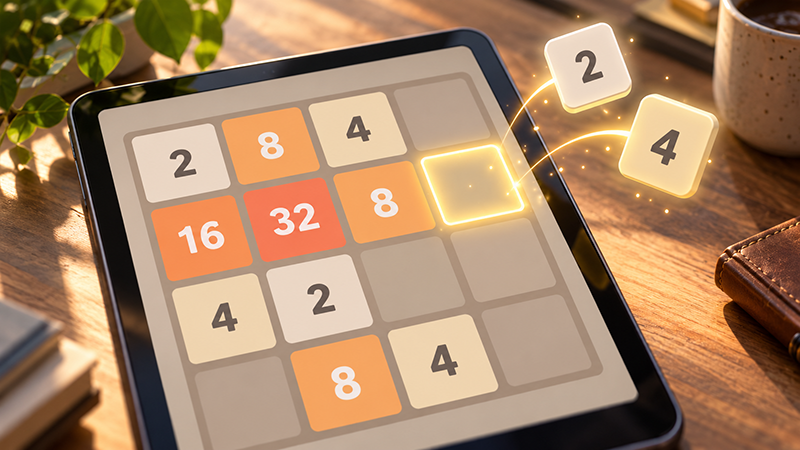
You cannot predict the exact location through normal gameplay. You can only calculate the possible locations after the move is complete. Before swiping, you may know which cells are likely to become empty, but the new tile is selected after the movement and merging process.
This is why planning several moves ahead is different from predicting several spawns ahead. You can plan a move sequence that preserves your structure, but you should leave alternatives in case the next tile appears somewhere unexpected.
For instance, imagine that you want to combine two 8 tiles on the right side. If your plan leaves no space for an unwanted 2 near the center, it is fragile. A safer plan may take one additional move to open a second area before attempting the merge. It may be slightly slower, but it gives the random spawn fewer opportunities to ruin the position.
What happens when there are no empty cells?
If a swipe does not change the board, no new tile is added. This is an important rule. Pressing a direction that cannot move or merge anything does not consume an empty space or advance the game.
When a valid move leaves no empty cell, the game cannot place the required new tile. In normal play, this situation means the board is effectively full and the game checks whether any legal merge remains. If no adjacent equal tiles can merge, the game ends. If a merge occurred during the move, the resulting empty space normally allows the new tile to be created.
A full board is not always immediately lost. Look for at least one pair of equal neighboring tiles. If such a pair exists, a legal move may still open space. If every neighboring pair has different values and no swipe can change the board, there is no route to continue.
Does randomness make strategy irrelevant?
No. Randomness affects the difficulty of each game, but it does not erase the value of good decisions. A strong strategy increases the number of situations you can survive. It also reduces the chance that one unlucky spawn will force an irreversible mistake.
Two players can receive similar tile sequences and achieve very different results because one player preserves empty space, avoids unnecessary corner movement, and creates merges efficiently. Over many games, these choices matter much more than trying to guess the next tile.
The best mindset is to separate what you can control from what you cannot:
- You cannot control: the next tile’s exact value or location.
- You can control: the direction of your move, the arrangement of existing tiles, your number of empty cells, and the risks you accept.
- You can improve: your ability to recognize safe merges, preserve a corner, and recover from awkward spawns.
Practical checklist before every move
- Check whether the move is valid and whether it creates a merge.
- Identify where the new empty spaces will appear.
- Protect your largest tile if possible, especially when it is anchored in a corner.
- Make sure the move does not trap important tiles behind an unmovable wall.
- Consider at least one unwanted spawn location and how you would respond to it.
- Prefer moves that preserve more than one future option.
The next tile in 2048 is random, but the conditions surrounding it do not have to be. You cannot choose whether a 2 or 4 appears, and you cannot select its square. You can, however, keep the board open, maintain a stable structure, and avoid moves that leave randomness with only one disastrous place to go. That is the practical answer: the spawn is random, while the quality of your preparation is under your control.
Related reading: the math behind the spawns is covered in our 2048 probability explained guide — why new tiles are usually 2 instead of 4.
