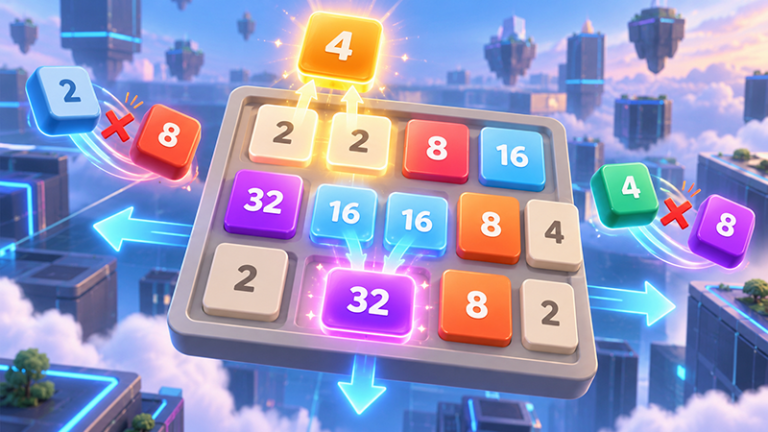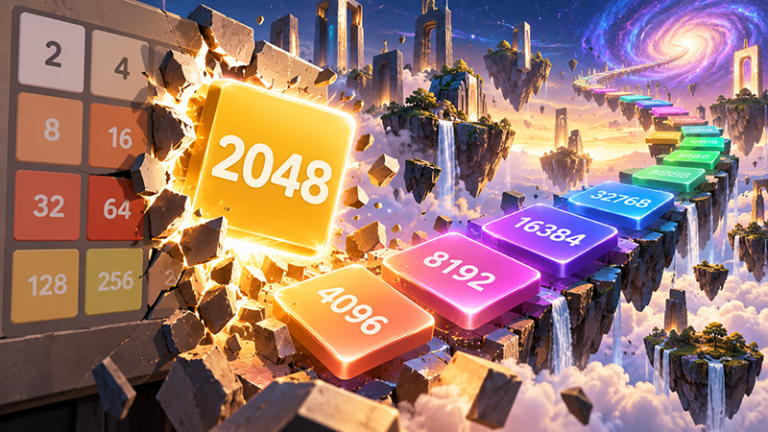
In 2048, the players who go further are usually the ones who stop treating every merge as a win. They keep the board readable, protect the biggest tile, and leave enough room to recover when a bad spawn arrives. That is what separates a run that dies around 256 or 512 from one that keeps moving toward 1024, 2048, and beyond.
The 2048 advanced strategy is really a set of habits: where your largest tile sits, which side of the board stays stable, and how many empty cells you keep alive. Once those habits are in place, the game feels less random and a lot easier to manage.
What board control really means in 2048
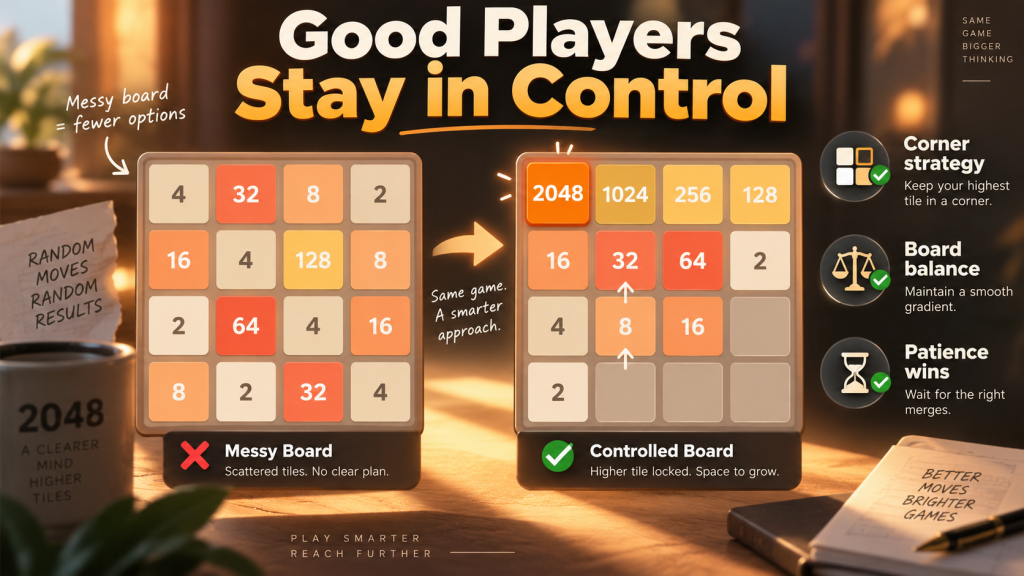
Board control means every move has a purpose. A good move either keeps your structure intact, creates a useful merge, or buys you space for the next turn. If a move only rearranges tiles and makes the board harder to read, it is usually the wrong move, even if it looks harmless in the moment.
Strong players keep one side of the board organized and use the rest as working space. They avoid letting the grid spread out in every direction. Instead, they build a pattern where tiles slide, combine, and return to roughly the same order after each turn.
That is why 2048 starts to feel easier once you stop reacting to every new tile and begin playing a structure. The board becomes something you maintain, not just something that keeps changing.
Keep your largest tile in a fixed corner
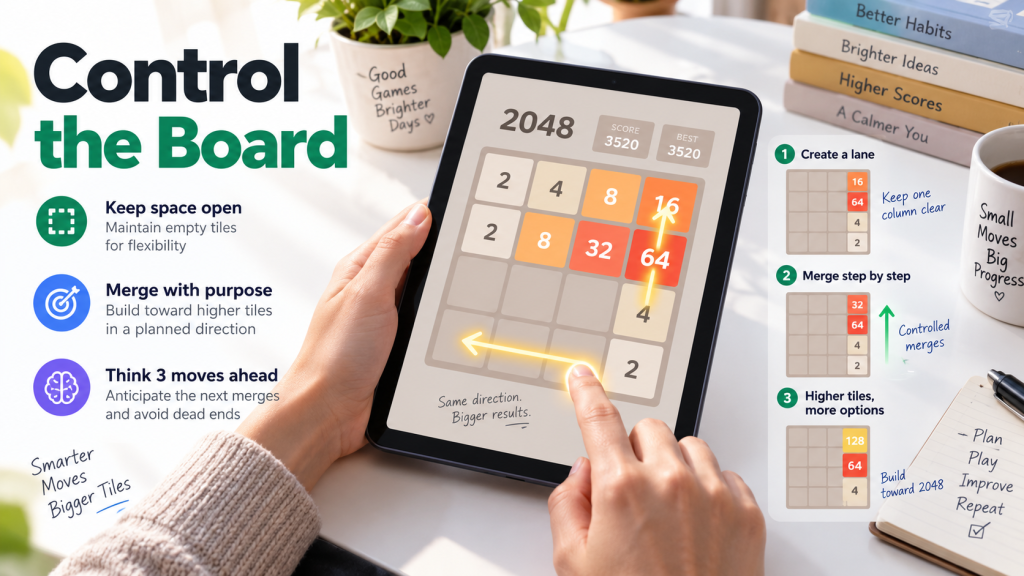
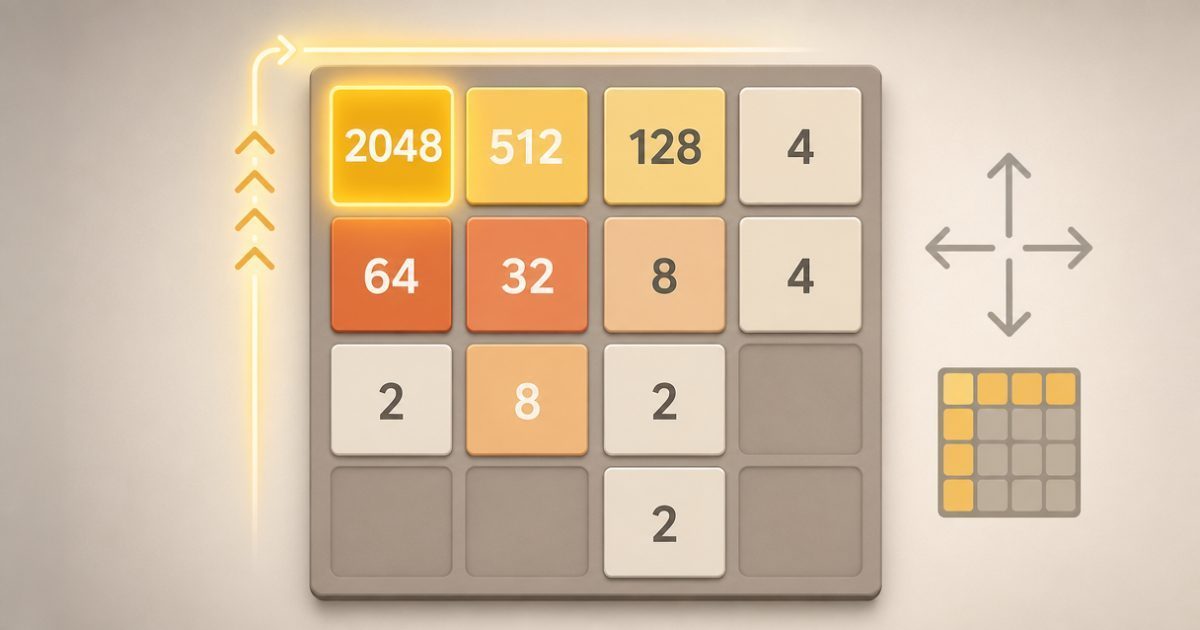
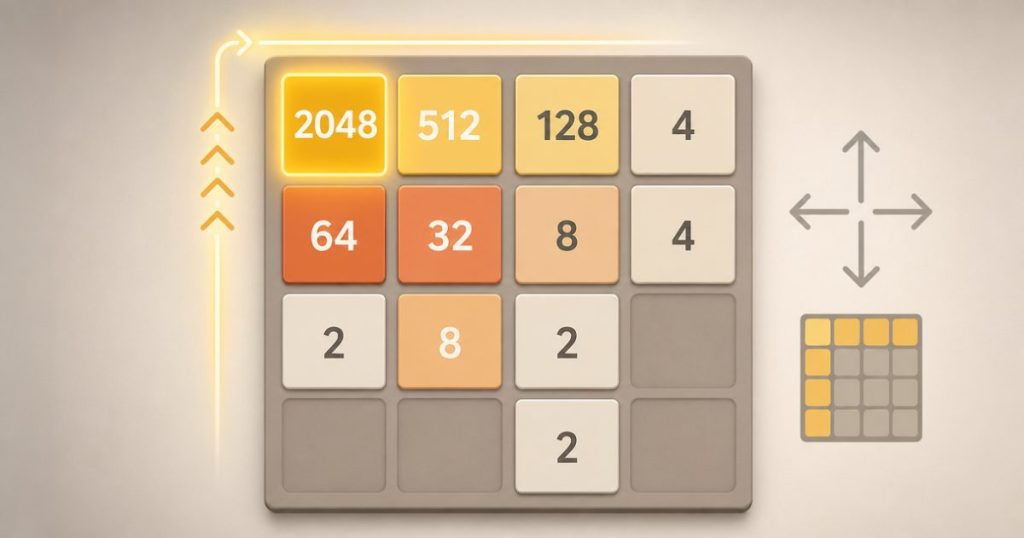
The single most important habit is protecting your largest tile. In most games, that means parking it in one corner and keeping it there as long as possible. Bottom-left and bottom-right are common choices, but consistency matters more than the exact corner.
Once the largest tile is in place, the goal is to keep smaller tiles from drifting above or beside it in a way that blocks future merges. If the biggest tile gets pulled into the middle, the board usually becomes much harder to manage. The clean edge that was organizing everything disappears with it.
Why the corner works
A corner gives your largest tile two walls. That limits the directions it can drift and makes the board easier to read. You know where the key tile should stay, so your attention can go to building the next matching pair instead of rescuing the board after every swipe.
If you want to keep improving, treat that corner as protected space. Do not move your largest tile unless there is a clear reason. One careless swipe can undo several good turns.
Build in one direction, but leave yourself room to escape
Many strong players use a directional habit: they keep sliding in a way that reinforces the same general layout. That creates order. The mistake is turning that habit into a rigid rule, because 2048 still asks for small adjustments when the board changes shape.
The better approach is controlled repetition. You want a default direction that keeps tiles stacking in a predictable way, but you also need enough flexibility to avoid getting trapped. If you only play by habit, the board can fill with high-value tiles that no longer connect.
A practical rule is to protect a few empty cells and keep them near the active side of the board. Those spaces are more than breathing room. They are what let you survive awkward tile spawns and still recover into a workable position.
Empty cells matter more than they look
When the board gets crowded, the game stops giving you clean choices. One extra empty square can decide whether a merge happens now or four moves later. That difference is often what separates a stable board from a dead one.
Good players do not wait until the grid is almost full before caring about space. They protect it continuously. If a move makes the board cleaner but leaves no room to respond, it may still be the wrong move.
Maintain tile order, not just tile value
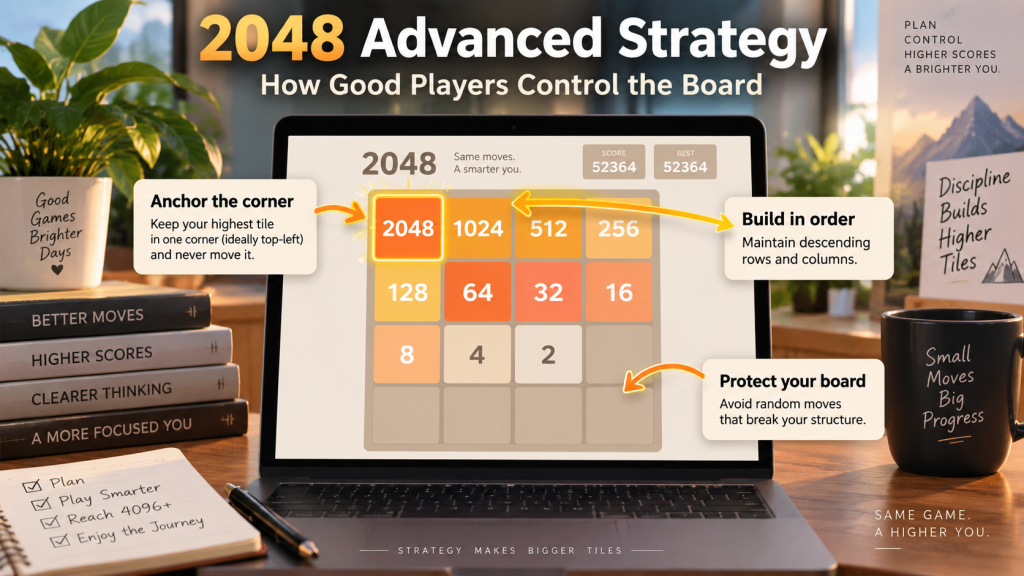
A board with large numbers is not automatically a good board. What matters is whether those numbers are arranged in a way that still allows merging. Two 128s can be more useful than a random 256 if the 256 sits in the wrong place and blocks the rest of the lane.
That is why ordering matters. In a controlled board, tiles usually increase smoothly across a row or column, with the largest tile anchored at one end and smaller tiles arranged behind it. That setup lets you combine lower tiles in sequence without disturbing the whole structure.
When the order breaks, the game gets messy fast. You may still have strong tiles on the board, but they are no longer helping each other.
Think in layers: the largest tile is the anchor, the next largest tiles are support, and the smaller tiles are the material you use to keep the structure alive.
Do not chase every merge immediately
Newer players often merge as soon as they can. That feels efficient, but it is not always correct. Sometimes the better move is the one that delays a merge for one turn so a stronger merge becomes possible right after.
This is one of the biggest shifts in 2048 advanced strategy. You stop asking, “Can I merge now?” and start asking, “Will this merge improve the board or damage it?” If a merge pulls a tile out of your clean order or fills a useful gap too early, it can reduce your options later.
Strong players often accept small inefficiencies in exchange for long-term stability. They would rather keep the board organized than force a merge that creates a dead end.
Use the next two moves, not just the next move
Looking one move ahead is not enough in 2048. A move can seem safe by itself and still create a trap on the following turn. That is why experienced players check the short sequence around a move, not only the immediate result.
Before you swipe, ask what the board will look like after the next spawn and the next decision. If the current move opens a nice merge but leaves no recovery path, it may be a bad trade.
This habit matters even more when the grid is crowded. At that point, the question is rarely “What is the best merge?” It is “Which move leaves me with the most useful board after the next tile appears?”
Common mistakes that break board control
- Moving the largest tile out of the corner without a clear reason.
- Breaking tile order just to force a small merge.
- Filling every empty cell and leaving no recovery room.
- Playing on autopilot instead of checking what the move does to the structure.
- Chasing high-value tiles too early while the lower tiles are still disorganized.
These mistakes are common because they often feel like progress in the moment. The board changes, numbers combine, and the run looks active. But if the layout becomes harder to read, the game is usually moving toward collapse.
A simple control checklist for better runs
If you want a quick way to review your play, use this checklist during a game:
- Is my largest tile still protected in a corner?
- Do I still have enough empty cells to respond to a bad spawn?
- Are my tiles arranged in a usable order?
- Did this move improve the board or just change it?
- If I play one more move, will I still have a safe response?
That is the basic discipline behind better runs on Game 2048. Not a secret pattern, just consistent control of the board state.
When to break your own pattern
Even a good system needs exceptions. Sometimes the board forces you to move away from your preferred direction or sacrifice a smaller merge to avoid losing the run. The key is to make those exceptions deliberately, not by accident.
If breaking your pattern gives you space, restores tile order, or saves the corner anchor, it may be worth it. If it only creates short-term satisfaction, it is probably a mistake. The more advanced you get, the more these trade-offs matter.
That is also why board control keeps paying off. Once you understand the structure, you can adapt to awkward positions instead of relying on lucky tile spawns to solve everything for you.
Frequently Asked Questions
What is the most important 2048 strategy for advanced players?
Protecting your largest tile in a fixed corner is usually the most important habit. It gives the rest of the board a stable structure to build around.
Should I always merge whenever I can?
No. A merge is only useful if it keeps the board organized and leaves room to recover on the next turn.
Is a larger board easier to control?
A larger board gives you more space, but it also changes the rhythm of the game. You still need tile order and a stable anchor if you want to build high tiles efficiently.
Good 2048 play is mostly about restraint. Keep one corner stable, protect your biggest tile, and leave enough empty space for the board to breathe after a bad spawn. If those three things hold, your merges become easier to plan and your runs last longer.
The quickest way to improve is to review each loss by asking where control broke down: corner position, tile order, or empty space. Fixing that weak point usually helps more than trying to memorize a longer sequence of moves.