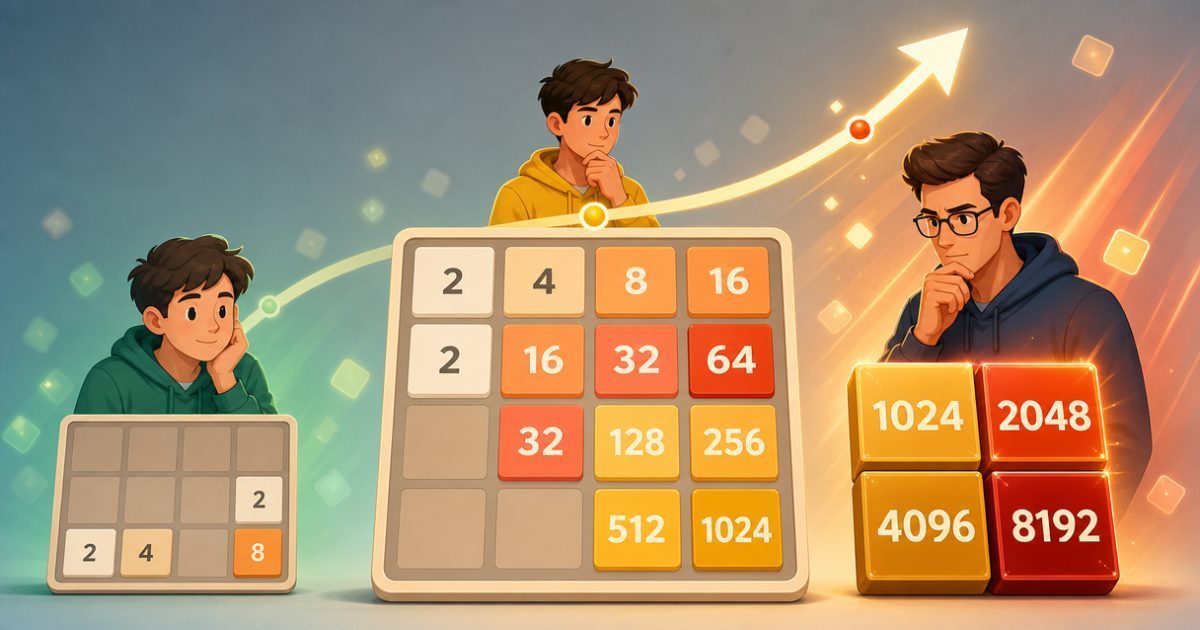
There isn’t one official score that makes someone “good” at 2048. What counts as a good score depends on the board size, the game mode, and how consistently you manage the board. On the classic 4×4 board, though, you can use practical score ranges to judge where you stand.
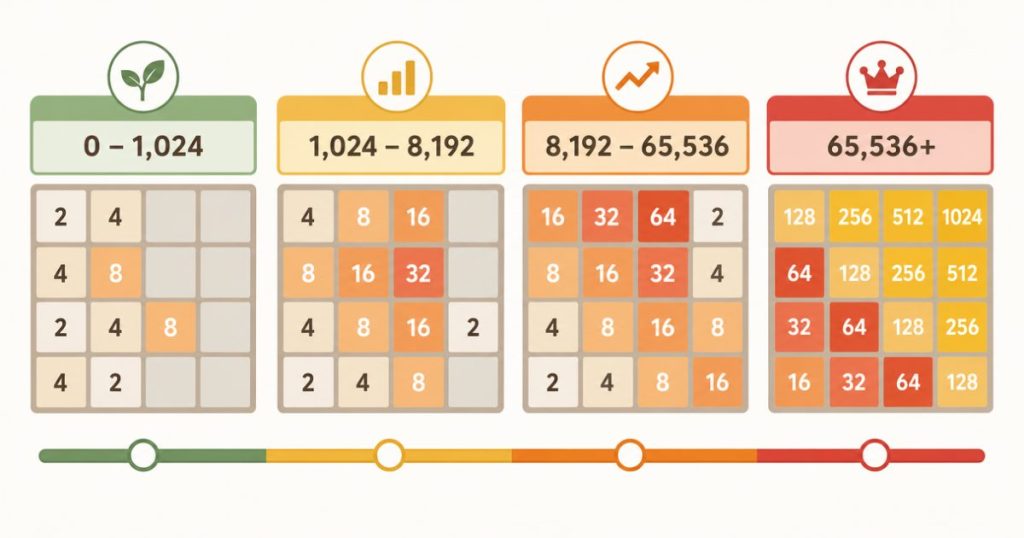
On that standard board, a score around 1,000 to 2,000 is usually beginner territory. Around 2,000 to 5,000 is a solid casual result. Scores from 5,000 to 10,000+ usually reflect strong board control, while 10,000+ is often expert-level for many players.
Practical score ranges on the classic 4×4 board
On the standard 4×4 board, score gives you a useful snapshot of how long and how cleanly you survived. It is not a perfect skill test, but it does offer a reliable benchmark.
| Score range | Typical level | What it usually means |
|---|---|---|
| Under 1,000 | New or inconsistent | You are still learning how to keep the board open and avoid early lockups. |
| 1,000–2,000 | Beginner | You can keep a run going, but merges and tile order are still breaking down often. |
| 2,000–5,000 | Average casual player | You understand the basics and can usually build a decent run, even if it ends before the board is fully controlled. |
| 5,000–10,000 | Advanced | You are keeping the board organized, merging efficiently, and avoiding obvious mistakes for longer stretches. |
| 10,000+ | Expert | You are controlling the board well enough to survive for a long time and build high-value tiles consistently. |
These ranges are not official rules. They are practical benchmarks that help you compare your runs with the typical progress of players on the classic game.
What a strong score says about your 2048 skill
A higher score usually comes from three things: surviving longer, keeping the board organized, and making efficient merges. If you are constantly opening new space, preserving your largest tile in a corner, and avoiding random tile order, your score tends to rise naturally.
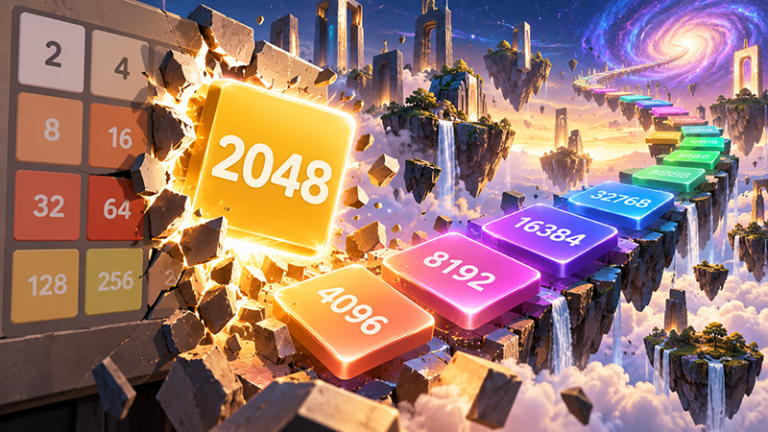
That is why a player can win by reaching 2048 and still have a modest score. Reaching the 2048 tile only means you completed the basic goal. It does not automatically mean the run was especially efficient or controlled. A much stronger run usually keeps going beyond 2048 and adds points through repeated high-value merges.
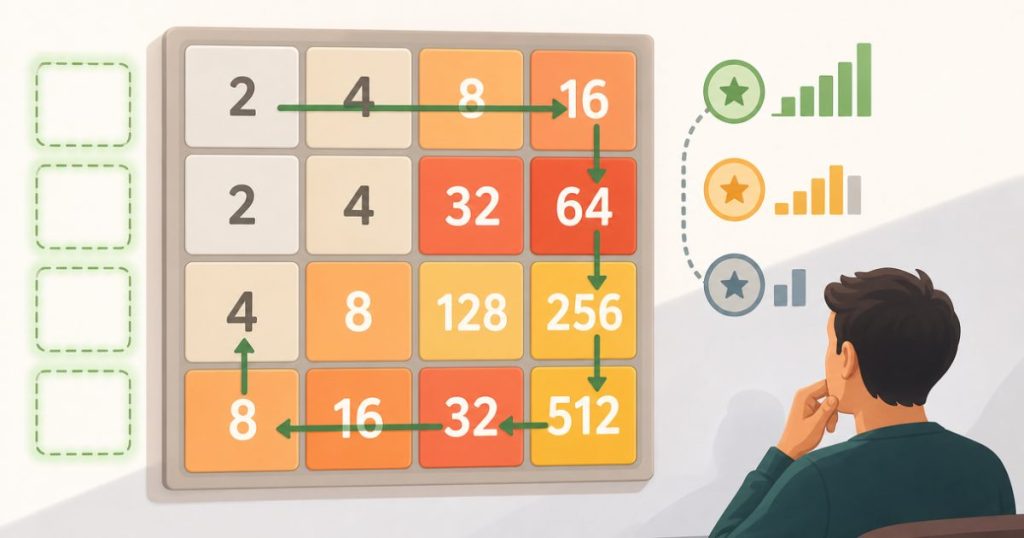
Good players often rely on habits like corner strategy, snake patterns, and avoiding board lockups. Those habits help preserve merge options instead of forcing desperate moves that fill the board too quickly. If you want a deeper look at those habits, 2048 advanced strategy explains the board-control ideas that support higher scores.
Why the same score can mean different things
Score is useful, but it is not the only measure of skill. The highest tile you reached matters too, because a 5,000-point game that ends at 512 is very different from a 5,000-point game that reaches 2048 or 4096. Consistency matters as well. If you occasionally get a lucky run but usually collapse early, your true level is lower than one great score might suggest.
Luck also plays a role. The position of new tiles and whether you get a 2 or a 4 can help or hurt a run. Still, long-term improvement comes more from strategy than luck. Over many games, stronger board management usually beats random play.
How board size and game mode change the benchmark
You should compare scores within the same board size. A score that feels strong on 4×4 may be ordinary on a larger board, because bigger boards create longer games and more merge opportunities. The same is true for different game modes, which can change the pace and the amount of space you have to work with.
That means a “good” score on 5×5, 6×6, or larger boards is not directly comparable to a classic 4×4 result. Larger boards usually allow higher scores because you have more room to organize tiles and keep playing. If you are switching between layouts, use the same board size when you measure progress. A detailed board-size comparison is here: 2048 board sizes compared.
How to judge your own score without overthinking it
A simple way to evaluate your run is to ask three questions:
- Did I beat my usual score range?
- Did I reach a higher max tile than before?
- Did I keep the board organized for longer than I normally do?
If you answered yes to all three, that is real progress even if the score still looks modest. A clean 3,000-point run can be more impressive than a messy 6,000-point run if the lower score shows better control and a higher tile.
For beginners, a good goal is to move from simply reaching 2048 to building repeatable control. Once you can keep your largest tile anchored and avoid board lockups, your scores usually start climbing faster.
Quick ways to move from average to expert-level scores
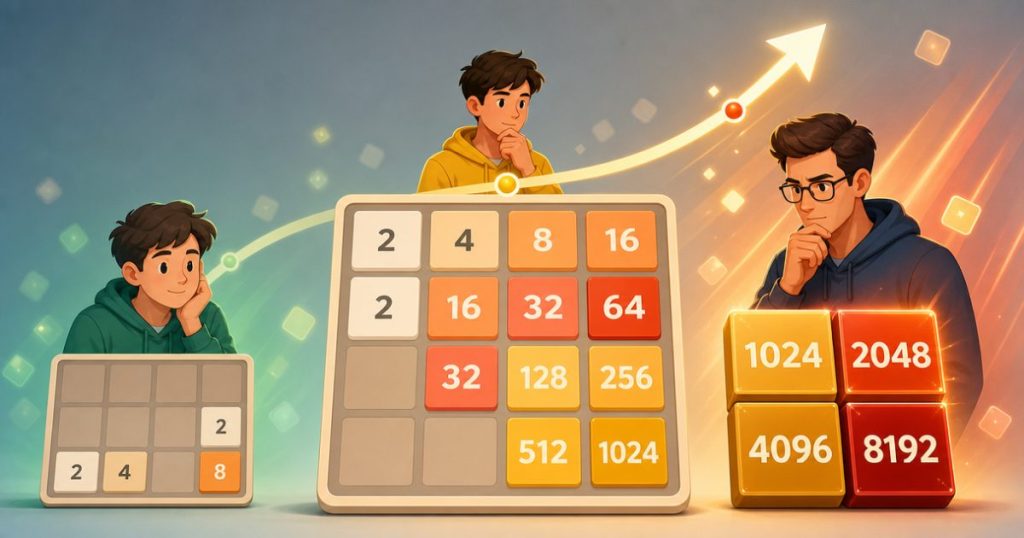
If your scores keep landing in the middle range, the biggest gains usually come from improving board discipline rather than chasing risky merges.
- Keep your largest tile in one corner as long as possible.
- Use a consistent tile order instead of scattering values across the board.
- Leave at least one side of the board flexible so you can recover from bad spawns.
- Avoid moves that pull your biggest tile out of position just for a small merge.
- Focus on smooth, efficient merges instead of forcing every possible merge immediately.
These habits do not guarantee a huge score, but they make high scores much more likely over time. They also help on mobile, where accidental swipes can make board control harder even though the benchmark for a good score stays the same.
What to watch for when a run is going well
A good run usually feels calm rather than frantic. You still have empty cells, your biggest tile stays protected, and most of your merges happen in the same general pattern. When the board starts filling unevenly or your largest tile gets pushed away from its corner, the score often stops rising efficiently.
When a low score still counts as a useful game
Sometimes a low score still teaches you something. If you reached 2048 with a messy board, the run shows you can complete the goal but may need better tile ordering or safer moves. If you lost early with a small score, that often points to a board-management problem rather than bad luck alone.
Frequently Asked Questions
What score is considered good in 2048 for a beginner?
On the classic 4×4 board, anything around 1,000 to 2,000 is a normal beginner range. It shows you can keep a game going, even if the board still breaks down fairly often.
What is an average score on the classic 2048 board?
A score between 2,000 and 5,000 is a solid average result for casual play on the standard 4×4 board.
Is reaching the 2048 tile itself a good score?
It is a major milestone, but it is not the same as scoring well. You can reach 2048 with a modest score, especially if the run ends soon after.
Do larger boards change what counts as a good score?
Yes. Larger boards usually allow longer games and higher scores, so you should compare results only within the same board size or game mode.
The easiest way to judge a 2048 score is to compare it with the board size you played and the control you kept during the run. On the classic 4×4 board, 1,000–2,000 is a beginner result, 2,000–5,000 is solid casual play, 5,000–10,000+ is strong, and 10,000+ is usually expert-level for many players.
If you want a better benchmark, look at score, max tile, and consistency together. A clean run that stays organized is more valuable than one lucky score spike, and that is usually the best sign you are moving from casual play toward stronger 2048 strategy.