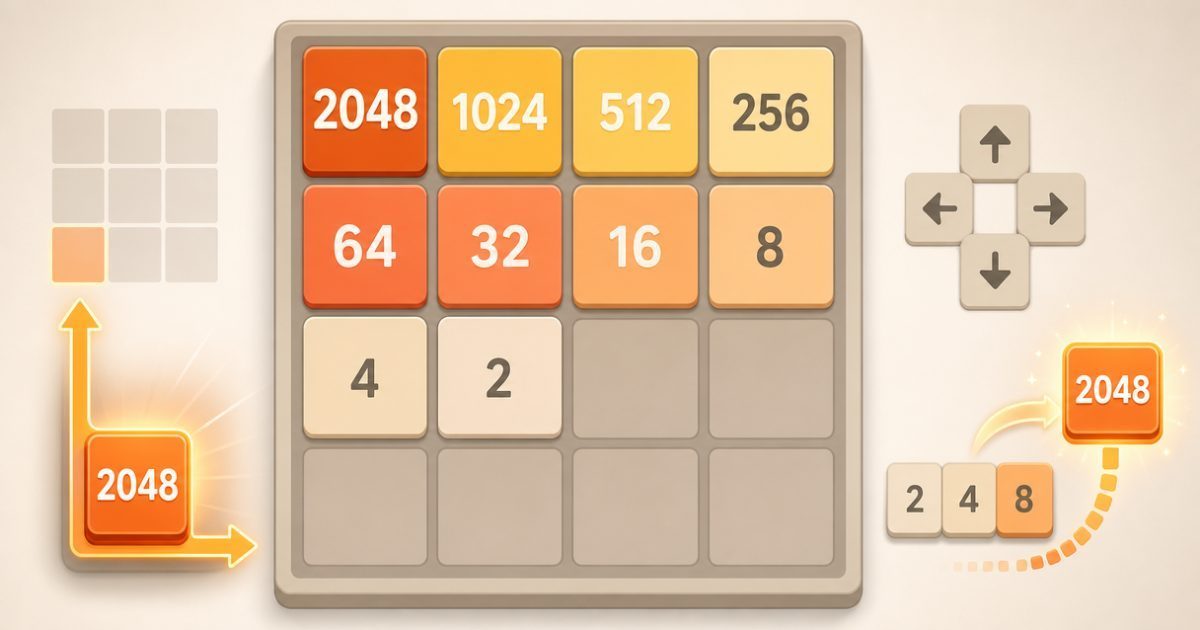
The best way to get a higher 2048 score is to keep the board stable long enough to keep merging. Big scores usually come from long, controlled games, not from taking every merge as soon as it appears.
That creates the main trade-off in 2048: you want points, but you also need space. A merge that breaks your tile order, pulls your largest tile out of the corner, or closes off your escape route can cost you more than it gives back.
Protect the corner before you chase points
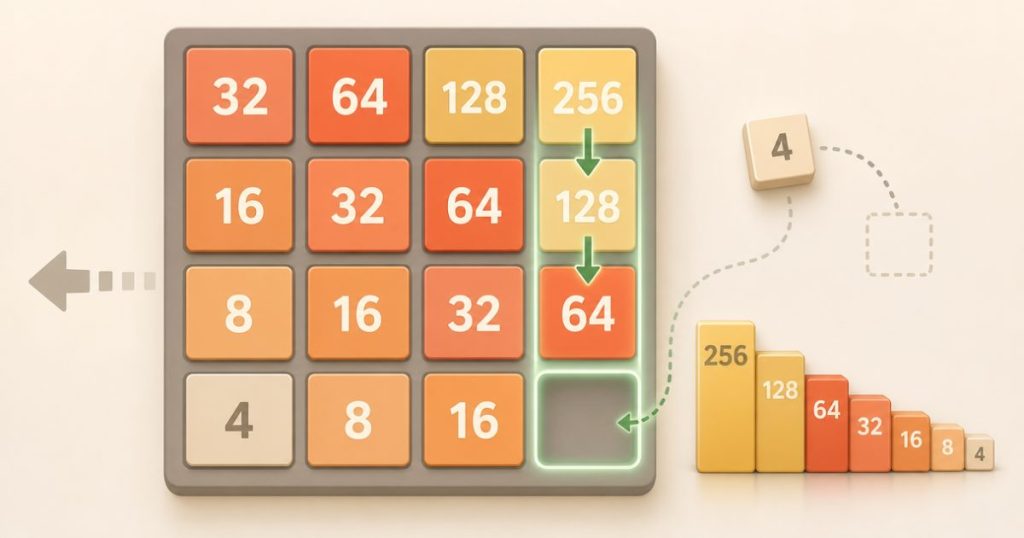
The simplest rule in 2048 is to keep your largest tile anchored in one corner. That corner becomes your base. When your biggest tile stays put, it is easier to build around it, line up smaller tiles, and make clean merges without disturbing the whole board.
A good corner strategy does two things. It protects your strongest position and cuts down the number of moves that can damage your setup. If your largest tile keeps drifting away from the corner, every merge becomes harder to manage.
Many strong runs use a descending or snake-like order, where large tiles sit in a controlled path and smaller tiles feed into them. The exact shape can vary, but the goal is the same: keep values organized and avoid random placement.
Safe merges keep the board healthy
Not every merge is worth taking right away. A safe merge improves your score and still leaves the board in good shape. A risky merge may add points now, but it can create clutter, break your tile order, or block the moves you need next.
A simple way to judge a move is to ask three questions: does it keep your largest tile in place, does it preserve at least one reliable direction of movement, and does it leave your tiles organized? If the answer is yes, the merge is usually safe. If it pushes your structure into the middle of the board, fills your last useful lane, or scatters your high tiles, it is probably risky.
For example, imagine your top-right corner holds your largest tile and the row beneath it is arranged in descending order. If a merge in that area keeps the corner intact, it may be worth taking. If the same merge drags the biggest tile into the center and leaves no clean way back, the score gain is not worth the damage.
Use empty space as insurance
Open cells are not wasted space. They give you room to recover when the game spawns a tile in an awkward spot.
One extra open row or column can be the difference between keeping your plan alive and getting trapped after a bad spawn. When the board still has breathing room, do not rush to fill every gap just because a merge is available.
If you want a deeper look at how board habits affect long-term results, this guide on 2048 advanced strategy explains the control patterns strong players rely on.
Choose between the quick point and the long run
In many positions, the best move is not the one with the biggest immediate score. It is the one that keeps the next three or four moves playable. That is why patience matters in 2048. Waiting one turn for a cleaner merge often creates a better chain later.
Use this simple rule when you are choosing between two options:
- Take the merge now if it preserves your corner, keeps your tile order intact, and leaves room to maneuver.
- Pass on the merge if it pulls your largest tile out of place, blocks an empty lane, or creates a dead end.
Small merges are fine when they protect structure. You do not need to avoid every low-value merge. You just need to avoid merges that solve the current move while damaging the next several.
A consistent movement pattern helps, but only if it stays flexible
Most players do better with a steady movement pattern than with random swipes. A stable pattern makes it easier to keep tiles ordered and lowers the risk of breaking your setup.
At the same time, do not lock yourself into a pattern so tightly that you miss a necessary recovery move. If the board starts to crowd one side, the best move may be the one that restores breathing room, even if it breaks your usual rhythm for a turn.
What to do when the board starts tightening up
When the grid gets crowded, slow down. This is where many good runs fall apart, because the player starts moving faster and swiping out of habit. Tight boards reward careful decisions, not speed.
Focus on creating or preserving one safe lane. If you can keep one row or column open enough to move tiles through it, you have a better chance of surviving awkward spawns and setting up the next merge chain.
When space is low, prefer moves that rebuild order over moves that simply add another merge. Sometimes a small, plain move is the one that saves the game.
How to tell a risky move from a safe one
A risky move usually does at least one of these things:
- It moves your largest tile away from the corner.
- It fills the last open space in a useful lane.
- It mixes high and low tiles together.
- It leaves you with no clear recovery path.
A safe move usually does the opposite. It keeps the biggest tile anchored, preserves empty space, and leaves the board in a state where the next merge still makes sense.
Why long games usually produce higher scores
2048 scoring rewards repeated merging. That means a long, controlled game usually beats a short, aggressive one. You are not trying to win one merge. You are trying to keep creating merge opportunities over time.
That is why random play often produces a decent early score and then falls apart. The player gets a few quick merges, the board gets messy, and the game ends before the score can grow. Controlled play may feel slower, but it keeps the merge chain alive.
If you want a broader view of what affects results, this article on whether 2048 is luck or skill explains why consistency matters so much.
Simple habits that improve score without wrecking structure
- Keep your largest tile in the same corner for as long as possible.
- Prefer merges that preserve empty space.
- Use small merges when they help the board stay ordered.
- Avoid random swipes that scatter your tiles.
- Watch for the move that keeps your next option open, not just the move that scores now.
- Slow down when the board gets crowded.
If you keep the board organized, your score rises naturally. The biggest gains usually come not from forcing one huge merge, but from staying alive long enough to keep collecting safe ones.
Frequently Asked Questions
Should I always keep my biggest tile in one corner?
Yes, for most standard 2048 strategies. Keeping the largest tile anchored makes the board easier to control and reduces the chance of breaking your setup.
Is it better to take small merges or wait for bigger ones?
Take small merges when they preserve structure and keep space open. Waiting is better only if the delay does not put the board at risk.
What counts as a risky move in 2048?
Any move that pulls your largest tile out of position, scatters your order, or closes off important empty space is usually risky.
What should I do when the board is almost full?
Slow down and focus on restoring order. Try to preserve one open lane, avoid random swipes, and choose the move that gives you the most recovery room.
The easiest way to score higher in game 2048 online is to treat board control as part of scoring, not as something separate. Keep your biggest tile anchored, protect empty space, and only take merges that leave the board playable after the move.
If you are unsure what to do in a given position, choose the move that preserves structure. A slightly smaller score now is often what leads to a much bigger score later.
