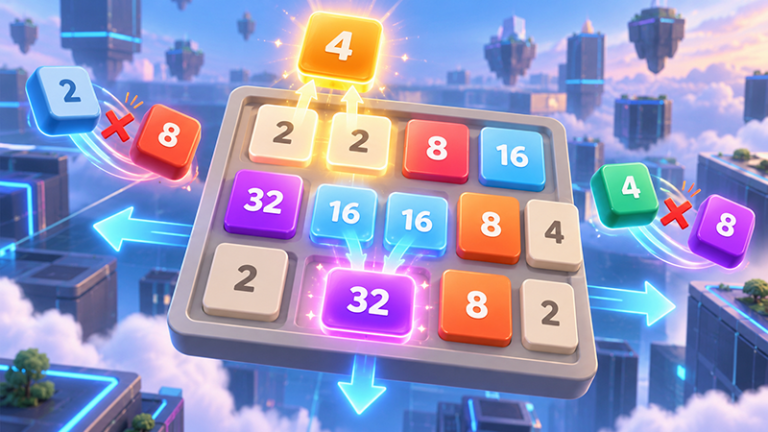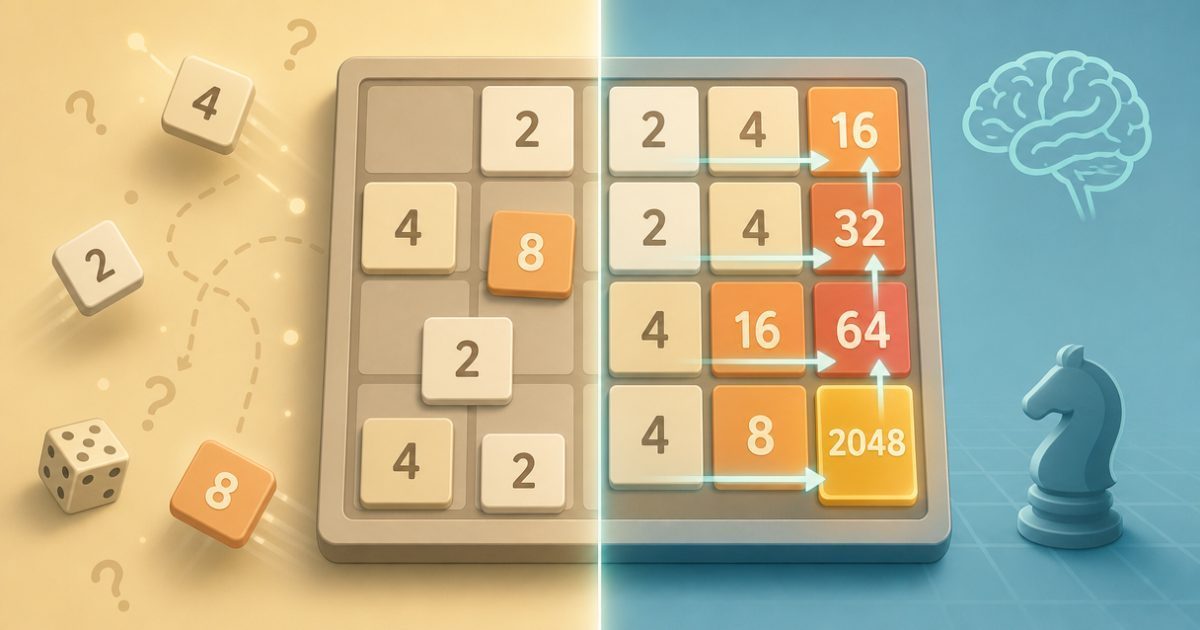
2048 is both luck and skill, but your score is shaped mostly by skill once you understand how the game works. Random tile spawns can help or hurt a run, yet your move choices, board organization, and ability to keep merge options open usually matter more over time.
That is why two players can get the same sequence of tiles and finish with very different results. One keeps the board open and merges cleanly. The other fills the grid with scattered numbers and runs out of moves much sooner.
What luck controls in 2048
Luck in 2048 comes from the tiles the game adds after each move. Most new tiles are 2s, and some are 4s. Their value and position are random, so you never get full control over what appears next.
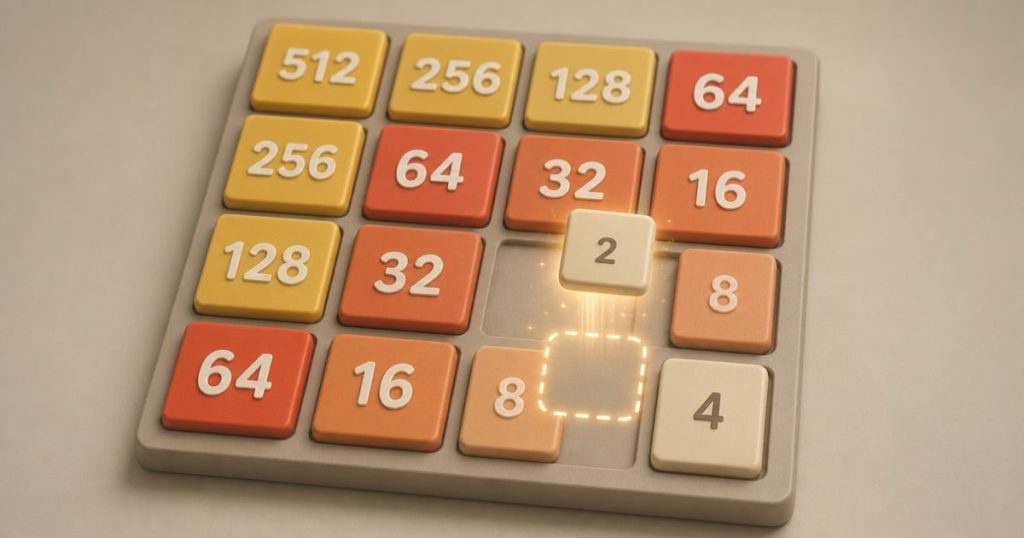
That randomness matters because a helpful tile can create an easy merge, while a bad spawn can block a lane you wanted to keep open. A single awkward 4 is often enough to make a strong board harder to manage.
Luck also becomes more noticeable as the board fills up. Early in a run, there is usually enough space to recover from a bad spawn. Later, when only a few cells are open, one poor placement can force a messy move or end the game outright.
What skill controls in 2048
Skill in 2048 is the part you can influence directly. You choose which direction to move, which tiles to protect, and how to keep the board organized so future merges stay possible.
The strongest players usually do a few things well:
- They keep their largest tile anchored in one corner.
- They avoid moves that break tile order without a good reason.
- They preserve empty spaces so the board can breathe.
- They plan ahead for more than one merge, not just the next move.
That kind of discipline does not remove randomness, but it reduces how much damage a bad spawn can do. If you want a deeper breakdown of those habits, see 2048 advanced strategy.
Why beginner games feel luck-based
At first, game 2048 can feel unfair because beginners often move in ways that scramble the board. When tiles are not organized, a random spawn seems like the main reason the run failed.
But what usually happens is simpler: the board was already fragile. The random tile just exposed the problem. Once you learn to keep structure on the board, the game starts to feel much less dependent on luck.
How skill changes your score even when luck is bad
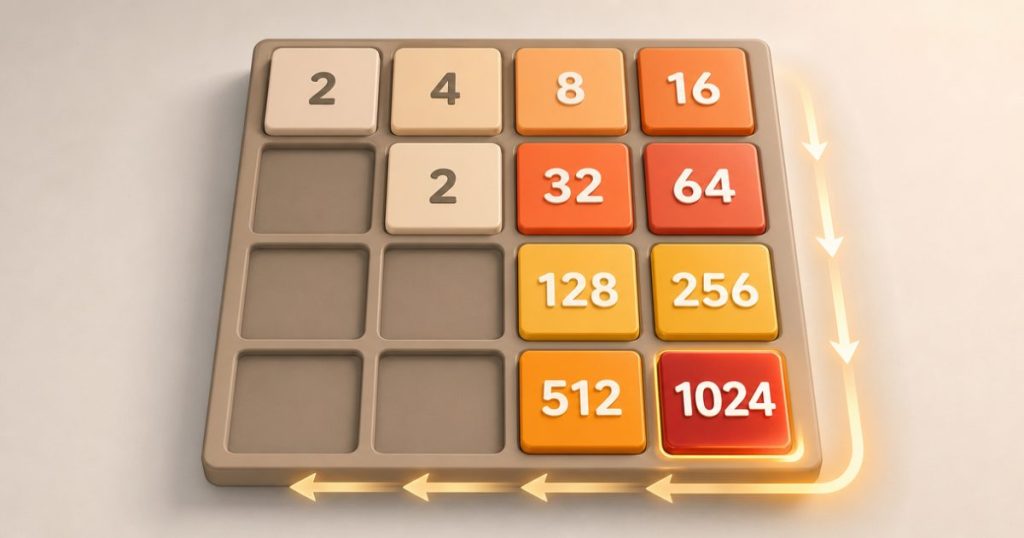
Bad luck does happen. A 4 may appear in a useful spot. Several awkward spawns may arrive in a row. The board may also force you into a choice that is not ideal.
Skilled play does not stop those moments, but it makes them easier to survive. A disciplined board gives you more empty cells, cleaner merge chains, and more options when the game throws you something inconvenient.
That is also why high scores usually come from repeated efficient merges, not from one lucky big merge. A run grows through steady board control, tile order, and enough open space to keep the merge cycle going.
Simple examples of luck and skill working together
Imagine two players get the same random spawn: a 4 appears near the edge of the board.
- Player A already has a tidy corner setup, so the new tile fits without breaking the flow. The board stays stable, and the next few merges are still possible.
- Player B has tiles scattered across the grid, so that same spawn blocks movement and forces a bad shift. The board becomes harder to save from that point.
The random event was identical. The result was not, because the board state and move discipline were different.
Put another way, luck decides the shape of the next problem, but skill decides whether that problem becomes a small inconvenience or the start of a collapse.
Does board size change the balance between luck and skill?
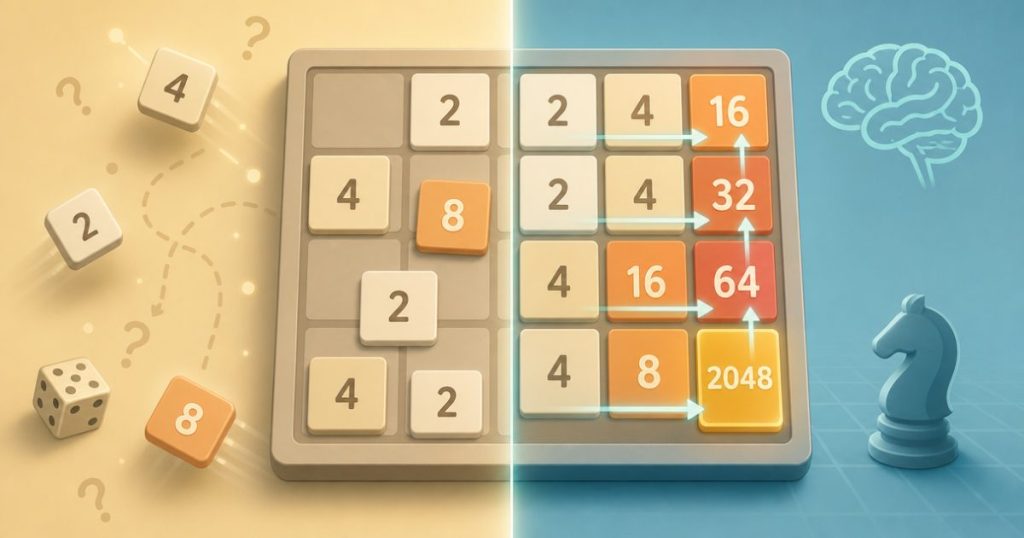
Yes, a little. On the classic 4×4 board, every mistake matters quickly because space disappears fast. That makes the game feel harsher and more random, especially for newer players.
On larger boards, there is more room to recover, so skill can show through more clearly over longer runs. You still have random tile spawns, but you also have more space to organize the board and absorb a bad draw. The basic principles stay the same, though: control the structure, protect empty cells, and avoid chaotic moves.
How to think about improving
If you want better scores, do not try to beat luck. Instead, make luck less important.
- Keep one corner as your main home for the largest tile.
- Do not break your tile order unless it creates a clear merge.
- Leave yourself enough empty spaces to recover from a bad spawn.
- Think about the next two or three moves, not just the next swipe.
That approach will not guarantee a high score, but it will make your runs much more consistent. For beginners, a step-by-step focus on these habits is often the fastest way to improve.
If you also want a practical benchmark for what counts as a solid run, it helps to compare your results with typical score ranges for the classic board. Better strategy will not erase randomness, but it will make your scores much less dependent on it.
Frequently Asked Questions
Can a bad random spawn ruin a good 2048 run?
Yes. A poor spawn can break your structure or block a key lane, especially when the board is already tight. Strong play reduces the damage, but it cannot eliminate randomness.
Why do good players score so much higher in 2048?
They create more empty space, keep tile order under control, and make efficient merges over and over. That lets them survive longer and build score steadily instead of relying on lucky moments.
Is there a strategy that makes 2048 mostly skill-based?
No strategy removes randomness completely, but a disciplined corner-based approach makes skill much more important than luck in practice.
So, is 2048 luck or skill? The fair answer is both, but skill does most of the work over a full game. Random tile spawns create the pressure, while your board control, merge planning, and move discipline decide how well you handle it.
If you want to score higher, focus on the parts you can control: keep the board organized, protect a corner, and preserve space. The game will always have some randomness, but good strategy makes that randomness far less powerful.