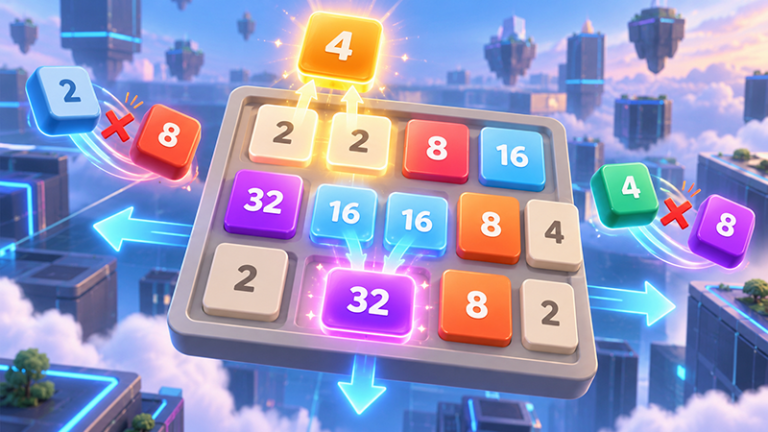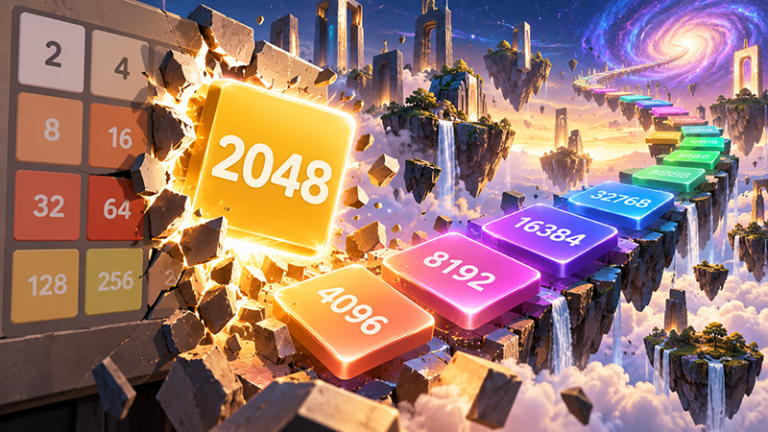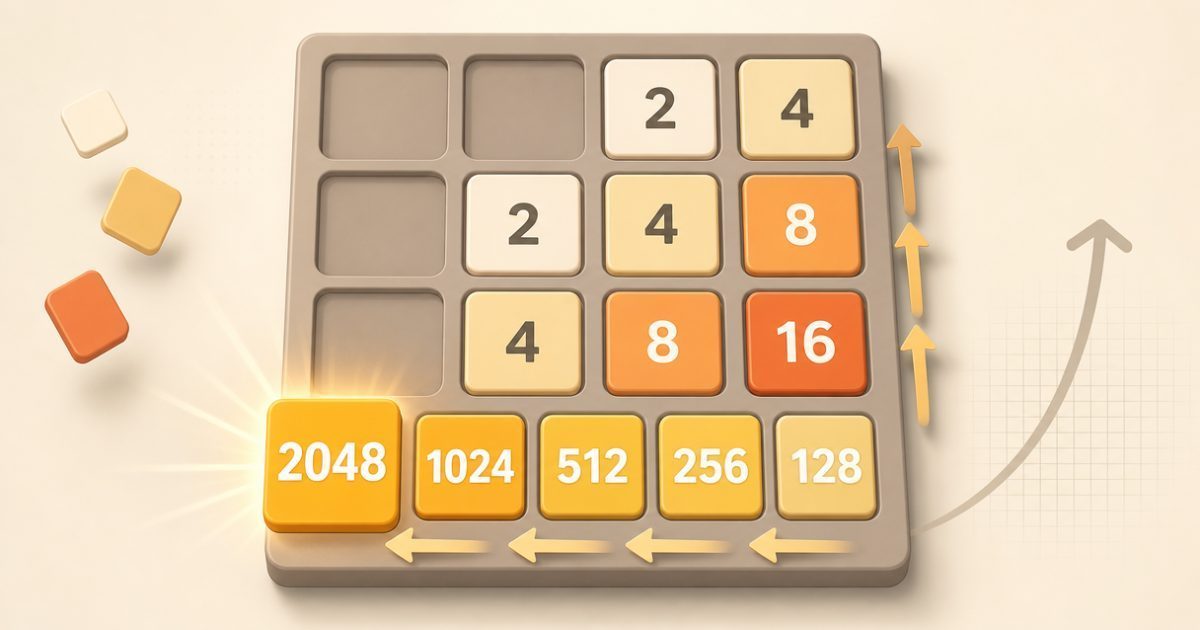
The easiest reliable way to reach the game 2048 tile is to keep your largest tile fixed in one corner, build the rest of the board around it, and use a limited set of moves that preserve that shape. 2048 is mostly a board-management game, not a speed game. If the board stays organized and you leave room for new tiles, you give yourself far more chances to make the right merge.
You do not need a complicated system. You need a stable pattern, enough empty spaces, and the discipline not to pull your highest tile away from its corner.
Why this strategy works
Corner play works because it gives the board a clear order. When your biggest tile stays in one place, you always know where the rest of the values should go. That makes it easier to plan merges and avoid the common mistake of moving the top tile into the middle, where it becomes much harder to protect.
The method is simple, but it is not automatic. New tiles still spawn randomly, so no approach guarantees a win every time. Even so, this strategy makes the game far more manageable and gives you a much better chance of reaching 2048 and building higher scores after that.
Step 1: pick a corner and keep the highest tile there
Choose one corner and treat it as your anchor. Most players use the bottom-left, bottom-right, top-left, or top-right corner and stick with that choice for the whole run. Once the largest tile settles there, your job is to keep it there.
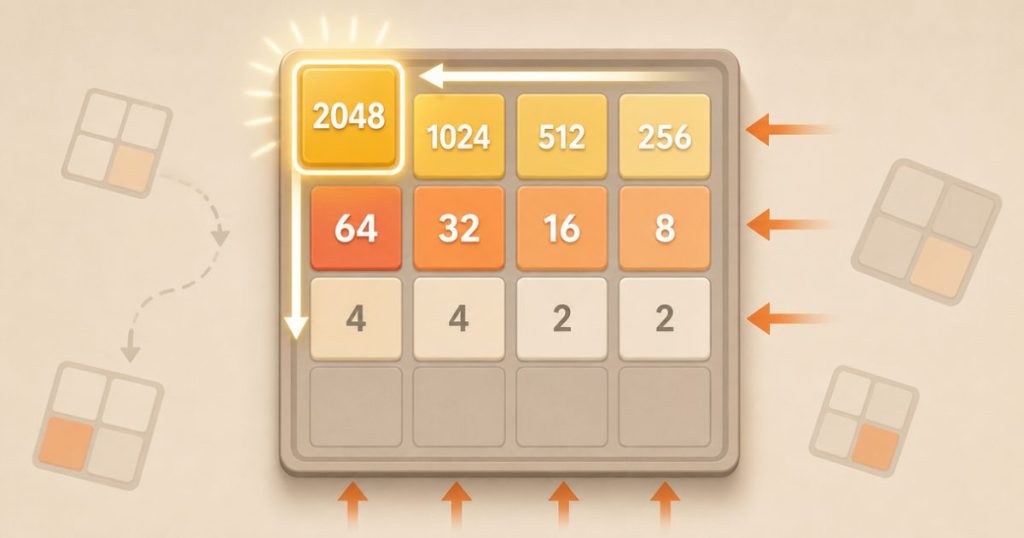
Do not switch corners because one merge looks convenient. That usually breaks the pattern and makes the board harder to read. The rule is even more important after the 1024 tile, when one careless move can undo several minutes of careful setup.
Step 2: build a stable row or column around that corner
After you pick a corner, build a descending line of tiles around it. For example, if your 1024 tile is in the bottom-left corner, you want the tiles next to it to support future merges instead of scattering across the board. Smaller values should feed larger ones, not drift away from the anchor.
The goal is not to merge everything as soon as you can. The goal is to create a chain of values that leads toward the corner. A good merge increases the tile value and keeps the structure intact at the same time.
Step 3: use two main directions
The cleanest way to play is to rely mostly on two directions that support your chosen corner. If your anchor is the bottom-left corner, you will usually use left and down much more than right and up. If your anchor is the top-right corner, you will rely mostly on right and up.
This does not mean you never use the other directions. It means you use them sparingly, only when you need to make space or correct a specific merge. The fewer directions you use, the easier it is to protect the highest tile and keep the board organized.
When to swipe and when to hold back
- Swipe toward your anchor to compress tiles and keep the biggest tile in place.
- Swipe away from your anchor only when you need to open space or set up a merge that will return to the corner.
- Avoid random swipes because they spread tiles across the board and create dead ends.
Step 4: create space before you chase the next merge
Empty spaces are what keep 2048 from locking up. If the board gets too full, you lose flexibility, and even a good tile order can collapse. That is why strong players think about space before they think about the next merge.
If the board feels crowded, open one or two safe spaces near your active side first. Once you have breathing room, you can go back to building toward the corner. This matters most on the classic 4×4 board, where every move has a bigger effect than it would on a larger grid.
A simple recovery pattern when the board starts to clog
- Use your main direction to compress the board toward the anchor.
- Look for a move that creates one open cell without breaking your highest-tile position.
- Only take a secondary merge if it restores space instead of stealing it.
- Return to your main two-direction pattern as soon as the board is stable again.
Good moves vs. bad moves
Here is the basic difference: a good move supports the corner while a bad move breaks it. Imagine a bottom-left setup with the 1024 tile fixed in place, a 512 tile directly above it, and two 256 tiles nearby. A safe move compresses those smaller tiles so the next merge can happen without shifting the 1024 out of the corner.
Now imagine the same board, but you swipe in a way that pulls the 1024 tile out of the corner just to combine two smaller tiles elsewhere. That may look productive for one turn, but it usually makes the next few turns harder. The board becomes less predictable, and empty spaces disappear faster.
A useful rule is this: if a merge gives you value but damages your structure, it is usually the wrong move.
Common mistakes that stop players from reaching 2048
Most failed runs come from the same few habits. The first is moving the highest tile around the board. Once that tile leaves its corner, the setup becomes much harder to maintain. The second is trying to merge every possible pair immediately. That can feel efficient, but it often destroys the order you need later.
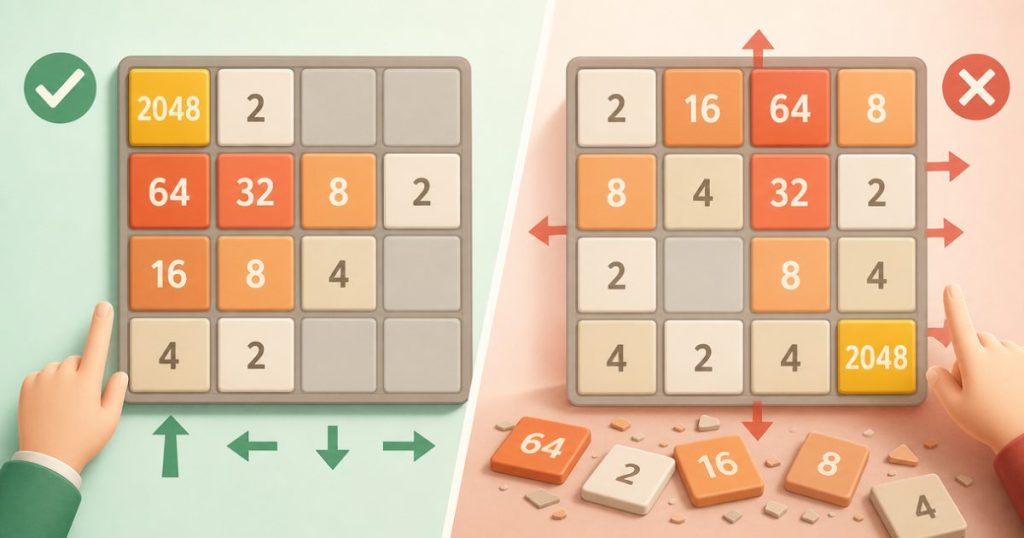
Another common mistake is using all four directions too often. The more directions you use, the easier it is to scatter tiles and trap yourself. A smaller move set is usually safer because it creates repeatable patterns and makes the board easier to manage.
- Breaking the corner structure by swiping in the wrong direction.
- Chasing short-term merges that damage long-term board control.
- Letting the board fill completely before creating new space.
- Switching corners mid-game without a clear recovery plan.
What to do when a tile spawns in the wrong place
A bad spawn does not mean the run is over. The safest response is to use your normal structure-preserving moves and bring the board back into order if you can. Sometimes that means delaying a merge. Sometimes it means making a small move that opens one safe cell instead of chasing a larger merge right away.
If the board is already messy, recovery may be limited. In that case, the main goal is to stop the damage from spreading. Protect the anchor, avoid unnecessary swipes, and look for the move that restores the most space with the least disruption.
Does this strategy still work after 1024?
Yes, and it matters even more after 1024. The closer you get to 2048, the less room you have for mistakes. At that stage, one bad swipe can move your highest tile out of position or block the merge path you were building for several turns.
The same idea still applies: protect the anchor, keep the board ordered, and make space before you need it. Reaching 2048 is usually less about a dramatic final move and more about not ruining the structure you already built.
What to remember if you want a higher score, too
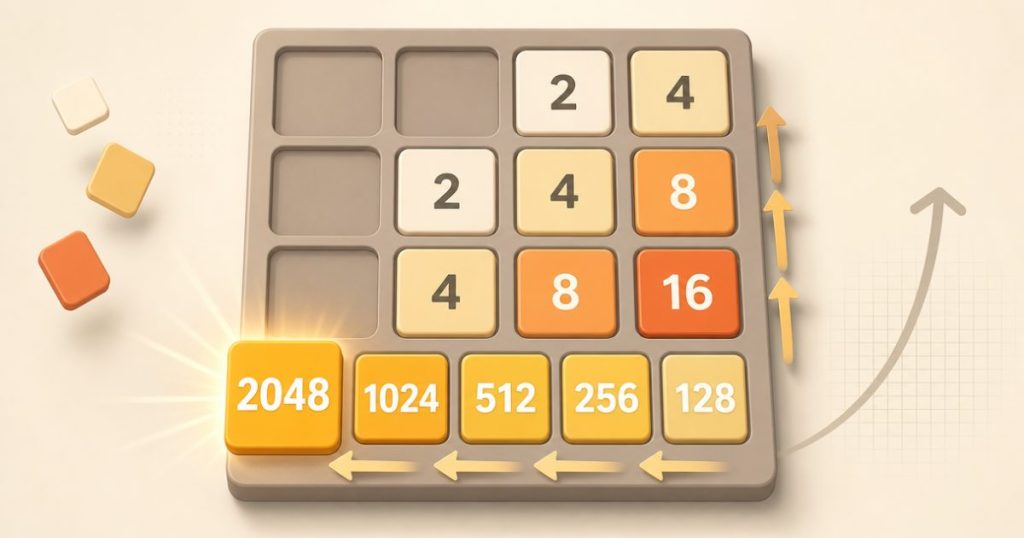
If your goal is not just to reach 2048 but to keep going afterward, the same strategy helps there as well. A stable corner setup gives you more controlled merges, which usually leads to better score accumulation over time. You are not just aiming for one tile; you are keeping the board alive long enough to keep merging efficiently.
That is why this approach works so well for beginners and improving players alike. It is simple enough to follow, but strong enough to support higher scores once you start playing more consistently.
Frequently Asked Questions
Which corner is best for getting the 2048 tile?
Any corner can work as long as you stay consistent. The best choice is the one you can protect most naturally with your preferred move pattern.
What if a new tile appears in the wrong place?
Don’t panic. Use your normal structure-preserving moves to compress the board and bring the new tile back into your pattern if possible.
Is it better to chase merges or keep the structure?
Keep the structure first. A merge that breaks your corner setup often costs you more later than it gains right away.
Does this strategy work on larger boards too?
Yes, but larger boards give you more room and may require more flexibility. This method is strongest on the classic 4×4 board.
If you want the easiest reliable path to the 2048 tile, stop trying to play everywhere at once. Pick one corner, keep your largest tile there, and let the rest of the board serve that structure. The game becomes much easier to control once your moves have a clear job.
You still need a little luck with tile spawns, but good board management gives you the best chance to reach 2048 on the classic 4×4 board. If you can keep empty spaces open and avoid breaking your corner setup, you will give yourself far more winning runs than random swiping ever will.