If you have played 2048 for more than a few minutes, you have probably wondered whether a good run comes from smart decisions or simply getting lucky.
Some games feel almost effortless. New tiles appear exactly where you need them, merges line up naturally, and your board stays open long enough to build 512, 1024, or even 2048.
Other games feel completely different. A 4 appears in an awkward square, your largest tile gets pushed out of position, and suddenly a board that looked safe becomes difficult to manage.
So, is 2048 luck or skill?
The best answer is:
2048 involves both luck and skill, but skill has a much greater effect on long-term results.
Random tile generation can influence any individual game. However, when you compare hundreds or thousands of games, good strategy consistently produces higher scores, longer games, and larger tiles.
To see how large that difference can be, we compared results from a 2,000-game 2048 benchmark: 1,000 games using random legal moves and 1,000 games using a simple strategy focused on board structure, empty spaces, and keeping the largest tile near a corner.
The results make the role of skill much easier to see.
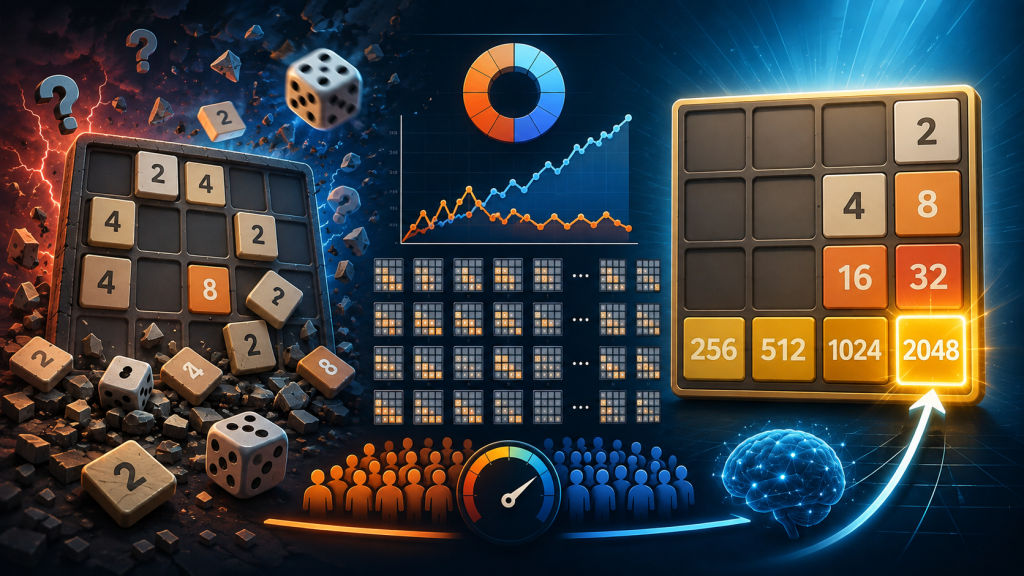
2048 Has Randomness — But It Is Not a Random Game
2048 is played on a 4×4 grid.
After most successful moves, a new tile appears in one of the empty spaces. In the benchmark used for this comparison, new tiles followed the common distribution of:
- 90% chance of a 2
- 10% chance of a 4
You cannot choose where that new tile appears.
You also cannot directly control whether the game gives you a 2 or a 4.
That is where luck enters 2048.
But almost everything that happens before the next tile appears depends on your decisions.
You choose:
- which direction to move;
- which tiles to merge;
- where your largest tile stays;
- how many empty cells remain;
- whether high-value tiles stay organized;
- whether you preserve future moves;
- whether you break or maintain your board structure.
This makes 2048 very different from a game based primarily on chance.
The game gives you random situations.
Your skill determines how well you handle them.
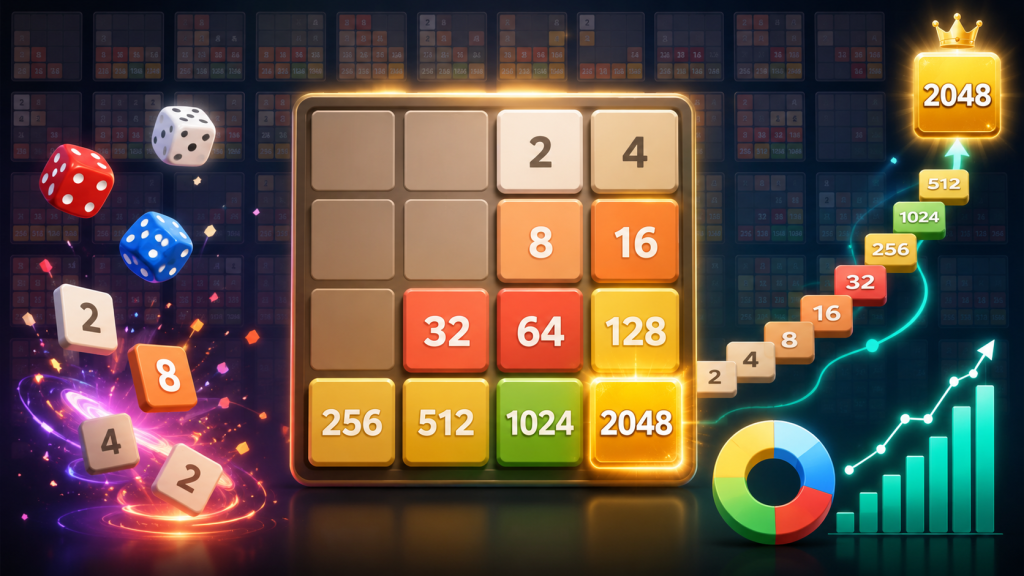
What the 2,000-Game Benchmark Tested
To compare luck and skill more clearly, 2,000 simulated games were divided into two groups.
Group 1: Random Play
The first 1,000 games selected randomly from the legal moves available at each turn.
There was no attempt to:
- protect a corner;
- preserve empty cells;
- organize large tiles;
- plan future merges.
If left, right, up, and down were available, any one of them could be chosen.
Group 2: Strategy-Based Play
The next 1,000 games used a basic strategy.
The strategy favored moves that:
- kept the largest tile close to a preferred corner;
- preserved more empty spaces;
- avoided unnecessary board disruption;
- kept larger tiles grouped together;
- maintained a more stable board structure.
This was not an advanced 2048 AI.
It did not calculate dozens of moves into the future or use a sophisticated search algorithm.
That is important.
The benchmark was designed to answer a practical question:
Can even relatively simple strategy outperform random play consistently?
The answer was yes.
2,000-Game Benchmark Results
| Metric | Random Play | Strategy Play |
|---|---|---|
| Games Played | 1,000 | 1,000 |
| Average Score | 1,111 | 3,027 |
| Median Score | 1,054 | 2,646 |
| Average Moves per Game | 120 | 248 |
| Reached 512 or Higher | 0.1% | 16.5% |
| Reached 1024 or Higher | 0% | 1.3% |
| Highest Tile | 512 | 1024 |
The difference is substantial.
The strategy-based player averaged approximately 3,027 points, compared with only 1,111 points for random play.
That is roughly 2.7 times the average score.
The strategy player also survived for approximately 248 moves per game, more than twice the random player’s average of 120 moves.
The largest difference appeared when looking at high-value tiles.
Random play reached a 512 tile in only 0.1% of games.
Strategy-based play reached at least 512 in 16.5% of games.
And while none of the 1,000 random games reached 1024, the strategy player did so in 1.3% of games.
Luck was present in both groups.
The main difference was how the moves were chosen.
Why Luck Feels More Important Than It Really Is
People tend to remember unusual events.
In 2048, that usually means remembering the frustrating moment when a new 2 appears in the worst possible square.
Suppose you have spent several minutes building a clean bottom row.
Then a new tile appears in the one empty space you wanted to keep open.
It is natural to think:
“I lost because I was unlucky.”
Sometimes that may be partly true.
But the more useful question is:
Why was the board in a position where one bad tile could destroy the game?
Strong 2048 play is largely about creating positions that can tolerate imperfect tile spawns.
If your board has five or six empty cells, one inconvenient tile may be easy to absorb.
If your board has only one empty cell, the same tile can be disastrous.
Skill does not remove randomness.
It reduces how much damage randomness can cause.
Where Luck Actually Matters in 2048
Luck does have a genuine effect on individual games.
There are three main ways it matters.
1. New Tile Position
A tile can appear in any available empty cell.
Sometimes it appears exactly where you wanted to build your next merge.
Other times it appears far away and requires several moves to integrate into the board.
2. Getting a 2 or a 4
Most new tiles are 2s, but occasional 4s can affect your planned sequence.
Depending on the board, a 4 may be useful or inconvenient.
3. Several Bad Spawns in a Row
One awkward spawn is usually manageable.
A sequence of difficult spawns can create much more pressure.
Even a good player can eventually reach a position where every available move has a disadvantage.
So no, 2048 is not completely deterministic.
But short-term randomness and long-term performance are different things.
A player can be unlucky in one game.
It is much harder to blame luck for consistently poor results across 100 games.
Skill Becomes More Obvious Over Many Games
Imagine two players.
One swipes based on whatever merge looks attractive at the moment.
The other follows a basic structure:
- Keep the largest tile near one corner.
- Avoid breaking that corner unless necessary.
- Preserve empty spaces.
- Keep larger tiles ordered.
- Avoid scattering high-value tiles across the board.
In a single game, the first player may occasionally score higher.
That does not mean the strategy is worse.
Randomness can create short-term variation.
Over dozens or hundreds of games, however, stronger decision-making begins to dominate the results.
That is exactly what the 2,000-game comparison shows.
Random play sometimes survives for a while.
Strategy-based play survives longer much more consistently.
You can test this yourself by playing several rounds of 2048 at 2048playgame.com. Instead of comparing only your best score, pay attention to how often you reach 256, 512, 1024, and 2048 while using the same strategy.
Consistency tells you more about skill than one unusually good game.
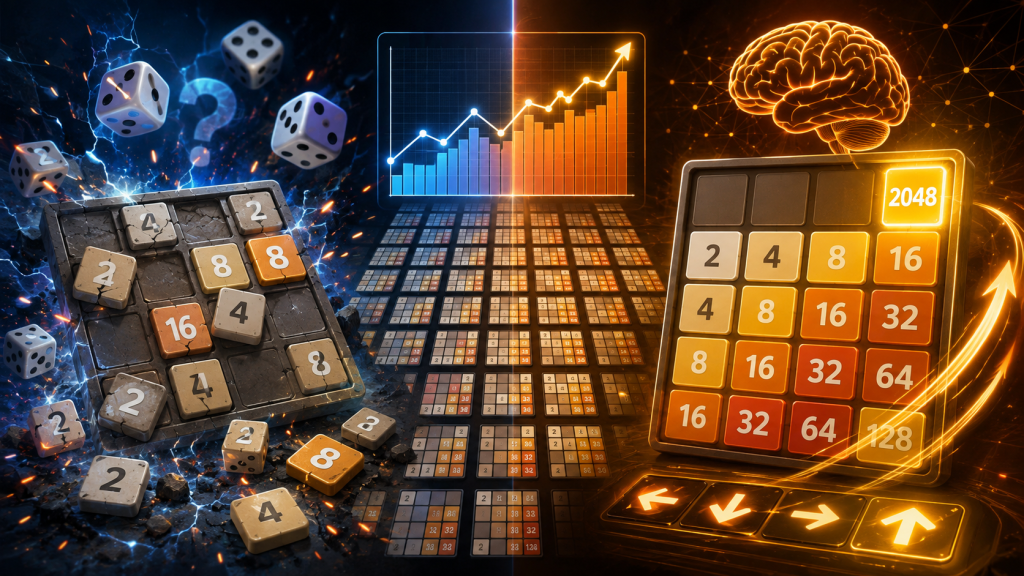
Why Keeping Your Largest Tile in a Corner Works
One of the most common 2048 strategies is keeping the largest tile in a corner.
For example, imagine your preferred corner is the bottom-left.
An ideal bottom row might eventually look something like:
1024 | 512 | 256 | 128
The smaller tiles can then be developed above that row and gradually fed into the sequence.
Why does this help?
Because a corner reduces the number of directions in which your largest tile can move.
This makes the board more predictable.
When the largest tiles remain organized, it becomes easier to create future merges.
Compare that with a board where:
- 512 is in the top-left;
- 256 is near the center;
- another 256 is on the right;
- 128 is trapped underneath smaller tiles.
The total value of the board may look impressive, but converting those tiles into larger numbers becomes difficult.
A strong 2048 board is not simply a board containing large numbers.
It is a board where those numbers are positioned so they can eventually combine.
Empty Spaces May Matter More Than Your Current Score
A common beginner mistake is focusing too much on immediate merges.
Two matching tiles appear.
You see the opportunity.
You merge them immediately.
But the move that creates the most points right now is not always the best move.
In many situations, empty cells are more valuable than an immediate merge.
Empty spaces give you flexibility.
They provide:
- more possible moves;
- more locations for new tiles;
- more ways to reorganize the board;
- greater ability to recover from bad spawns;
- lower risk of reaching game over.
Consider two boards.
Board A contains several high-value tiles but only one empty square.
Board B contains slightly smaller tiles but six empty squares.
Board B may actually be in a much stronger position because it has room to continue developing.
This also explains part of the benchmark result.
The strategy player lasted about twice as many moves as random play.
Those extra moves provide more opportunities to build:
2 → 4 → 8 → 16 → 32 → 64 → 128 → 256 → 512 → 1024 → 2048
Reaching 2048 requires a very long sequence of successful merges.
Keeping the board alive is therefore one of the most important skills in the game.
Good Players Think Beyond the Next Merge
A beginner often asks:
“What can I merge now?”
A stronger player asks:
“What will the board look like after I make this move?”
That is one of the biggest differences between casual and strategic play.
Suppose swiping right creates two merges immediately.
The score goes up.
It feels like a successful move.
But that same swipe may move your largest tile away from its corner and allow a new 2 to spawn behind it.
You gained a few points but damaged the structure of the board.
Good players are willing to delay a merge when necessary.
They evaluate the board several moves ahead rather than automatically taking every available combination.
The more valuable your tiles become, the more important this becomes.
A poorly positioned 16 is easy to fix.
A poorly positioned 1024 may ruin an entire game.
Is Reaching 2048 Mostly Luck?
No.
Luck can make the journey easier or harder, but consistently reaching the 2048 tile requires strategy.
To create one 2048 tile, you ultimately need enough smaller tiles to build:
- two 1024s;
- four 512-equivalents;
- eight 256-equivalents;
- sixteen 128-equivalents;
- and many more lower-value tiles beneath them.
During that process, the game continually adds new tiles to your board.
You must repeatedly create space, organize values, and protect the position of your largest tiles.
A lucky spawn may save one move.
It cannot replace hundreds of good decisions.
This is why a beginner may occasionally reach 512 but struggle to repeat it.
Once players understand board structure and space management, reaching 512 becomes more routine, and 1024 or 2048 becomes a realistic target rather than a rare accident.
Can a Good Player Still Lose Because of Bad Luck?
Yes.
There is no contradiction here.
A skill-based game can still contain randomness.
You can make several good decisions and then receive a difficult sequence of new tiles.
Even experienced players sometimes reach positions that are extremely hard—or impossible—to recover from.
That is why one game should not be used to measure your skill.
A better measure is your performance across many games.
For example:
- How often do you reach 512?
- How often do you reach 1024?
- How long does your board stay playable?
- How often does your largest tile remain in position?
- How many empty cells do you normally preserve?
- Can you recover after an awkward spawn?
If these improve over time, your skill is improving.
How to Make Your 2048 Games Less Dependent on Luck
You cannot control the next tile, but you can create a board that handles randomness better.
Keep Your Largest Tile in One Corner
Choose a preferred corner and avoid moving your largest tile away from it unless there is no reasonable alternative.
Do Not Swipe in All Four Directions Without a Plan
Using every direction freely tends to scatter your largest tiles.
Try to make most moves support the same overall structure.
Keep Large Tiles Close Together
Large tiles on opposite sides of the board may take many moves to reconnect.
Build your larger numbers in an ordered sequence whenever possible.
Protect Empty Cells
Before taking an easy merge, check whether the move improves or reduces your available space.
Avoid Breaking a Stable Row
If you have successfully created a descending row of high-value tiles, protect it.
Breaking the row can be much more costly than delaying a small merge elsewhere.
Think About the Next Spawn
You cannot know exactly where the next tile will appear.
You can, however, notice when a move leaves only one or two extremely dangerous spawn locations.
Practice Consistently
One of the easiest ways to see the difference between luck and skill is to use the same strategy over multiple games.
For example, you can play 2048 online on 2048playgame.com, choose one corner strategy, and track your results over 10 or 20 games.
Do not focus only on your highest score.
Track how consistently you reach larger tiles.
That will show your real progress much more clearly.
Does This Benchmark Prove That 2048 Is Pure Skill?
No.
The benchmark does not show that randomness is irrelevant.
It also does not prove that every possible 2048 game can be won.
What it demonstrates is something more practical:
When randomness stays the same, changing the quality of decisions dramatically changes the results.
Both groups received randomly generated tiles.
Yet the strategy group scored approximately 2.7 times higher and survived more than twice as long.
That strongly suggests that player decisions are a major factor in 2048 performance.
An advanced 2048 solver using deeper search and better evaluation would likely produce stronger results again.
So the game can be summarized as:
Random input + strategic decisions = your result.
You do not control the problem the game gives you.
You do control how you respond.
Final Verdict: Is 2048 Luck or Skill?
2048 is a skill-based puzzle game with a meaningful element of luck.
Random tile placement can help or hurt any individual run.
But the 2,000-game benchmark shows that strategy produces dramatically better results over time.
Compared with random play, the basic strategy player:
- achieved roughly 2.7× the average score;
- survived more than twice as many moves;
- reached 512+ in 16.5% of games instead of 0.1%;
- reached higher-value tiles far more consistently.
So yes, you can lose a game because of an unfortunate tile.
You can also occasionally achieve a surprisingly good score because several tiles appear exactly where you need them.
But those isolated games do not tell the full story.
Over enough games, the player who manages space, protects the largest tile, organizes the board, and plans moves carefully will outperform the player who simply hopes for good spawns.
If you want to find out where your own results fall, try a series of games on 2048playgame.com using the same strategy each time.
Luck may influence your next tile.
Skill determines what you do with it.
Frequently Asked Questions
Is 2048 a game of luck?
2048 contains luck because new tiles appear randomly on available spaces. However, strategy strongly influences how long you survive, how efficiently you merge tiles, and how often you reach high-value tiles.
Does 2048 require skill?
Yes. Successful 2048 play involves board management, tile positioning, space preservation, planning, and understanding when to merge or delay a merge.
Is there a strategy to win 2048?
There is no single strategy that guarantees success in every game, but keeping the largest tile in a corner, maintaining an ordered board, and preserving empty cells can greatly improve your chances.
What is the best corner in 2048?
There is no universally required corner. Bottom-left and bottom-right are both popular. The important part is choosing one corner and maintaining a consistent structure around it.
Can you reach 2048 by moving randomly?
It may theoretically happen under extremely favorable circumstances, but the benchmark shows that random play performs dramatically worse than structured strategy. Random moves are not a reliable way to reach 2048.
Why do I keep losing at 512 in 2048?
Players often struggle around 512 because the board becomes more crowded and positioning mistakes become harder to repair. Focus on preserving empty cells, keeping your largest tiles together, and avoiding moves that break your main row.
Is 2048 always solvable?
Because new tiles appear randomly, not every game state offers the same difficulty. Skill can greatly improve your odds, but randomness means that unfavorable situations can still occur.
How can I tell if I am getting better at 2048?
Do not measure progress only by your single highest score. Track how consistently you reach 256, 512, 1024, and 2048, how long your games last, and how often you maintain a stable board structure.