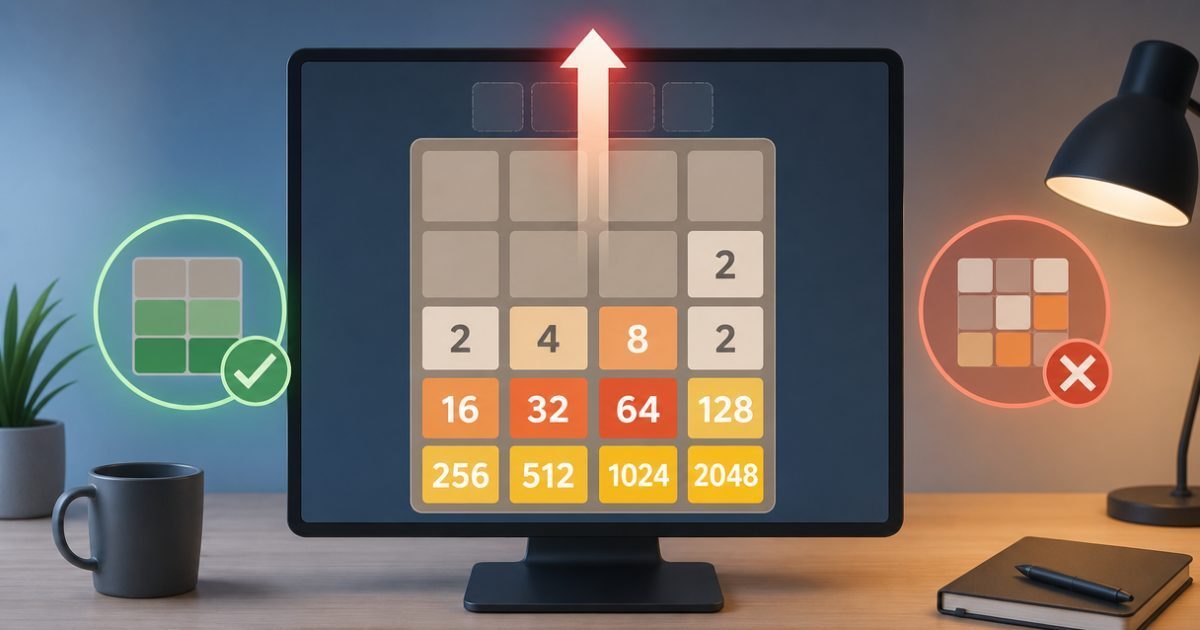
Yes, but only in limited situations. In most 2048 strategies, swiping up is risky because it can break the tile order that strong players depend on. If your largest tile is anchored in a corner and the rest of the board is arranged to feed into that corner, an up swipe can pull tiles out of place and make the next few moves harder.
That’s why some players call it the “forbidden move.” It’s not actually banned, and it’s not always wrong. The real question is whether the swipe up preserves your board, creates a useful merge, or leaves you with a position that’s harder to recover from.
What players mean by the “forbidden move”
The phrase usually refers to a move that goes against a corner-based 2048 strategy. On a standard 4×4 board, many players keep their highest tile locked in one corner and build the rest of the tiles so they flow toward that corner in a predictable pattern. That structure helps you avoid messy boards and gives you a better chance of making safe merges.
Swiping up can feel forbidden because it often interferes with that structure. If your board is organized in rows from largest to smallest, or from one side to the other, an upward swipe may pull tiles into new rows and break the pattern you worked to create. Once that order is gone, it’s harder to recover cleanly.
Why the up swipe is usually dangerous
The biggest reason is corner control. A strong 2048 setup depends on keeping the largest tile in the same corner for as long as possible. That corner acts like an anchor and gives the rest of the board a place to organize around.
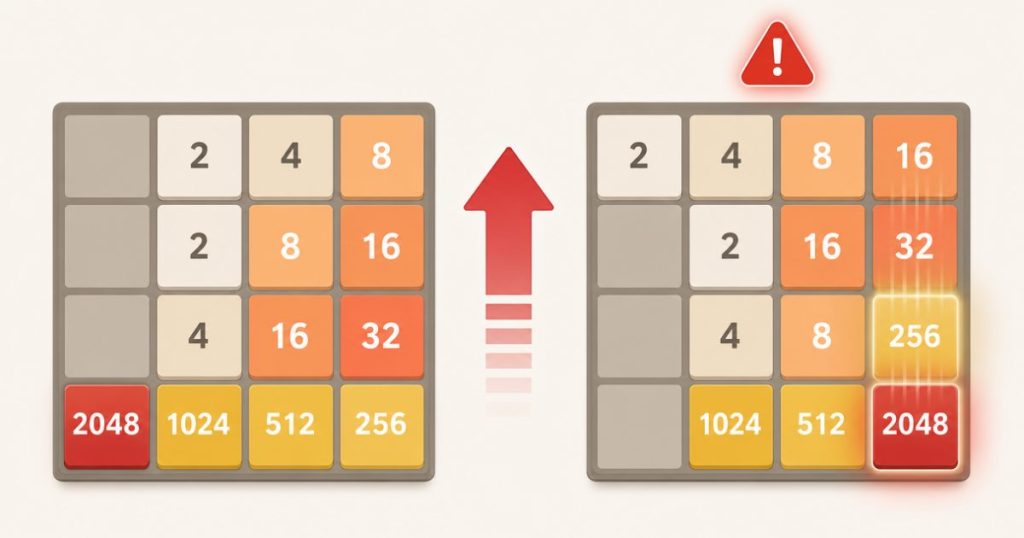
An up swipe can weaken that anchor in a few ways:
- It can move important tiles out of the corner lane.
- It can separate matching tiles that were close to merging.
- It can create a new top-row arrangement that is harder to manage.
- It can reduce the number of empty spaces where future tiles might land safely.
The danger is that the damage may not show up right away. The board can look fine after the swipe, but a few turns later you may realize that your clean structure is gone and your largest tile no longer has a protected path.
That’s why experienced players don’t judge moves by the next merge alone. They look at how the whole board will behave after the move, especially where the largest tile will end up and whether the remaining tiles still form a useful order.
A simple rule for deciding whether to swipe up
Use this rule: swipe up only if it either helps preserve your structure or is the least damaging move available. If it breaks your corner setup without creating a clear benefit, avoid it.
That becomes easier to apply if you ask three quick questions before moving:
- Will my largest tile stay anchored? If the answer is no, the move is probably bad unless you are already in a recovery situation.
- Will this swipe create or preserve empty spaces? If the board gets tighter and more crowded, you’re taking on more risk.
- Does the move create a real merge chain? A chain that clears space is often worth more than a move that only reshuffles the board.
If the answer to all three is negative, keep your hands off the up arrow.
When swiping up is the right move
There are several board states where swiping up makes sense. The first is when the move creates a merge you need without ruining your anchor. If two tiles in a column are ready to combine and the largest tile still stays protected, the move can be both efficient and safe.
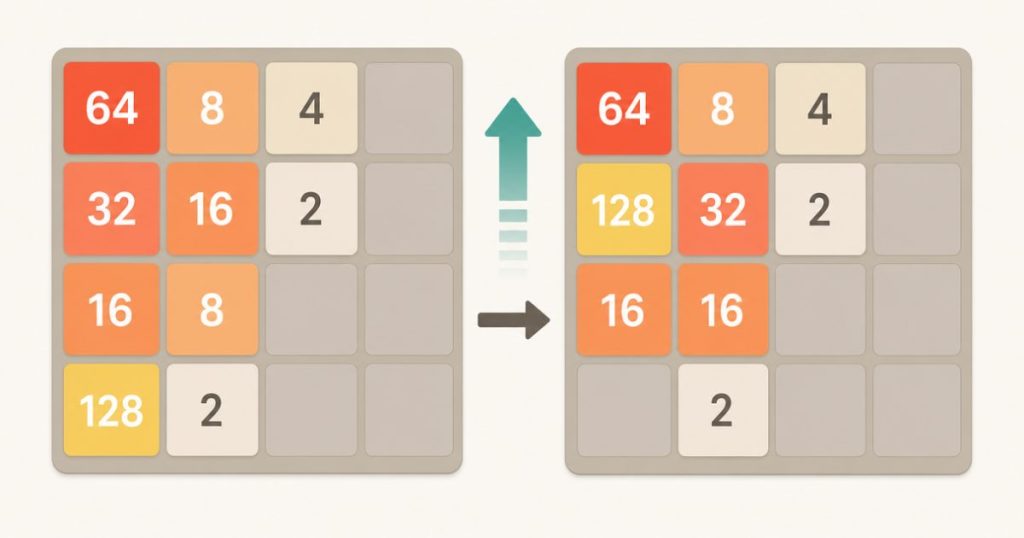
It can also be the right choice when the board has become crowded and you need a recovery move. In 2048, a recovery move isn’t always elegant. It’s the move that buys you breathing room. If every horizontal move would trap the board faster, an up swipe may be the least bad option.
Another useful case is when the move opens a lane for future play. Sometimes an upward move shifts smaller tiles into a better order and clears an empty space near the bottom or middle of the board. If that new space helps you keep the game alive, the move may be worth it even if it isn’t your preferred style.
For players on larger boards, this judgment can be a little more flexible. A 5×5 or 6×6 board has more room to absorb a risky move than a tight 4×4 grid. Even so, the same principle applies: the move should improve board control, not just create motion.
A good up-swipe example
Imagine your highest tile is safely in the bottom-right corner. Above it, you have a column with two matching smaller tiles and one empty space that lets them combine cleanly. If swiping up merges those tiles while the bottom-right corner still stays protected, the move improves the board without breaking your structure.
In that case, the up swipe is doing real work. It clears space, keeps the corner intact, and supports a stable next turn.
A bad up-swipe example
Now imagine your largest tile is still in the corner, but the row above it is part of a carefully ordered chain. An up swipe pulls one of your mid-value tiles into the wrong column, separates a useful pair, and leaves the top row messy. You may not lose immediately, but you’ve made future merges harder and reduced your control over the board.
That’s the classic mistake. The move may look harmless because nothing dramatic happens on the spot. The real cost is that the board is no longer easy to read or manage.
How swiping up breaks tile order
Tile ordering matters because it gives the board structure. Strong players usually want tiles arranged so the biggest values stay near one corner, with smaller tiles feeding toward them in a predictable line. That way, each move has a purpose and the board stays readable.
An upward swipe can scramble that order by changing which tiles share a row or column. Once tiles are pulled into new positions, you may lose the simple pattern that made the board manageable. That can lead to accidental merges in the wrong place, blocked corners, and fewer safe follow-up moves.
This is also why many players avoid random directional changes. If you move left, right, and up without a plan, the board tends to lose its shape. 2048 rewards consistency more than improvisation.
What to do instead when you want to keep the board stable
If your goal is to preserve control, stay with the moves that protect your corner and maintain a predictable layout. On most boards, that means using one or two preferred directions as your base and treating the other directions as exceptions.
Useful habits include:
- Keep the largest tile in the same corner as long as possible.
- Prefer moves that preserve a clean row or column structure.
- Make merges that open space instead of moves that simply reshuffle tiles.
- Think one move ahead so you know where the next spawn might hurt you.
If you want a deeper refresher on those habits, these beginner 2048 rules are a good starting point for board control and corner play.
When the board gets messy, don’t panic and start swiping in every direction. Look for the move that restores structure first. Often that is a horizontal move, a merge that clears room, or a safe setup move that prepares your next turn.
What if every other move is worse?
That’s when the up swipe becomes a survival move. If left, right, and down all either destroy your setup or create an immediate dead end, swiping up may be the only move that keeps the game alive. In that situation, the question is not whether the move is ideal. It’s whether it gives you one more chance to recover.
The key is to recognize the difference between a planned up swipe and a rescue swipe. A planned up swipe is chosen because it creates value without harming control. A rescue swipe is chosen because the board is already in trouble and you need the least damaging option.
If you find yourself in rescue mode often, the real fix is earlier in the game. That usually means you let the board get too unstable before making a decision. Better empty-space management and steadier tile ordering reduce the need for risky upward moves.
How to recover after an accidental up swipe
If you swipe up by mistake and the board shifts in a bad way, don’t try to fix it with more random moves. That usually makes the position worse. Instead, pause and re-read the board shape.
Look for the new corner anchor, identify the longest clean row or column, and choose the move that protects that structure. The goal is not to undo the mistake instantly. The goal is to stop the damage from spreading.
In practice, recovery often means:
- rebuilding a corner anchor with the largest tile you still control,
- protecting whatever ordered row or column remains,
- creating at least one open cell before attempting more merges,
- avoiding the urge to chase a single tile if it breaks the board again.
Some games can still be saved after a bad up swipe. The board may be messy, but if you regain empty space and restore a simple pattern, you can keep playing longer than you expect.
The real rule behind the forbidden move
The up swipe isn’t forbidden because it is always wrong. It’s risky because it can undo the board structure that makes 2048 manageable. When it preserves corner control, supports a needed merge, or acts as a smart recovery move, it can be the right call.
So the practical rule is simple: don’t swipe up just because it’s available. Swipe up only when the board state says it is safe, useful, or necessary. That one habit will do more for your consistency than trying to memorize a rigid list of “never” moves.
Frequently Asked Questions
Why do experienced 2048 players avoid swiping up so often?
Because it can break corner control and tile ordering, which makes the board harder to manage on later turns.
Can swiping up ever improve your position?
Yes. It can be useful if it creates a needed merge, opens space, or is the least damaging recovery move available.
How do I know if an up swipe will ruin my setup?
Check whether your largest tile stays anchored, whether the board gains or loses space, and whether the move preserves a clean row or column structure.
What should I do if every other move is worse?
Use the up swipe only as a survival move, then focus on restoring empty space and rebuilding a simple board structure on the next turns.
If you want stronger game 2048 online runs, treat the up swipe as a decision, not a habit. The best players don’t avoid it blindly. They use it only when it keeps the board organized, protects the corner, or solves a problem that other moves can’t fix.
When you’re unsure, check three things before moving: your largest tile’s position, the amount of empty space left, and whether the swipe creates a real merge. If it hurts all three, skip it. If it helps at least one without damaging the others, it may be the move that keeps your game alive.
