When the 2048 play game board is almost full, the goal changes. You are no longer trying to build the cleanest long-term setup. You are trying to survive the next move, then the one after that. The best endgame decisions create space without breaking the corner and tile order that kept the run alive.
The basic rule is simple: choose the move that gives you immediate breathing room while keeping your largest tile anchored. If a swipe opens a lane, creates a merge, or protects a clean side of the board, it is usually better than a flashy move that leaves you trapped on the next turn.
What changes in the 2048 endgame
The endgame starts when only a few empty tiles remain and every swipe matters. Early in a run, you can think about setup. In the crowded late game, setup only matters if it helps you survive the next two or three moves.
That shifts the priorities:
- Space comes first. If a move creates an empty tile or opens a lane, it has real value.
- Structure comes second. You still want your largest tile in a corner and your tiles in a predictable order.
- Greed comes last. A bigger merge is not worth it if it destroys your board pattern and leads to game over.
With one or two empty spaces left, a single bad swipe can collapse the whole position. With three or four empty spaces, you still have some room to choose between safer and more aggressive moves. The fewer empty tiles you have, the more important it becomes to preserve the board’s shape.
How to choose the safest move on a crowded board
When several merges are possible, pick the move that improves both space and stability. A safe endgame move usually does at least one of these things:
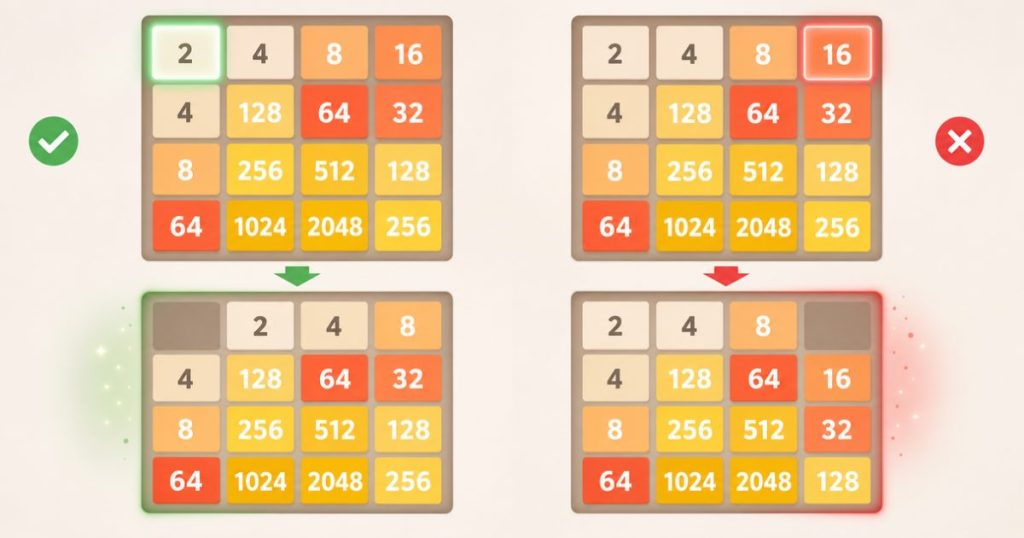
- creates an immediate merge without scattering your biggest tiles
- keeps your largest tile in the same corner
- preserves one relatively clean row or column
- opens a lane you can use on the next turn
If two moves look similar, choose the one that leaves the board easier to read. A clear row or column gives you more control than a messy board with the same number of empty spaces.
It also helps to think two moves ahead. Ask not only, “What does this swipe do now?” but also, “What will I be able to do after the next spawn?” That small check often separates a safe recovery from an immediate trap.
Safe merge vs. risky merge
Suppose you can make a small merge that keeps your corner intact, or a bigger merge that pulls your tiles out of order. The safer merge is usually the right choice if the board is cramped. On a crowded board, preserving control matters more than taking the largest possible points on this turn.
A risky merge only makes sense if it clearly opens space or restores a stable pattern. If it just looks impressive, it is probably not helping.
Why your largest tile still needs a corner
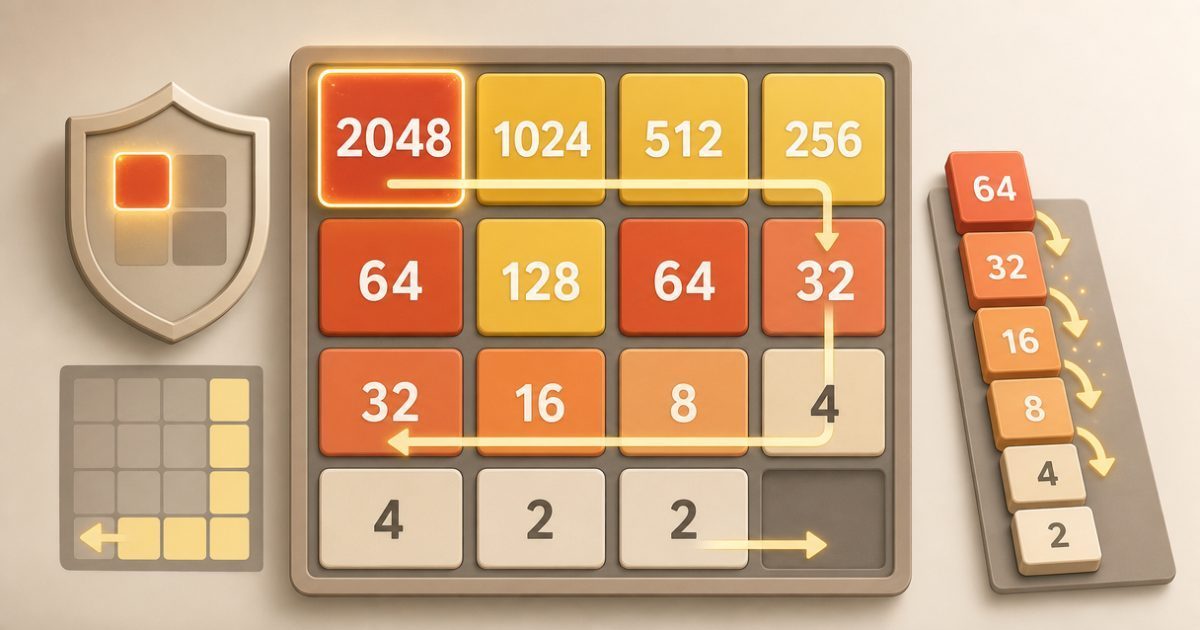
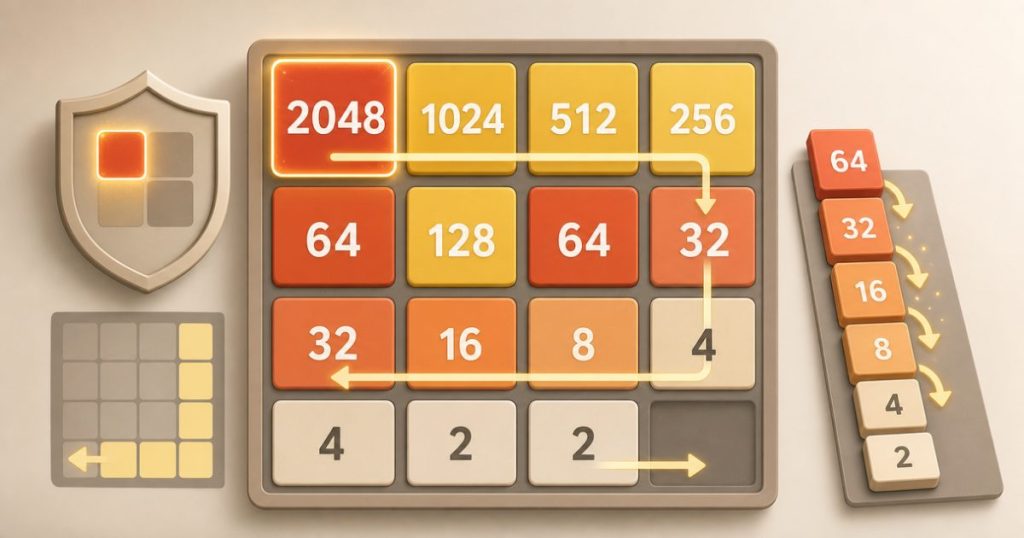
Even in panic mode, the largest tile should usually stay anchored in one corner if possible. That corner gives the rest of the board a fixed reference point. Without it, your tiles drift in different directions, and the board becomes harder to manage on the very next move.
A stable corner also helps preserve a clean tile chain. If your biggest tiles stay ordered along one edge, you can sometimes recover from a bad position by forcing merges back into that structure. If the order breaks, you often lose the ability to plan at all.
This is why repeated random swipes are so dangerous. They may create one temporary opening, but they often push the largest tile out of position or scatter the chain that was holding the board together.
One clean side is better than a messy board
If you can keep one row or one column relatively clean, do it. That clean edge acts like a lane. It gives you room to move tiles in a predictable direction and reduces the chance that the board locks up completely.
In practice, that means you should protect the side that supports your corner strategy. If your largest tile lives in the lower-right corner, for example, you usually want the rest of the board organized so the final row and final column still work together.
What to do when no obvious merge is available
Sometimes the board gives you no perfect move. In that case, you need the least bad move, not the most exciting one. Your options are usually one of three things:
- Force a merge. Take a small merge if it creates room and keeps the structure usable.
- Open a lane. Move in a direction that clears a row or column, even if the merge value is small.
- Accept a minor sacrifice. Give up a little board neatness if it prevents immediate collapse.
This is where endgame play becomes practical. A small merge that buys one more move is often worth more than waiting for a better one that never arrives. If the board is close to full, space itself is the resource you are spending.
One useful rule: if your move creates no merge and does not improve the board’s shape, it is probably bad. In a crowded position, empty moves waste one of your few chances to recover.
How to survive with only one or two empty tiles
With one or two empty spaces left, every spawn matters. Narrow your decision to the move that protects your escape lane and avoids sealing off your largest tile corner. At that point, it is often better to take a modest merge than to chase a perfect one.
If the board still has a lane, try to keep it open by moving tiles back into the same general pattern. If the lane disappears, the board can become impossible to control in just one or two turns. That is why the last few moves are about consistency, not creativity.
When the position feels fragile, avoid swiping in directions that bounce tiles around without improving the layout. A tiny gain in score is not worth losing the only route that still keeps the board alive.
How to tell whether a board is still recoverable
A crowded board is usually recoverable if you can still do at least one of these things:
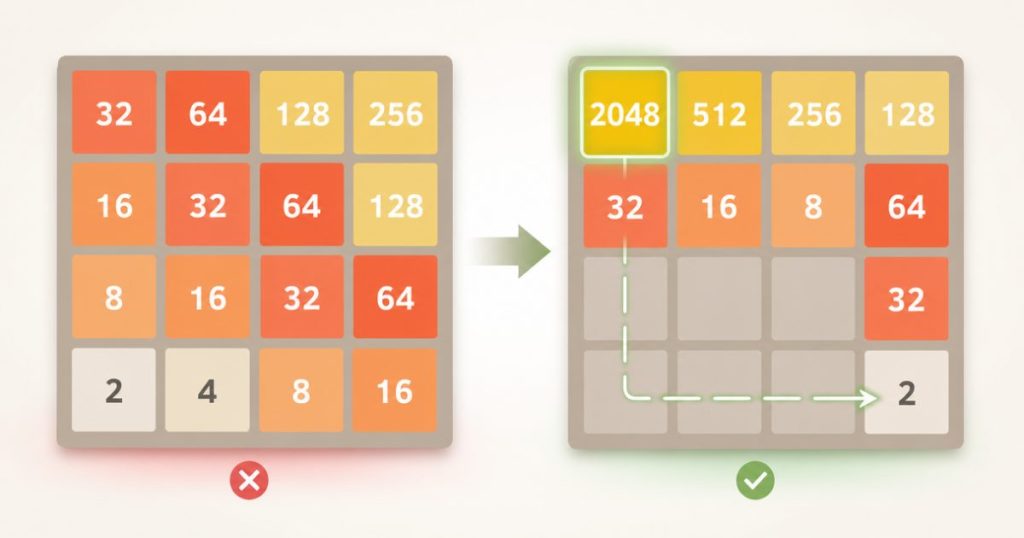
- make a merge without moving the largest tile out of its corner
- preserve one clean edge or lane
- restore a tile order that keeps equal values near each other
- buy one more empty space with the next move or two
A board is usually close to lost when every legal move breaks the structure in a different way. If no swipe creates space, no corner can be preserved, and your largest tiles are already scattered, recovery becomes unlikely.
That does not mean every awkward board is lost. Some positions look bad but can still be saved if one forced merge clears the path. The question is whether the next two moves still have a plan behind them. If they do not, the position is probably beyond saving.
Before you swipe, check these three things
- Will this move keep my largest tile anchored?
- Does it create or preserve an open lane?
- What will the board look like after the next new tile appears?
If you can answer all three quickly, you are still playing the board. If you cannot, the board is already controlling you.
Common endgame mistakes that cause instant failure
The most common late-game mistake is chasing the biggest merge available. A huge merge may feel like progress, but if it breaks the corner or destroys the chain, it can end the run immediately.
Other frequent mistakes include:
- Random swiping. This usually scatters the board instead of rescuing it.
- Breaking the corner. Once the largest tile leaves its anchor, recovery gets much harder.
- Ignoring the next spawn. A move that looks safe now may fail after the new tile appears.
- Trying to save score instead of space. In the endgame, survival matters more than a slightly higher merge value.
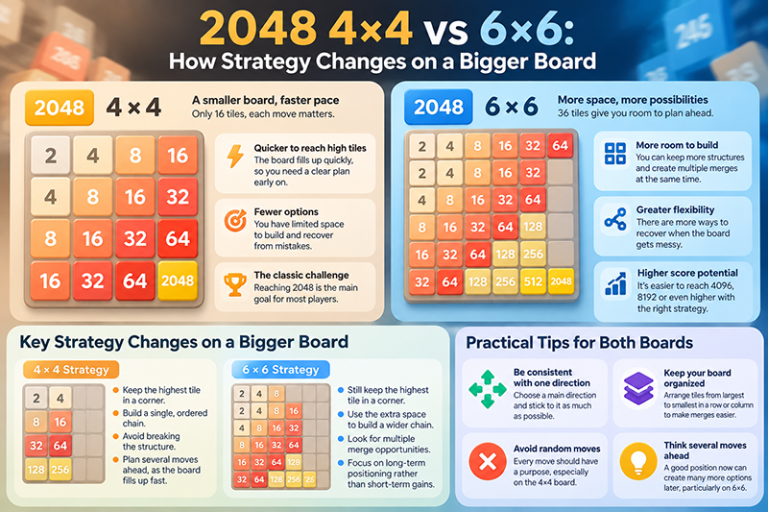
On larger boards, these mistakes can take longer to punish, but the same principle still applies. The more crowded the board becomes, the more dangerous it is to break structure for a short-term gain.
If you want a stronger foundation for late-game survival, it helps to practice the early and mid-game pattern that keeps the board organized in the first place. This guide on the easiest reliable way to reach 2048 covers the corner-based approach that makes endgame recovery possible in the first place.
A simple last-moves checklist
When the board is almost full, use this quick checklist before every swipe:
- Is there a merge that also preserves my corner?
- Can I open or protect one lane?
- Will this move keep the board ordered enough for the next spawn?
- Am I choosing space, or just chasing points?
If a move creates space and keeps structure intact, take it. If it only looks attractive because it makes a bigger number, be careful. The endgame is less about style and more about buying one more useful turn.
Frequently Asked Questions
What should I do first when the board is almost full?
Look for the move that creates space without moving your largest tile out of its corner. In a crowded board, space and structure matter more than score.
Should I always protect the corner tile in the endgame?
Usually yes. Keeping the largest tile anchored in one corner makes the board easier to manage and helps preserve a usable tile chain.
Is it better to make a small merge now or wait for a bigger one?
If the board is crowded, take the small merge if it buys space or keeps the pattern stable. Waiting for a bigger merge is risky when you only have a few empty tiles left.
How do I know when the board is beyond saving?
If no legal move preserves your corner, opens a lane, or creates a useful merge chain, the position is probably lost.
The best 2048 endgame strategy is simple: create space, protect your corner, and avoid breaking the tile order that still gives you control. When the board is crowded, a safe merge that keeps the structure alive is usually better than a bigger move that traps you two turns later.
If a position still has one clean lane and a stable corner, it is worth fighting for. If every move destroys a different part of the board, the run may already be over. That distinction is what separates a recoverable endgame from a losing one.