You finally merge two 1024 tiles, the golden 2048 tile appears, and the game announces that you’ve won. For many players, that’s the finish line. But if you’ve ever wondered what happens when you keep playing, there’s another challenge waiting: creating a 4096 tile.
Yes, you can get 4096 in 2048. The original game allows you to continue after reaching 2048, and merging two 2048 tiles creates a 4096 tile. You can even go beyond that to 8192 and higher numbers, provided you can keep the board playable.
Getting there, however, is considerably harder than reaching your first 2048. The board doesn’t get bigger, new tiles keep appearing, and every wasted move can make the next merge more difficult.
The good news is that you don’t need a secret trick or extraordinary luck. You need a reliable way to organize your tiles, protect your largest numbers, and create enough space for the next big merge.
Here’s how to do it.
Is It Really Possible to Get 4096 in 2048?
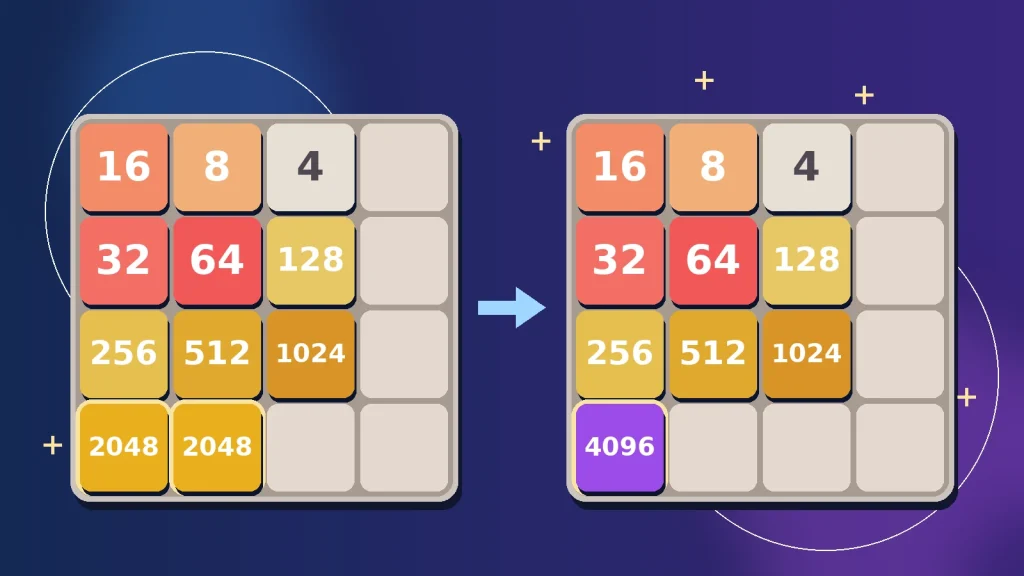
Absolutely. Although the game is called 2048, that number represents the original winning goal, not the highest tile you can create.
In classic 2048, you play on a 4×4 grid containing 16 cells. You slide numbered tiles up, down, left, or right. When two tiles with the same value collide, they merge into one tile worth twice as much.
The sequence continues beyond 2048:
| Merge | Result |
|---|---|
| 256 + 256 | 512 |
| 512 + 512 | 1024 |
| 1024 + 1024 | 2048 |
| 2048 + 2048 | 4096 |
| 4096 + 4096 | 8192 |
| 8192 + 8192 | 16384 |
After creating your first 2048 tile, select Keep going if your version of the game displays a victory message.
The board remains active, allowing you to continue combining tiles until no legal moves remain.
Some alternative 2048 games have different modes or stopping conditions, so check whether the version you’re playing supports continued play.
The important thing to understand is that 4096 follows exactly the same merging rules as every smaller tile. There’s no special combination or hidden requirement.
You simply need two 2048 tiles next to each other and a swipe that brings them together.
How Hard Is It to Reach 4096?
Reaching 4096 is a substantial step beyond winning the standard game.
To create one 2048 tile, you must accumulate and combine tiles with a total value of 2048.
To create 4096, you need twice that value.
If every tile originally spawned as a 2, building one 4096 tile would require the equivalent of 2,048 starting tiles. In actual games, some new tiles appear as 4s, reducing the number of individual spawns needed.
But the biggest challenge isn’t simply collecting enough numbers.
It’s managing the limited space on your board.
By the time you reach 2048, you may already have several large tiles occupying important positions. To create another 2048, you must keep merging smaller tiles while preserving a path toward your existing high-value tile.
New 2s and 4s continue appearing after successful moves. If you place them carelessly, they can interrupt the order you’ve worked hard to build.
That’s why reaching 4096 requires more patience and planning than repeatedly swiping in the same direction.
What Changes After You Reach 2048?
The game rules don’t change, but the way you should approach the board does.
Early in a run, there are plenty of empty cells. Small mistakes are relatively easy to recover from, and you can often make several moves without worrying about running out of space.
Once a 2048 tile appears, your options may become much more restricted.
Your largest tile is valuable, but it also occupies a cell that may remain unchanged for many turns. Other high-value tiles, such as 1024 and 512, need to be organized so they can eventually merge toward it.
At this stage, three things matter more than ever:
- Keeping your largest tile in a stable position.
- Maintaining an orderly sequence of decreasing tile values.
- Preserving enough empty cells to absorb new tiles and create merges.
A move that gains points immediately may damage your layout and make your next merge almost impossible.
When playing for 4096, think about the position you’ll have after several moves, not just the points you’ll receive from the next swipe.
Strategy 1: Keep Your Largest Tile in One Corner
The corner strategy is one of the most useful habits you can develop in 2048.
The idea is straightforward: choose a corner and build your largest tile there. Then organize smaller tiles around it instead of letting the biggest numbers drift across the board.
For example, suppose you choose the bottom-left corner.
Once your 2048 tile reaches that position, try to keep it there while building another 2048.
Your preferred movements will usually be:
Left: Keeps tiles pressed toward your chosen corner.
Down: Helps maintain the bottom edge as your main organizing row.
Right: Can be useful for repositioning smaller tiles, but should be considered carefully.
Up: Usually requires the greatest caution because it may lift your largest tile away from the bottom edge.
This doesn’t mean you must never swipe right or up.
Sometimes a less-preferred direction is necessary to avoid running out of moves. What matters is understanding how that swipe will affect your largest tile and whether you can restore your layout afterward.
Why does the corner strategy work?
Keeping your biggest tile in a corner gives your board a predictable structure.
Instead of constantly moving large numbers around, you build smaller values toward a fixed destination.
Think of the corner as the end of an assembly line.
Small tiles enter the board, combine into larger tiles, and gradually move toward the corner, where they can join your existing high-value numbers.
This reduces unnecessary movement and makes future merges easier to plan.
However, simply pressing left and down repeatedly won’t guarantee success.
You still need to pay attention to the arrangement of the other tiles.
That’s where the next technique becomes useful.
Strategy 2: Use the Snake Pattern to Organize Your Tiles
The snake strategy extends the corner method by arranging tile values in a descending sequence that winds through the grid.
Rather than placing large tiles wherever they happen to fit, you aim to keep them connected in a predictable order.
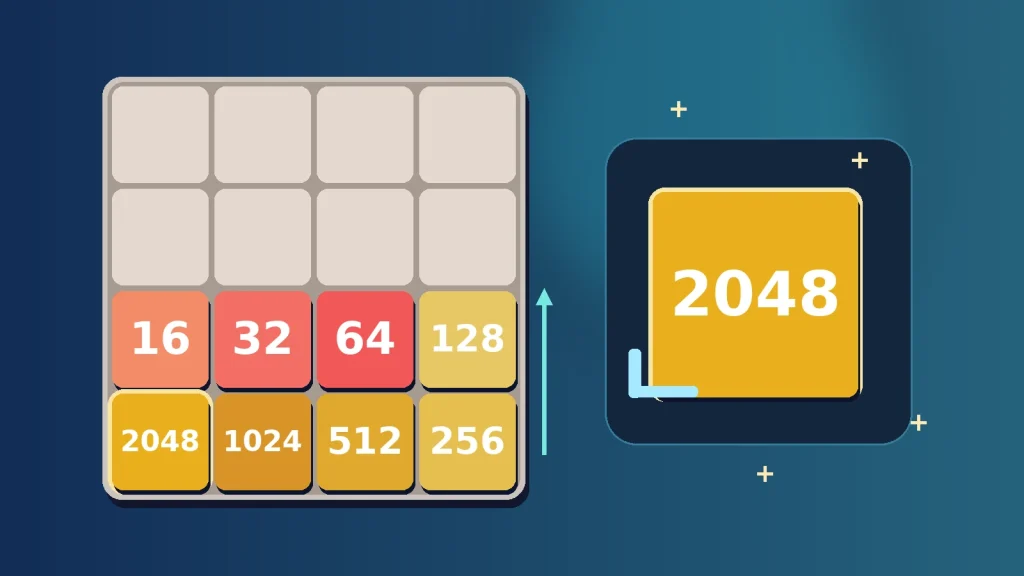
With your largest tile in the bottom-left corner, an idealized arrangement might look like this:
| Empty | Empty | Empty | Empty |
| Empty | Empty | Empty | Empty |
| 16 | 32 | 64 | 128 |
| 2048 | 1024 | 512 | 256 |
Follow the numbers from 2048 across the bottom row toward 256, then move upward to 128 and follow the next row backward.
The values decrease as you follow the path, creating a snake-like sequence.
This is an illustration of the target ordering, not a requirement that every game must have exactly this layout.
Why is this pattern useful?
Suppose you manage to create a second 128 tile near your existing 128.
You can combine them into 256, which can then be brought together with the next 256 in your chain.
That can eventually produce larger combinations without scattering your valuable tiles around the board.
The snake pattern helps you see which tile needs to be created next and where it should go.
It also reduces the chance of trapping a large number behind several small tiles.
Don’t force a perfect snake
Real games rarely follow an ideal arrangement.
New tiles appear in random empty cells, and some pieces will temporarily interrupt your preferred sequence.
That’s normal.
A common mistake is trying so hard to restore a perfect snake that you sacrifice the empty cells needed to survive.
Treat the pattern as a guide, not a rigid rule.
Keeping most of your high-value tiles in order is more important than making every cell look perfect.
Strategy 3: Keep Your Largest Row Organized
Once your largest tile is safely in a corner, the next priority is maintaining the row connected to it.
For a bottom-left corner strategy, that means the bottom row.
Ideally, tile values should decrease as you move away from the corner.
For example:
| Column 1 | Column 2 | Column 3 | Column 4 |
|---|---|---|---|
| 2048 | 1024 | 512 | 256 |
This arrangement gives you a clear progression for future merges.
It also makes the bottom row more stable.
When the row is completely filled, horizontal swipes cannot shift its tiles into empty positions, although adjacent equal values can still merge.
That stability can be useful when you need to rearrange smaller tiles above.
But don’t fill the bottom row with unrelated numbers just to occupy every cell.
A row containing 2048, 2, 1024, and 4 may be full, yet it is poorly organized.
The small tiles between the large ones can prevent important merges.
Your goal is not merely to fill the row. It’s to keep the numbers arranged so that they can be combined in a useful order.
Strategy 4: Protect Your Empty Cells
One of the biggest differences between a successful 4096 attempt and a failed run is how you manage free space.
Every successful swipe that changes the board normally introduces a new tile, either a 2 or a 4.
If you aren’t merging tiles often enough, the grid gradually becomes crowded.
Once all 16 cells are occupied and no adjacent matching tiles can merge, the game ends.
This is why empty space matters.
A board with several empty cells gives you more flexibility to rearrange numbers, absorb new tiles, and recover from awkward placements.
A nearly full board leaves very little room for mistakes.
Don’t sacrifice space for a small merge
Imagine that you’re trying to decide between two moves.
The first combines two 4 tiles into an 8 but disrupts your organized bottom row.
The second keeps your high-value chain intact and positions another pair for a future merge.
The first move offers an immediate reward. The second may give you a safer board.
When you’re working toward 4096, the safer move can be more valuable.
You don’t need to reject every small merge. Just consider whether the move improves your position or merely adds points.
Watch the number of available moves
Before swiping, check whether your board will still have room to maneuver afterward.
Pay attention to:
- Empty cells along the upper rows.
- Matching numbers that can be merged soon.
- Small tiles trapped between larger numbers.
- Moves that could force your largest tile out of position.
There’s no fixed number of empty cells that guarantees survival.
The goal is to maintain enough flexibility that you’re not constantly forced into dangerous moves.
Strategy 5: Plan Your Merges Before Swiping
A crucial part of reaching 4096 is thinking at least one or two moves ahead.
This becomes especially important when your board contains a 2048 tile and you’re trying to assemble the second one.
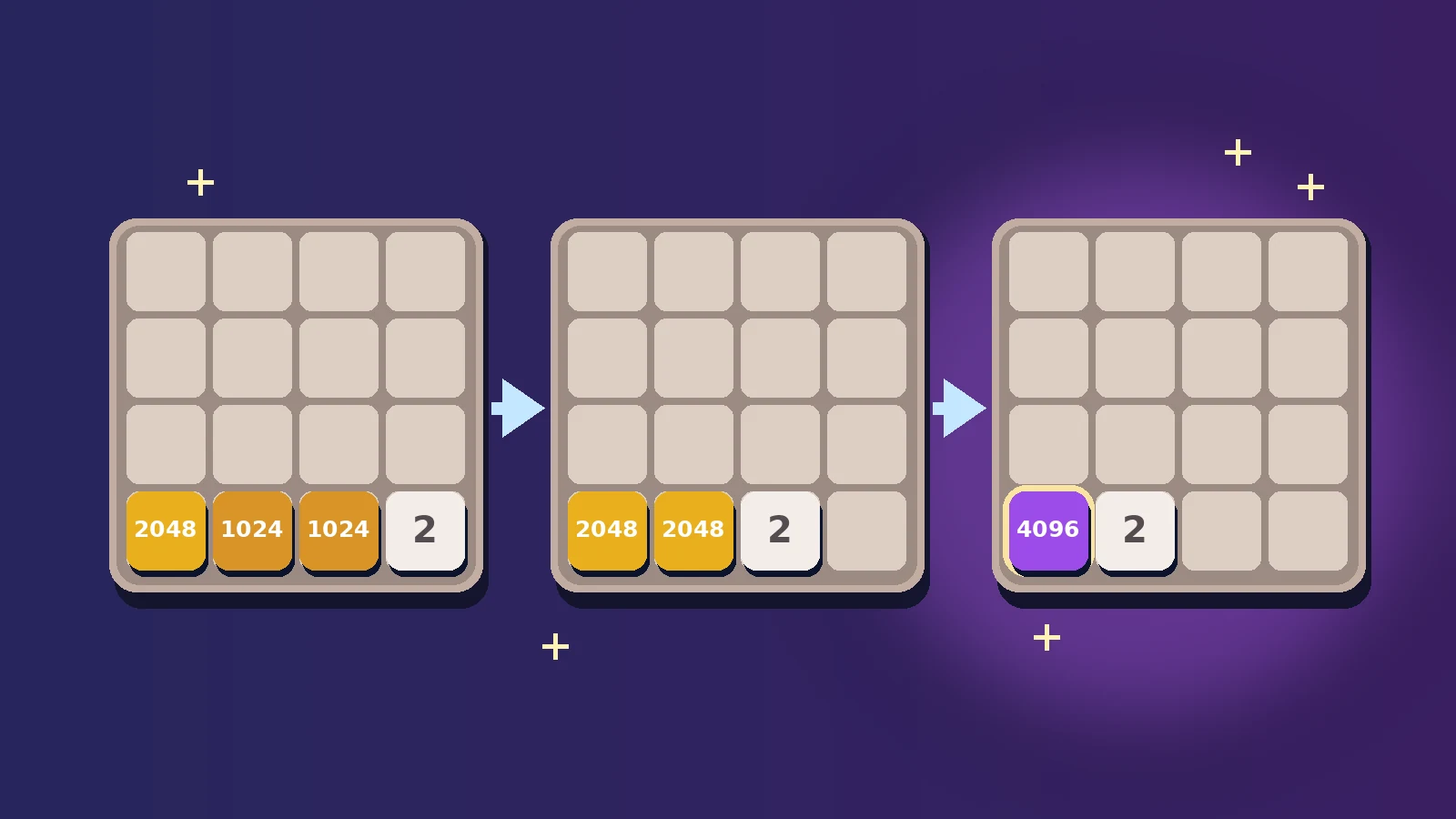
Suppose you have the following row:
| 2048 | 1024 | 1024 | 2 |
|---|
If you swipe left, the two 1024 tiles merge.
The row becomes, before the new random tile appears:
| 2048 | 2048 | 2 | Empty |
|---|
Now the two 2048 tiles are next to each other.
A second left swipe merges them into 4096.
This example illustrates an important rule: a tile created by a merge cannot merge again during the same swipe.
You need a separate move to combine the newly created 2048 with the existing one.
In an actual game, a new tile may appear after the first swipe, so the exact board can look slightly different. However, the two adjacent 2048 tiles can still merge toward the left as long as the move remains legal.
Not every 4096 opportunity will be this straightforward.
Often, you’ll need several preparatory moves to bring two 1024 tiles together without disturbing your first 2048.
The more carefully you plan, the less likely you are to destroy your setup just before reaching the goal.
Strategy 6: Know When to Break Your Preferred Direction
Many 2048 strategy guides recommend avoiding one direction almost entirely.
For a bottom-left corner strategy, that direction is usually up.
The advice is useful because swiping upward can move the largest tile away from its anchor.
But treating it as an absolute rule can also be a mistake.
Sometimes the board becomes crowded, and your preferred directions no longer create useful changes.
In that situation, refusing to change direction may leave you with no way to improve your position.
Before making an unusual move, ask three questions.
Will my largest tile move?
Check whether the swipe shifts your anchor tile away from the corner.
Can I restore the layout afterward?
An emergency move is less dangerous if you can quickly return the largest tile to its intended position.
Will the move open enough space to justify the risk?
Sometimes a temporary disruption is worthwhile if it produces an important merge or frees several cells.
The strongest players aren’t those who follow one movement rule without exception.
They’re the ones who understand when a rule helps and when the current board demands a different approach.
The Most Common Mistakes When Trying to Reach 4096
Even players who can reach 2048 regularly may struggle to create the next tile.
Several habits tend to cause trouble.
Moving your largest tile too often
If your 2048 tile constantly changes position, the rest of the board becomes harder to organize.
Try to keep it anchored unless moving it is necessary for a specific plan.
Chasing every possible merge
Just because two tiles can combine doesn’t mean they should combine immediately.
A poorly timed merge can disrupt the order of your larger numbers.
Consider whether it improves the overall board.
Letting small tiles divide large ones
A row containing 2048, 4, 1024, and 8 is difficult to consolidate.
Small numbers trapped between large tiles can prevent useful combinations.
Try to keep new 2s and 4s in an area where they can grow before moving toward your largest tiles.
Ignoring the next move
A swipe may create a useful merge but leave the board with no safe continuation.
Before committing, imagine where all the other tiles will slide.
Panicking when the board gets crowded
2048 is not a speed game in its classic form.
You usually have time to examine the board before moving.
When the grid is nearly full, slow down. Look for matching numbers, possible rearrangements, and ways to restore empty space.
A careful move is worth more than several rushed swipes.
How Long Does It Take to Reach 4096?
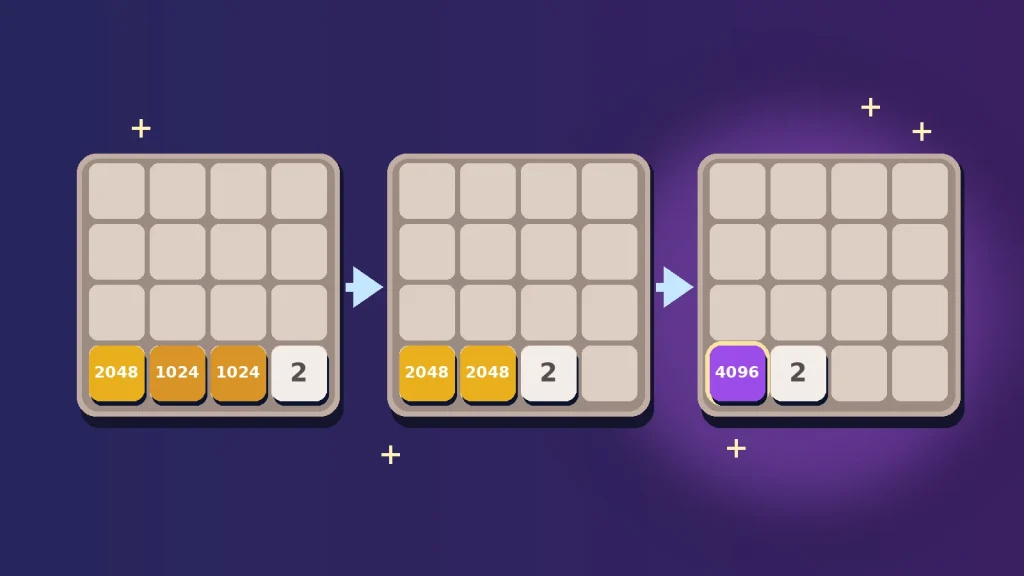
There isn’t a fixed number of moves or minutes required to create a 4096 tile.
The time depends on your strategy, the arrangement of new tiles, and how efficiently you combine them.
Because 4096 contains twice the value of 2048, reaching it generally requires a substantially longer run.
However, that doesn’t mean it takes exactly twice as long.
Some games produce helpful tile placements, while others require additional moves to reorganize the board.
Your playing style matters too.
If you spend time evaluating each move, a successful run may take longer in real time but involve fewer unnecessary swipes.
Instead of focusing on the clock, aim to maintain a stable board through each milestone.
If you can reach 1024 and 2048 while keeping your largest tiles organized, you’re building the habits needed for 4096.
Can You Get 8192 After Reaching 4096?
Yes. If your game continues after 4096, you can create an 8192 tile by merging two 4096 tiles.
The same doubling pattern continues:
4096 + 4096 = 8192.
And after that:
8192 + 8192 = 16384.
The main difficulty is that the board still contains only 16 cells.
Creating larger tiles requires accumulating more value while keeping the available space organized.
As the numbers grow, mistakes become harder to recover from.
A misplaced small tile that was only a minor inconvenience early in the game can become a serious obstacle when you’re protecting several high-value tiles.
This is why many advanced players focus heavily on preserving their corner and descending tile sequence.
The strategy doesn’t fundamentally change after 4096. It simply becomes more demanding.
Does Reaching 4096 Mean Your Score Is 4096?
No. Your largest tile and your game score are two different things.
The number displayed on a tile represents its value.
Your score, meanwhile, increases whenever tiles merge. In the original rules, each successful merge adds the value of the newly created tile to your score.
For example:
| Merge | Points added |
|---|---|
| 2 + 2 = 4 | 4 |
| 4 + 4 = 8 | 8 |
| 512 + 512 = 1024 | 1024 |
| 1024 + 1024 = 2048 | 2048 |
| 2048 + 2048 = 4096 | 4096 |
When you finally merge two 2048 tiles, you earn 4096 points from that merge alone.
Your total score will already include all the previous merges used to build those tiles.
Therefore, having a score greater than 4096 doesn’t mean you’ve created a 4096 tile.
If you’re aiming to reach a new tile milestone, watch the numbers on the board rather than the score counter.
Is Getting 4096 About Luck or Skill?
Both play a role, but skill has a major influence on your chances.
In classic 2048, new tiles appear in random empty locations. Most are 2s, while some are 4s.
You can’t control exactly where the next tile will appear.
However, you can control how you respond to the board.
A player who swipes randomly may occasionally create a large tile, but the board is likely to become disorganized.
A player who maintains a stable corner, keeps large tiles in order, and protects empty space is better prepared for awkward spawns.
Good strategy reduces the damage caused by randomness.
It doesn’t remove uncertainty entirely.
Even careful players can face difficult positions, so no simple corner rule guarantees that every game will produce 4096.
The aim is to improve your decisions consistently rather than depend on a lucky series of moves.
A Simple Practice Plan for Reaching 4096
If you’ve already reached 2048 once but haven’t managed to go further, try practicing specific skills instead of starting new games without a plan.
Practice 1: Hold one corner
Play a game with the goal of keeping your largest tile in the same corner for as long as possible.
Don’t worry about reaching 4096 immediately.
Focus on recognizing which moves preserve your anchor and which ones threaten it.
Practice 2: Build a descending row
Once your largest tile reaches 256 or 512, try arranging the next-largest values beside it in descending order.
If the sequence breaks, pay attention to what caused it.
Practice 3: Evaluate empty space
Before each move, check how many empty cells you have and whether the move will improve your ability to merge.
Try to avoid creating crowded boards through unnecessary swipes.
Practice 4: Continue after 2048
When you reach your first 2048 tile, treat that moment as the beginning of a new challenge.
Keep the original tile in position and work on assembling the next 1024 and 2048 without sacrificing your layout.
Practice 5: Review difficult positions
If your run ends, think back to the move that made the board difficult to recover.
Did you lose your corner? Break your descending sequence? Fill your last useful empty cell?
Identifying one recurring mistake can be more valuable than playing several new games without reflection.
Frequently Asked Questions About Getting 4096 in 2048
Can you actually get 4096 in the original 2048 game?
Yes. The original game allows you to continue after reaching the 2048 tile. By creating a second 2048 and merging the two, you can make a 4096 tile.
How do you make a 4096 tile in 2048?
You need to combine two 2048 tiles. Build the second 2048 through normal merges, position both 2048 tiles next to each other, and swipe in a direction that merges them.
What happens when you get 4096 in 2048?
The two 2048 tiles combine into a single 4096 tile, and the merge adds 4096 points to your score. In a version that allows continued play, you can keep going toward 8192.
Is 4096 harder to get than 2048?
Yes. Creating 4096 requires twice the total tile value of 2048, and you must manage the same limited 4×4 board for a longer period.
What is the best strategy to reach 4096?
A useful approach is to keep your largest tile in a corner, arrange the other large numbers in descending order, protect empty cells, and plan merges before swiping. This combination is generally more effective than relying on repeated movements without checking the board.
Should I always keep my largest tile in a corner?
Keeping the largest tile in one corner is a strong general strategy, but it isn’t an absolute rule. Some positions require temporary changes to your layout. The important thing is maintaining a clear plan and avoiding unnecessary movement of your largest tile.
Can you reach 4096 by using only two arrow keys?
It may be possible in a particular run, but repeatedly pressing the same two directions is not a reliable method. You still need to arrange merges, preserve space, and sometimes use another direction to escape difficult positions.
Is there a time limit for reaching 4096?
Classic 2048 generally has no countdown timer. You can take time to plan each move. Some alternative versions introduce timed challenges, so the rules may vary.
Can you get 8192 or 16384 in 2048?
Yes, in versions that allow continued play. You can merge two 4096 tiles to create 8192 and two 8192 tiles to create 16384. These higher milestones become increasingly difficult because the board size remains unchanged.
Why do I keep losing after reaching 2048?
Common reasons include moving the largest tile away from its corner, breaking the order of large tiles, making unnecessary merges, and allowing small tiles to occupy important spaces. Improving board organization is often more useful than trying to move faster.
Final Thoughts
Getting 4096 in game 2048 is completely possible, but it requires more than simply continuing after the victory message.
You need to build a second 2048 tile while keeping your existing one safe, maintain an organized board, and avoid moves that leave too little space for future merges.
The corner strategy gives you a stable starting point. The snake pattern helps arrange your larger numbers. Careful planning and space management help keep the game alive long enough to bring those pieces together.
Most importantly, don’t rush.
When you’re working toward 4096, every swipe should have a purpose. Sometimes the best move isn’t the one that earns the most points immediately, but the one that leaves your board ready for the next important merge.
And when those two 2048 tiles finally meet, you’ll discover that the game’s original goal was only the beginning.
Related reading: curious what happens after you reach 2048 and whether you can keep playing toward 4096 and beyond?
