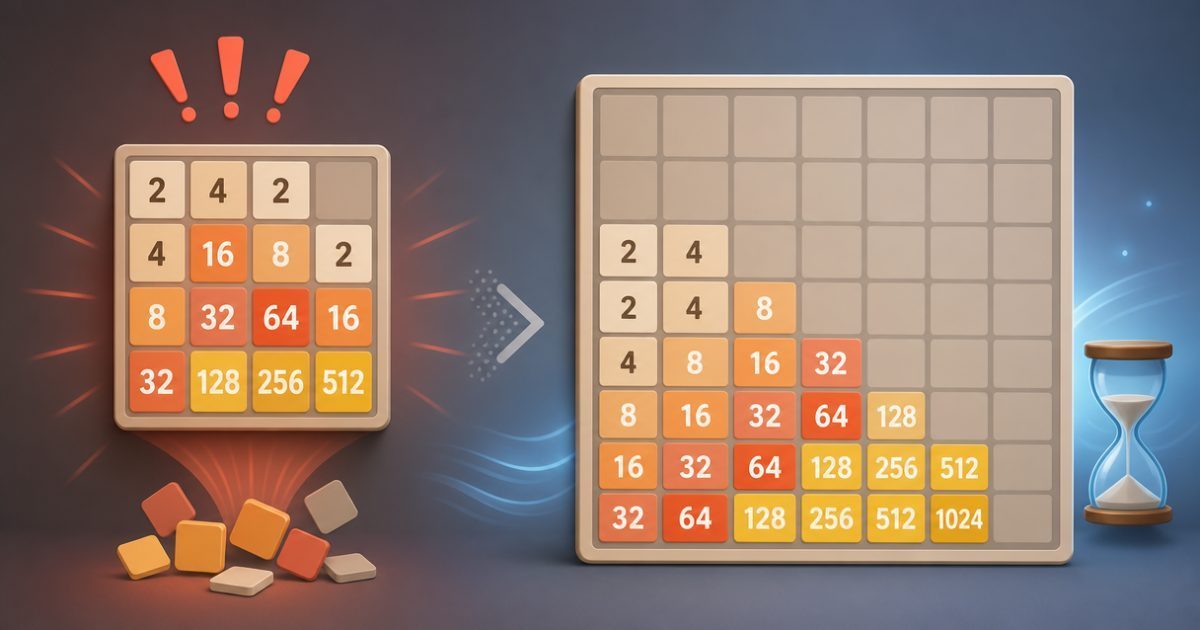
The short answer is no: a bigger 2048 board is not automatically easier. It gives you more room to move, but that extra space changes the game in both directions. You get more recovery room when a move goes wrong, yet you also need more planning because tiles spread out, merges happen less often, and a messy board can stay hidden longer.
That is why board size changes game 2048 online difficulty instead of simply making the game easier or harder. A smaller grid forces faster decisions and keeps your structure under pressure. A larger grid feels calmer at first, but it can become slow, spread out, and surprisingly hard to organize if you do not manage it carefully.
How board size changes the feel of 2048
Board size affects three things more than anything else: space, merge frequency, and recovery room. On a classic 4×4 board, every tile matters because the board fills quickly. That creates tension, but it also gives you a cleaner read on the board. If something goes wrong, you usually know right away.

On a larger board, such as 5×5, 6×6, or beyond, you have more empty cells to work with. That can make the game feel safer because one awkward spawn does not crush your run immediately. But the same extra space also makes the board less efficient. Tiles are farther apart, merges take longer to line up, and it is easier for stray values to drift away from your main structure.
That is the key tradeoff: more space usually means more room to maneuver, but not necessarily easier wins.
Why 4×4 feels tighter and more volatile
The classic 4×4 board is small enough that bad habits show up quickly. If you break your tile order, block your corner, or waste too many moves, the board can collapse fast. That makes it feel volatile. One poor decision can snowball because there is very little spare space to absorb the mistake.
At the same time, 4×4 is often easier to read. Your largest tile, your empty cells, and your problem areas all stay close together. You do not have to scan a wide board or guess where a tile disappeared. The danger is immediate, which is stressful, but that pressure also helps you learn control.
Why larger boards feel safer but slower
Larger boards give you more breathing room, so they often feel easier during the first part of a run. You can survive awkward spawns, delay a risky merge, and keep moving even if your structure is not perfect yet. That extra room can make a larger board more forgiving for casual play.
But the pace slows down. Because tiles are spread across more squares, you need more moves to gather matching values together. It can take longer to build momentum, and it is easier to end up with tiles that look harmless individually but are too far apart to combine efficiently. In other words, larger boards reduce immediate pressure without removing the deeper planning requirement.
What changes in strategy as the board gets bigger

Board size changes how you manage the grid, not just how crowded it feels. The core 2048 ideas still matter on every size: keep your largest tile anchored, avoid unnecessary chaos, and build a board that can merge in a predictable order. But the way you apply those ideas shifts with the grid.
On smaller boards, strategy is about discipline. On larger boards, it is about discipline plus organization over a wider space. You are not just protecting one corner. You are also deciding how to keep the rest of the board from drifting out of sync.
If you want a deeper look at the core structure behind that approach, corner strategy becomes even more important once the board starts to grow.
Corner strategy still matters, but it works differently
On a 4×4 board, corner play is about stability. You anchor your largest tile, build around it, and avoid moves that pull that anchor out of place. Because the grid is small, this structure is fairly easy to maintain if you are careful.
On a larger board, the corner still matters, but it is less about one isolated area and more about the whole flow of the board. A large empty center can hide weak control for a while. You may think the run is stable because you still have room, but if the higher values are spread across too many rows or columns, merges become harder to line up later.
That is why larger boards reward patience more than speed. You can afford a slower pace, but only if the board stays organized.
Edge control becomes more important on open boards
With more space available, it is easy to let tiles drift into the middle of the board. That usually creates trouble later. Once your higher values are no longer grouped along the edge or near your main anchor, the grid becomes harder to clean up.
Edge control helps because it gives your board a predictable shape. Even on a larger board, you want your important tiles to stay in a structure you can understand at a glance. If the board starts to look scattered, the extra space is no longer helping you. It is just delaying the moment when the problem becomes obvious.
Long-term planning matters more as the grid expands
On a 4×4 board, short-term planning is often enough. You can usually see the next few moves clearly because the board is compact. On a larger board, you have to think further ahead. A move that looks safe now may create a tile position that is awkward six moves later.
This is one reason larger boards can feel easier at first but harder later. Early on, they are forgiving. Later, they demand a clearer plan because there are more tiles to manage and more ways for the board to drift apart. Good play on a bigger board is less about reacting to the next merge and more about shaping where future merges will happen.
Which board size is best for beginners, intermediate players, and advanced players?
The best board size depends on what you want to learn. Bigger is not automatically better, and smaller is not automatically harder in a useful way. Different sizes teach different habits.
If your goal is to learn the basics of board control, the classic 4×4 board is usually the best place to start. It teaches you how to keep order, protect your corner, and recover from mistakes before the board gets out of hand. That pressure is useful because it reveals weak habits quickly.
If your goal is to practice longer planning and more relaxed tile management, a larger board can help. It gives you time to think, but it also exposes whether you can keep a wide grid organized. That makes larger boards a good training ground for more advanced control.
When players ask whether a bigger board is easier, the real question is usually: easier for what?
- For learning fundamentals: smaller boards are often better because they expose mistakes fast.
- For surviving longer: larger boards can feel easier because they give you more space to recover.
- For clean high-score play: the answer depends on how well you can keep a bigger board organized.
- For casual, low-pressure play: larger boards are usually more forgiving and slower.
How board size affects scoring and high-score potential
Board size changes score progression because it changes how quickly you can merge and how often you can keep the board productive. A smaller board tends to create faster merge cycles. You combine tiles more often, and the game moves at a brisk pace. That can help you build score quickly, but it also means mistakes punish you sooner.
Larger boards may support longer runs, which sounds ideal for scoring. In some cases, that is true. More space can keep a game alive long enough to build higher tiles and add more merges over time. But a longer game is not the same as a better score. If the board becomes too spread out, you may survive without producing efficient merges, which slows score growth.
So the relationship between board size and scoring is not simple. Smaller boards often create faster score progression. Larger boards may offer more high-score potential if you can manage them well, but they do not guarantee it. The score comes from how efficiently you keep merging, not just from having extra empty cells.
Why a bigger board can hide bad habits
One downside of larger boards is that they can make weak play look safer than it is. A stray tile on a 4×4 board often causes trouble immediately. On a larger board, that same mistake may sit quietly in the background for a long time. The game feels fine until the board finally tightens and you realize your structure is harder to fix than it looked.
That is why larger boards are not always the easiest way to improve. They can hide mistakes instead of correcting them. If your goal is to get better at 2048, a smaller board often teaches more because it forces cleaner habits.
When a smaller board is the better choice
A smaller board is better when you want tighter control, faster feedback, or a more classic 2048 experience. It is the stronger choice if you are still learning how tile ordering works, how to keep your largest tile in place, or how to avoid filling the grid with awkward gaps.
It is also a good choice if you want a more decisive game. On a 4×4 board, every move matters. That can be frustrating, but it is also useful. You learn how the game behaves under pressure, and that makes your strategy more disciplined.
Players who want a quick challenge usually prefer smaller boards. Players who want a slower, more open puzzle usually prefer larger ones.
When a larger board makes more sense
A larger board makes sense when your goal is longer runs, more room to recover, and a more deliberate pace. It is a good fit for players who already understand the basics and want to practice board organization across a wider grid.
It also works well if you do not want every mistake to end the game quickly. Extra space softens some of the immediate pressure, which can make the game feel more relaxed. That does not mean it is easy. It means the difficulty changes shape. The challenge shifts from surviving the next few moves to keeping a large board ordered over time.
If you want the most useful rule of thumb, use this: choose a smaller board when you want sharper training, and choose a larger board when you want more breathing room and longer planning.
Which board size fits your goal?
Think about what you want from the game before you choose a board size. The right size for practice is not always the right size for score chasing, and the right size for casual play is not always the best one for improvement.

- If you want to learn fast: choose 4×4. It forces clean habits and makes mistakes obvious.
- If you want more recovery room: choose a larger board. You will have more space, but you will also need better organization.
- If you want to practice high-score play: choose the size that lets you keep merges efficient, not just the size that feels easiest at first.
- If you want a slower, more relaxed run: a bigger board usually gives you that pace.
The size that feels easiest for a few moves is not always the size that helps you improve most. If you want the strongest foundation, smaller boards are better. If you want a different kind of challenge, larger boards can be more forgiving at first and more demanding later.
A practical way to think about board size
Imagine two runs. In the first, you play on a 4×4 board. You have very little room, so you keep your tiles tight and merge quickly. Every mistake shows up fast, which is stressful but clear.
In the second, you play on a larger board. You have room to move and can survive a few imperfect turns. But the tiles are spread out, so your high-value numbers are not always where you want them. You may feel safer at first, then realize the board has become harder to control because the merges are farther apart and the structure is less compact.
That is the real answer to the question. Bigger boards are not simply easier or harder. They change the shape of the challenge.
Smaller boards reward clean, fast control. Larger boards reward patience, organization, and long-term planning. The best board size is the one that matches the skill you want to practice.
Frequently Asked Questions
Is a bigger 2048 board easier to win on?
Usually not in a direct sense. A bigger board gives you more room to recover, but it also makes tiles spread out and can slow down merges. That can make the game easier early and harder later.
Which 2048 board size is best for beginners?
The classic 4×4 board is usually best for beginners because it teaches control quickly and shows mistakes right away. A larger board can feel forgiving, but it may also hide weak habits.
Does a larger board help you get a higher score?
It can, but only if you keep the board organized. More space can support longer runs, but score still depends on efficient merging and good board management.
If you want the most honest answer, board size changes 2048 difficulty by changing the kind of discipline the game asks from you. A 4×4 board is tighter and more punishing. A larger board gives you more room, but it also asks for stronger planning and cleaner structure over a wider space.
Pick the size that matches your goal. Use smaller boards to sharpen control and learn the fundamentals. Use larger boards when you want more breathing room, longer games, and a different kind of strategy challenge. Neither one is universally easier, and that is what makes board size such an important part of 2048.