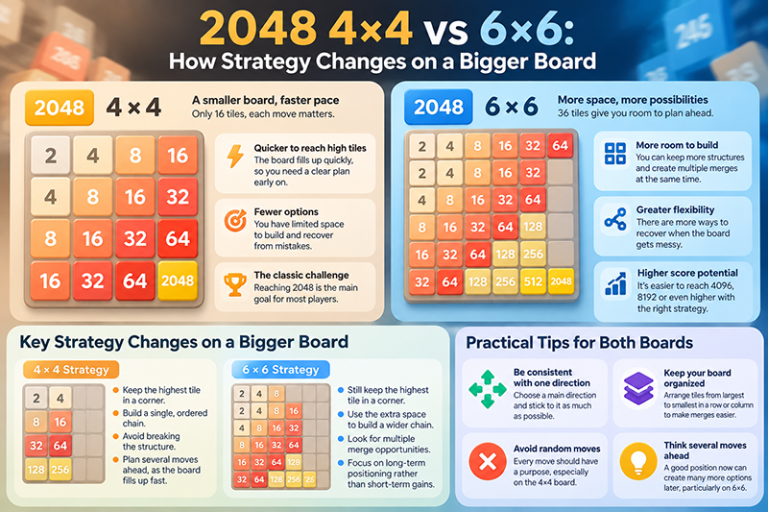
The number 2048 stays the same, but changing the grid changes the feel of the game. A 4×4 board gives you 16 cells and constant space pressure. A 5×5 board has 25 cells. By 10×10, you have 100 cells and a much longer runway for building large tiles.
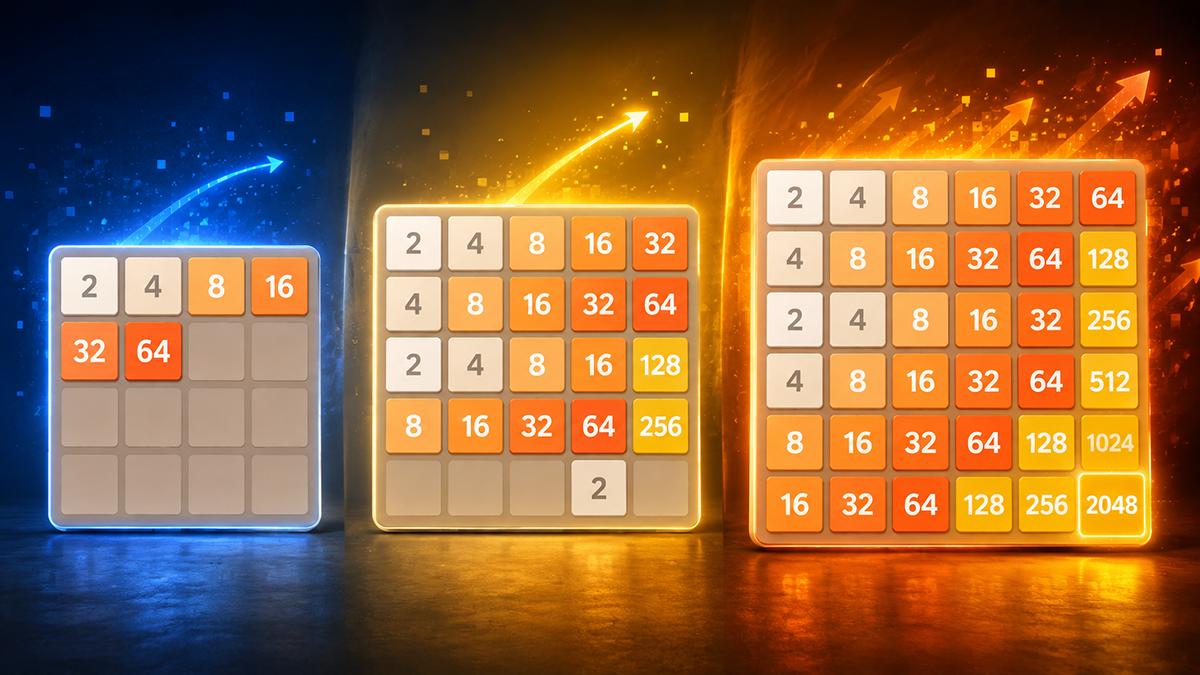
Quick board-size comparison
| Mode | Cells | What it feels like | Best for |
|---|---|---|---|
| 4×4 | 16 | Tight, tactical, mistakes matter quickly | The standard 2048 challenge |
| 5×5 | 25 | More breathing room without feeling huge | Learning long-term tile ordering |
| 6×6 | 36 | Longer runs and secondary merge lanes | Players who enjoy building beyond 2048 |
| 8×8 | 64 | Open, experimental, much less early pressure | Very large tiles and relaxed play |
| 10×10 | 100 | Huge board and long sessions | Extreme large-grid play |
Why 4×4 is the standard
The original-style 4×4 board has just enough space to create meaningful choices quickly. Every new tile consumes 1/16 of the grid, so a disorganized opening becomes expensive fast. That pressure is why corner discipline and empty-cell management matter so much.
If you want to compare your strategy with the familiar version of 2048, use 4×4 or Classic.
What changes on 5×5?
Moving from 16 to 25 cells is a substantial increase in room. You can survive an awkward spawn that might be fatal on 4×4, and you have space to build a secondary chain while your main anchor row develops.
For many players, 5×5 is the best learning board because the core rules remain obvious but mistakes are less immediately punishing.
How 6×6 changes strategy
A 6×6 grid gives you 36 cells, more than twice the capacity of 4×4. The anchor-corner principle still works, but you do not need every row to be tightly ordered. You can use one region for low-value work while preserving a large-tile chain elsewhere.
The trade-off is attention. With more tiles on screen, it becomes easier to overlook a blocked pair or accidentally create a medium tile far from your main structure.
8×8 and 10×10 are different kinds of challenges
Large boards reduce early space pressure so dramatically that the game becomes less about surviving the next five moves and more about maintaining order over a long session. You can build multiple lanes, but a messy board can also become enormous before it finally locks.
These modes are useful if your goal is to explore very high tiles rather than recreate the compact tension of standard 2048.
Is a larger board easier?
It is generally more forgiving in the early and middle game because there are more empty cells. That does not make every objective easier. Long sessions require sustained organization, and reaching exceptionally high tiles still demands many successful merges.
Which board should a beginner choose?
Start with 4×4 if you want to learn the standard rules exactly. Move to 5×5 if you understand merging but keep losing because the board fills before you can practice a stable pattern.
Which board is best for strategy practice?
Use 4×4 for move discipline and 5×5 for practicing tile ordering. Once your anchor and snake habits are consistent, larger modes become a place to experiment rather than a substitute for fundamentals.
Do the scoring rules change?
The basic merge scoring is the same: the result of each merge is added to the score. What changes is how long the board can keep creating merges before it reaches a dead end.
For the core mechanics, read how the game works. For winning patterns, see the strategy guide.