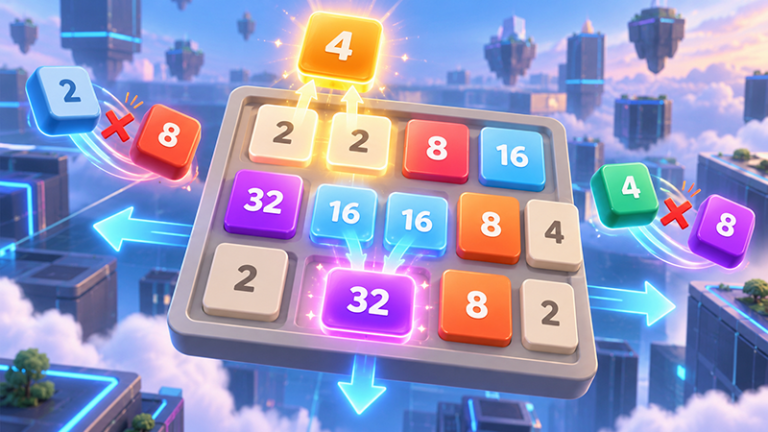
Undo can help you learn 2048 game, but it won’t automatically make you better at the standard game. Used well, it lets you test a move, inspect the board state, and understand why a position went wrong. Used carelessly, it becomes a safety net that hides mistakes instead of teaching you how to avoid them.
The main difference between 2048 with Undo and no-Undo play is pressure. Undo makes it easier to experiment. No-Undo play forces you to commit, plan ahead, and live with the result. If you want to improve your real 2048 skill, the best approach is usually a mix of both.
What Undo changes in 2048 gameplay
Undo changes one basic rule: your move is no longer final. Instead of treating every swipe as permanent, you can reverse a choice and try something else. That makes the game feel less punishing and more exploratory.

In normal play, the board state after each move matters a lot. A bad swipe can break your tile order, move your largest tile out of position, or fill a lane you needed to keep open. With Undo, you get a second look at the same position. That can be useful, but it also changes your habits. You may become more willing to try risky moves because the penalty seems smaller.
That is where Undo can help or hurt. If you use it to study board states, it becomes a learning tool. If you use it to erase every mistake, it can keep you from building the judgment that 2048 rewards.

What Undo teaches well
Undo is especially helpful when you are still learning how 2048 board control works. You can make a move, see the result, undo it, and compare the two positions. That immediate feedback is useful for a few core skills.
- Merge order: You can see which merge should happen first and which one blocks future space.
- Risk awareness: You learn when a move is safe and when it pushes the board toward a dead end.
- Board shape: You can notice how a single swipe affects empty cells, tile order, and your biggest tile’s position.
- Pattern recognition: Repeating the same board with different moves helps you spot patterns faster.
Undo is also useful when a position is crowded and hard to read. On a nearly full board, one bad move can be difficult to understand in real time. Undo lets you inspect the result and figure out why it failed. If you want a deeper look at late-game recovery, the endgame strategy guide pairs well with this kind of practice.
For beginners, this is the biggest advantage: you can make mistakes without losing the whole run immediately. That makes it easier to learn how the game works instead of just reacting to random tile spawns.
How Undo can create bad habits
Undo becomes a problem when it replaces real decision-making. If you always use it to rescue a move you should have avoided, you are not really training the same skill set as standard 2048. You are training yourself to depend on recovery instead of planning.
One common habit is hesitation. Players who lean too hard on Undo may stop committing to a clear board structure. They test too many options, then use Undo to escape the consequences. That can make them slower and less disciplined when they switch back to no-Undo play.
Another issue is false confidence. A move that looks fine when you can undo it may be much worse when you cannot. In a real game, every swipe changes the board permanently, so the question is not just “Can I recover?” It is “Should I make this move at all?”
Undo can also hide weak board management. If you keep using it to fix broken corners, bad merges, or awkward tile order, you may never develop the discipline to avoid those mistakes in the first place. That matters a lot if you are trying to build consistent high-score runs. Corner control, for example, is much more valuable when you can protect it without needing a reset. If you want to strengthen that part of your play, the corner strategy guide is a useful companion topic.
Does Undo transfer to better no-Undo play?
Sometimes, but not automatically. The skills you build with Undo can transfer if you use it deliberately. For example, if you test a move, undo it, and then explain to yourself why the board got worse, that lesson still matters in a normal game. You are learning board logic, not just pressing a button.
But if your Undo habit is mostly “make move, regret it, erase it,” the transfer is weak. No-Undo play asks for commitment under pressure. You need to read the board, protect empty space, and think several moves ahead. That skill only develops when the move you choose has consequences.
A good way to think about it is this: Undo can improve your understanding of the board, but no-Undo improves your discipline. High-score play needs both. Understanding helps you choose better moves. Discipline helps you keep your structure when the board gets tight.
How to practice with Undo without building bad habits
If you want Undo to help instead of hurt, use it as a review tool, not a permanent escape hatch. A simple practice workflow works better than random button pressing.

- Play the move you think is best. Don’t start by searching for a perfect answer.
- Check the result. Look at the empty cells, the merge order, and where your largest tile moved.
- Undo once. Compare the original board with the new one.
- Replay the same position without hesitation. Try to make the decision again from scratch.
- Use Undo to study the position, not to rescue every small mistake.
This method matters because it keeps the learning loop intact. You still have to think through the move, but you also get feedback. That is much more useful than using Undo to remove pressure entirely.
Another strong habit is to replay a tricky board state without Undo after you have studied it. If you can make the right call the second time, the lesson has actually stuck. If you keep needing Undo, the board probably exposed a weak spot in your planning.

When no-Undo play is the better choice
No-Undo play is the better training mode when you want to build the skills that matter in real 2048 runs. It forces you to think ahead and accept that a bad move can end the game. That pressure is not a flaw. It is part of what makes the game a strategy challenge instead of a puzzle with unlimited retries.
This mode is especially useful if you want to improve your consistency, not just your comfort. No-Undo play helps you develop habits like keeping your board organized, preserving a lane for merges, and resisting the urge to make a flashy move that breaks your structure.
It is also the better choice for score-focused players. Once you care about reaching 1024, 2048, or higher, irreversible mistakes matter more than short-term experimentation. The fewer bad habits you carry into those runs, the better your results tend to be.
Which mode fits your skill level?
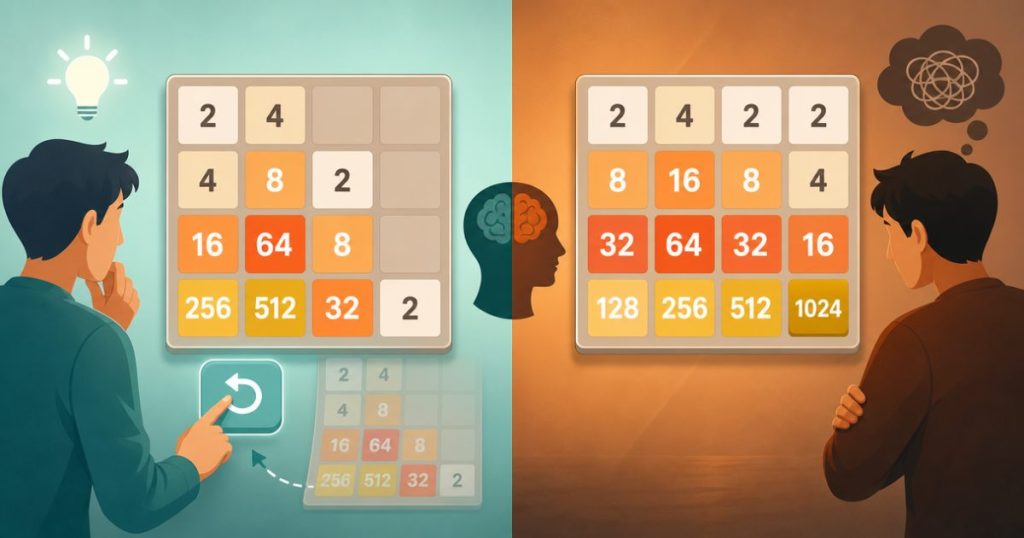
The right choice depends on your current goal. Undo and no-Undo are not rivals. They are useful at different stages of learning.
- Beginner: Use Undo often enough to understand how tiles merge and how one move changes the board. It is the easiest way to learn without getting stuck on early mistakes.
- Intermediate: Mix both modes. Use Undo to study difficult positions, then switch to no-Undo runs to practice commitment and board control.
- Advanced: Spend more time in no-Undo play. Use Undo mainly for analysis, not rescue. At this level, the gap between a good and bad decision is usually about planning, not reaction speed.
- Score-focused player: Lean heavily toward no-Undo. High-score runs depend on disciplined tile order, safe merges, and avoiding irreversible board damage.
If you want a simple rule, use this one: the more you want to learn, the more helpful Undo becomes; the more you want to perform under real conditions, the more no-Undo matters.
A practical way to use both modes
The strongest approach is often a mixed one. Use Undo while you are learning a new idea, then turn it off for practice runs. That gives you feedback without letting the button do all the work.
For example, you might spend a few games testing how a board behaves when your highest tile stays anchored in one corner, then switch to no-Undo and try to maintain that structure from start to finish. The learning mode helps you understand the pattern. The no-Undo mode shows whether you can execute it under pressure.
That balance works well because 2048 is not just about avoiding one bad swipe. It is about building a board that gives you room to keep merging. Undo can help you see the cost of a bad move, but no-Undo is what teaches you to avoid making it.
So, does Undo make you a better player?
Yes, if you use it to learn. No, if you use it to avoid learning. Undo is useful because it makes the board state easier to study. It helps beginners understand merges, tile order, and risk. It also helps experienced players review mistakes on crowded boards.
But real 2048 skill comes from making strong decisions without needing to reverse them. If you want better no-Undo performance, you need practice that includes commitment, planning, and discipline. Undo can support that process, but it cannot replace it.
Frequently Asked Questions
Should beginners use Undo in 2048?
Yes. Beginners can use Undo to see how moves affect the board, learn merge order, and understand mistakes without ending the game right away.
Will Undo help me get higher scores?
It can help indirectly if you use it for learning, but higher scores still depend on no-Undo discipline, planning, and board control.
When should I turn Undo off?
Turn it off when you want realistic practice, especially if you are working on consistency, high-score runs, or better decision-making under pressure.
If your goal is to understand 2048 faster, Undo is worth using. If your goal is to play cleaner, longer no-Undo runs, you need real practice without it. The best improvement usually comes from both: learn with Undo, then confirm the lesson in a no-Undo game.
Use Undo to study the board, not to avoid responsibility for every move. That one shift turns it from a crutch into a training tool.